


.
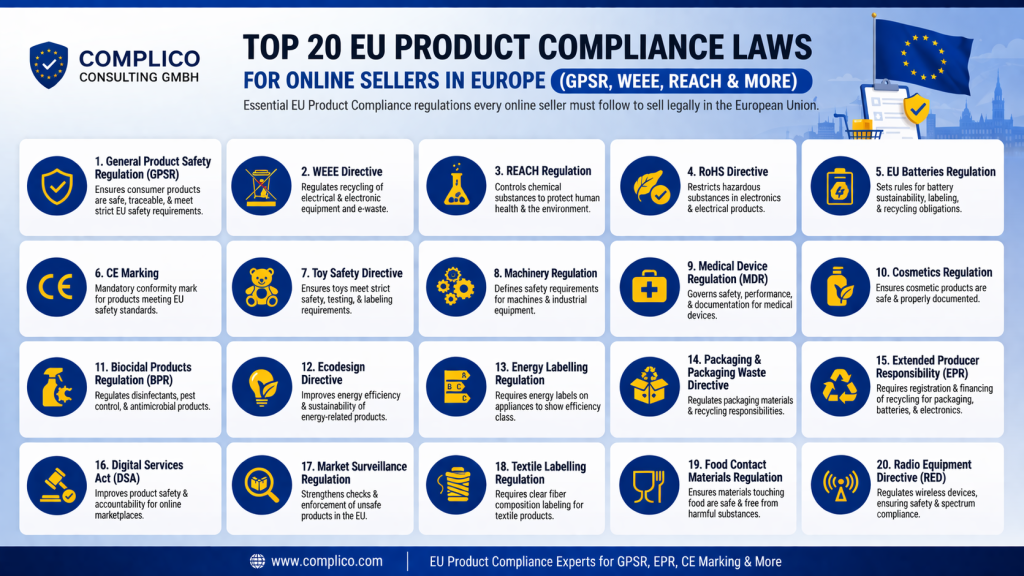
Selling products in Europe requires strict adherence to EU Product Compliance regulations. The European Union has implemented comprehensive product safety and environmental rules to protect consumers and ensure sustainable market practices.
Online sellers, importers, and manufacturers must ensure their products comply with EU laws before placing them on the market. Failure to comply can result in product bans, regulatory penalties, and marketplace restrictions.
Below are 20 of the most important EU Product Compliance laws that businesses must understand when selling products in Europe.
1. General Product Safety Regulation (GPSR)
The General Product Safety Regulation (EU) 2023/988 is the main consumer product safety regulation in the EU. It ensures that all consumer products sold in the European market are safe for use.
Under this regulation, businesses must conduct product risk assessments, maintain safety documentation, and ensure product traceability. Online sellers must also provide clear product information and contact details of responsible operators in the EU.
This regulation replaced the earlier General Product Safety Directive and significantly strengthened requirements for e-commerce sellers.
2. Waste Electrical and Electronic Equipment (WEEE Directive)
The WEEE Directive regulates the collection, recycling, and recovery of electronic waste generated from electrical and electronic products.
Companies selling electronics in the EU must register with national WEEE authorities and finance recycling programs. Products must also display the WEEE symbol to inform consumers that electronic waste should not be disposed of with regular household waste.
Online sellers must ensure proper WEEE registration before selling electronics in many EU countries.
3. REACH Regulation
The REACH Regulation (Registration, Evaluation, Authorisation and Restriction of Chemicals) controls the use of chemical substances in products.
Manufacturers and importers must ensure that chemicals used in products do not pose risks to human health or the environment. Companies may need to register substances with the European Chemicals Agency and provide safety information for products containing certain chemicals.
REACH applies to a wide range of products, including textiles, toys, electronics, and household goods.
4. RoHS Directive
The Restriction of Hazardous Substances (RoHS) Directive restricts the use of dangerous substances in electrical and electronic equipment.
The directive limits substances such as:
- Lead
- Mercury
- Cadmium
- Hexavalent chromium
- Certain flame retardants
Manufacturers must ensure that electronic products meet these limits and provide documentation proving compliance.
5. EU Batteries Regulation
The EU Batteries Regulation introduces strict environmental standards for the production, labeling, and recycling of batteries.
Companies selling batteries or battery-powered devices must ensure proper labeling, recycling participation, and reporting obligations. The regulation aims to improve sustainability and reduce environmental impact from battery waste.
6. CE Marking Regulations
CE marking indicates that a product meets EU safety, health, and environmental protection standards.
Many product categories require CE marking, including electronics, machinery, toys, and medical devices. Manufacturers must conduct conformity assessments and maintain technical documentation before applying the CE mark.
Without CE marking, products cannot legally be sold in the European Economic Area.
7. Toy Safety Directive
The Toy Safety Directive ensures that toys sold in the EU meet strict safety requirements for children.
Manufacturers must conduct safety testing, assess chemical risks, and provide clear labeling and warnings. Toys must also carry CE marking and technical documentation demonstrating compliance.
8. Machinery Regulation
The EU Machinery Regulation sets safety requirements for machines and industrial equipment sold in Europe.
It requires manufacturers to conduct risk assessments, prepare technical documentation, and ensure machines meet essential safety requirements before entering the market.
9. Medical Device Regulation (MDR)
The Medical Device Regulation (MDR) regulates medical products such as diagnostic tools, implants, and medical equipment.
Manufacturers must undergo strict conformity assessments, maintain clinical evidence, and ensure traceability throughout the product lifecycle.
10. Cosmetics Regulation
The EU Cosmetics Regulation ensures that cosmetic products are safe for human health before they are sold in the EU.
Manufacturers must submit product information files, conduct safety assessments, and register products in the EU cosmetic product notification portal.
11. Biocidal Products Regulation (BPR)
The Biocidal Products Regulation governs products used to control harmful organisms, such as disinfectants, insecticides, and antimicrobial products.
Manufacturers must obtain authorization before placing biocidal products on the EU market.
12. Ecodesign Directive
The Ecodesign Directive establishes environmental requirements for energy-related products such as appliances and electronics.
Products must meet efficiency and sustainability standards designed to reduce energy consumption and environmental impact.
13. Energy Labelling Regulation
The Energy Labelling Regulation requires appliances and electronic devices to display energy efficiency labels.
These labels help consumers compare products based on their energy consumption and environmental performance.
14. Packaging and Packaging Waste Directive
This directive regulates packaging materials and promotes recycling to reduce packaging waste.
Companies must ensure packaging is recyclable and may need to participate in national recycling programs.
15. Extended Producer Responsibility (EPR)
Many EU countries require companies to participate in Extended Producer Responsibility programs.
Businesses must register with national recycling systems and contribute financially to waste management programs for packaging, electronics, and batteries.
16. Digital Services Act (DSA)
The Digital Services Act introduces new rules for online marketplaces and digital platforms.
It aims to improve consumer protection by requiring platforms to remove illegal products and ensure product safety in online marketplaces.
17. Market Surveillance Regulation
The Market Surveillance Regulation strengthens enforcement of EU product safety laws.
Authorities now have greater powers to inspect products, remove unsafe goods from the market, and cooperate across EU countries.
18. Textile Labelling Regulation
The Textile Labelling Regulation requires clear labeling of textile products.
Manufacturers must provide information about fiber composition and ensure accurate labeling to protect consumers.
19. Food Contact Materials Regulation
The Food Contact Materials Regulation governs materials used in packaging and containers that come into contact with food.
These materials must be tested to ensure they do not release harmful substances into food products.
20. Radio Equipment Directive (RED)
The Radio Equipment Directive regulates wireless devices such as smartphones, routers, and Bluetooth products.
Manufacturers must ensure these products meet safety, electromagnetic compatibility, and radio spectrum requirements before selling them in the EU.
How Complico Supports EU Product Compliance
Understanding EU Product Compliance regulations can be complex for businesses entering the European market.
Complico Consulting GmbH provides regulatory support services to help companies meet European product compliance requirements.
These services include:
- GPSR Responsible Person services
- EPR registration and reporting
- Regulatory compliance consulting
- Product documentation and risk assessments
- Market access guidance for EU regulations
By working with compliance experts, businesses can ensure their products meet European regulatory requirements and avoid costly compliance issues.
Sources
- European Commission – Product Safety and Compliance
- Safety Gate – EU Rapid Alert System for Dangerous Products
- European Chemicals Agency – ECHA
- European Food Safety Authority – EFSA
- Your Europe – Selling Products Safely in the EU
