

As product safety enforcement across Europe becomes increasingly coordinated and data-driven, the EU Safety Gate 2025 Report offers important insights into the direction of regulatory oversight. The report clearly shows that compliance monitoring is intensifying across the European Union and the European Economic Area (EEA).
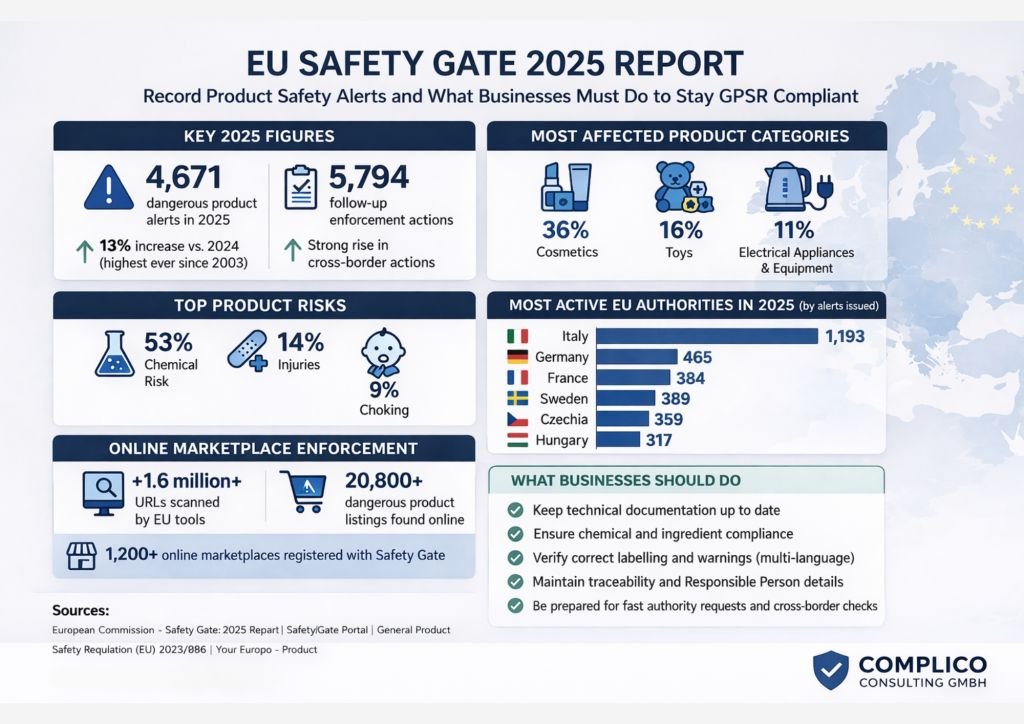
According to the European Commission, 2025 recorded the highest number of alerts for dangerous non-food products since the system began in 2003. Authorities validated 4,671 alerts and reported 5,794 follow-up enforcement actions, indicating that market surveillance authorities are taking stronger and faster action against unsafe products.
For manufacturers, importers, distributors, and online sellers, this data highlights the growing importance of product safety compliance. The increased enforcement activity is closely linked to the implementation of the General Product Safety Regulation (GPSR) (EU) 2023/988, which strengthens requirements related to traceability, product documentation, recall procedures, and online marketplace accountability.
For businesses selling products in the European market, the message is clear: regulatory compliance and product safety documentation must now be stronger, faster, and easier to access than ever before.
Overview of the Safety Gate 2025 Report
The Safety Gate system, formerly known as RAPEX, is the European Union’s rapid alert system used by national authorities to report dangerous non-food products. In 2025, authorities across the EU and EEA issued 4,671 alerts, representing a 13% increase compared to 2024 and more than double the number recorded in 2022.
Alongside these alerts, authorities issued 5,794 follow-up actions, showing that once a product is flagged in one country, other Member States increasingly investigate and respond quickly.
This trend demonstrates that product safety enforcement in Europe is no longer isolated within individual countries. Instead, it has become a coordinated EU-wide system, combining national inspections, digital monitoring, laboratory testing, and online marketplace oversight.
For companies selling consumer goods in Europe, this means a compliance issue identified in one country can quickly trigger enforcement across the entire EU market.
Key Findings from the Safety Gate 2025 Report
Several important insights emerge from the latest report:
- 4,671 dangerous product alerts were recorded in 2025, the highest annual number since the system began.
- 5,794 follow-up actions were reported by authorities across Europe.
- The most frequently notified product categories were:
- Cosmetics (36%)
- Toys (16%)
- Electrical appliances and equipment (11%)
- The most common risks identified were:
- Chemical risk (53%)
- Injuries (14%)
- Choking hazards (9%)
- Authorities increased enforcement against cosmetics containing BMHCA (Lilial).
- TPO in nail polish became a new enforcement focus after being banned in cosmetics in 2025.
- The EU’s eSurveillance web crawler scanned over 1.6 million URLs in 2025.
- More than 20,800 listings offering dangerous products were identified online.
- Over 1,200 online marketplaces registered with the Safety Gate system.
These figures show that product safety enforcement now combines laboratory testing, regulatory monitoring, digital surveillance, and cross-border enforcement cooperation.
Most Active Market Surveillance Authorities in 2025
The report also highlights which EU countries issued the highest number of alerts during 2025.
The most active authorities were:
Italy – 1,193 alerts
Italy remained the most active reporting country in the Safety Gate system, indicating particularly strong enforcement and inspection activity.
Germany – 465 alerts
Germany continues to be a central enforcement market with strong product testing and regulatory monitoring.
France – 455 alerts
France increased its activity significantly and remains one of the most important markets for product safety compliance.
Sweden – 384 alerts
Swedish authorities continue to focus heavily on consumer safety and chemical risk detection.
Czechia – 359 alerts
The Czech Republic remains highly active in product testing and regulatory notification.
Hungary – 317 alerts
Hungary continues to play a key role in market surveillance within Central Europe.
Together, these countries account for a significant share of Safety Gate notifications and should be considered high-priority compliance markets for businesses selling products in Europe.
Why the 2025 Report Is Particularly Important
The increase in alert numbers is significant, but the structure of enforcement is changing even more dramatically.
One major development is the increase in cross-border follow-up actions. When one country identifies a dangerous product, other countries quickly check whether the same product is available in their markets.
Another important trend is faster enforcement of new chemical restrictions. Authorities are reacting quickly to regulatory updates and immediately targeting products that contain newly banned substances.
The report also demonstrates the growing role of digital monitoring tools. Authorities are now able to detect dangerous products offered online even after they have already been flagged or removed in another market.
This means that non-compliant products are becoming easier for regulators to detect across multiple countries simultaneously.
Chemical Risks Remain the Leading Enforcement Issue
Chemical safety continues to be the most common reason for Safety Gate alerts.
In 2025, chemical risks accounted for 53% of all notifications, making it the dominant enforcement category.
A large portion of these alerts involved cosmetics containing BMHCA (Lilial), a substance banned in the EU due to potential reproductive toxicity and skin sensitisation concerns.
Another emerging issue was TPO in nail polish, which authorities began targeting shortly after the substance was banned in cosmetic products in 2025.
These examples show that companies cannot rely on outdated ingredient documentation or supplier declarations. Product formulations, chemical compliance documentation, and supplier information must be regularly reviewed and updated.
Product Categories with the Most Alerts
The Safety Gate report highlights three product categories responsible for the majority of alerts:
Cosmetics – 36%
Cosmetics remain the most frequently notified category due to chemical safety risks and ingredient restrictions.
Toys – 16%
Toy safety remains a major focus due to choking hazards, chemical exposure, and age-appropriateness concerns.
Electrical appliances and equipment – 11%
Electrical products are frequently flagged for electrical hazards, fire risks, and chemical compliance issues.
Businesses selling products in these sectors should expect higher levels of regulatory scrutiny and testing by market surveillance authorities.
Online Marketplace Monitoring Is Increasing
One of the most significant developments in the Safety Gate system is the growing focus on online marketplaces and e-commerce platforms.
The European Commission’s digital monitoring system scanned more than 1.6 million URLs in 2025 and detected over 20,800 online listings offering dangerous products already flagged by authorities.
Additionally, more than 1,200 online marketplaces have now registered within the Safety Gate system, strengthening cooperation between platforms and regulatory authorities.
For businesses selling products online, this means that product listings, safety warnings, and documentation must match the physical product and compliance files exactly.
What the Report Means for Manufacturers and Importers
The key takeaway from the Safety Gate 2025 report is that documentation readiness is now essential for compliance.
Companies selling consumer products in Europe should be able to quickly provide:
- Complete technical documentation
- Product risk assessments
- Traceability information
- EU Responsible Person details
- Accurate product labels and safety warnings
- Supporting documentation proving chemical and regulatory compliance
If this information is fragmented across suppliers or outdated documents, companies face greater risks during regulatory inspections.
Complico Consulting GmbH supports businesses by helping them prepare compliant documentation, manage product safety requirements, and meet EU regulatory standards.
Compliance Priorities for 2026
Based on the trends in the Safety Gate report, companies should prioritize the following actions:
Review technical documentation
Ensure product files are complete, accurate, and updated.
Verify chemical compliance
Confirm that products do not contain newly restricted substances.
Check labelling requirements
Ensure warnings and instructions are available in the appropriate EU languages.
Confirm economic operator details
Verify that manufacturer or responsible person information is clearly displayed.
Review marketplace listings
Ensure product listings, safety warnings, and documentation are consistent.
Focus on high-enforcement markets
Pay particular attention to markets such as Italy, Germany, and France.
Final Takeaway
The Safety Gate 2025 report confirms that EU product safety enforcement is becoming more coordinated, more digital, and more proactive.
Record numbers of alerts, increased cross-border enforcement, stronger chemical regulation monitoring, and advanced online surveillance mean that businesses must treat compliance as an ongoing operational priority rather than a one-time documentation exercise.
For companies selling products in the European Union, the best strategy is simple:
Maintain accurate technical documentation, ensure product labelling is compliant, verify chemical restrictions carefully, and always be prepared to provide safety documentation quickly when requested by authorities.
Complico Consulting GmbH helps businesses navigate these requirements and maintain full compliance with EU product safety regulations.
Official Sources
1. European Commission – Safety Gate System
2. General Product Safety Regulation (EU) 2023/988
3. Your Europe – Product Safety Rules for Businesses
Download Europe safety gate 2024 Report