

The Waste Electrical and Electronic Equipment (WEEE) Directive 2012/19/EU requires producers of electrical and electronic equipment (EEE) to register with national WEEE authorities before placing products on the EU market. Across Europe, each country operates its own national WEEE register where producers must submit registration details and compliance information.
For manufacturers, importers, and online sellers, understanding these national registers is essential to avoid penalties and ensure environmental compliance.
This guide explains how WEEE national registers work in Europe, why producers must register, and which authorities manage WEEE compliance in different countries.
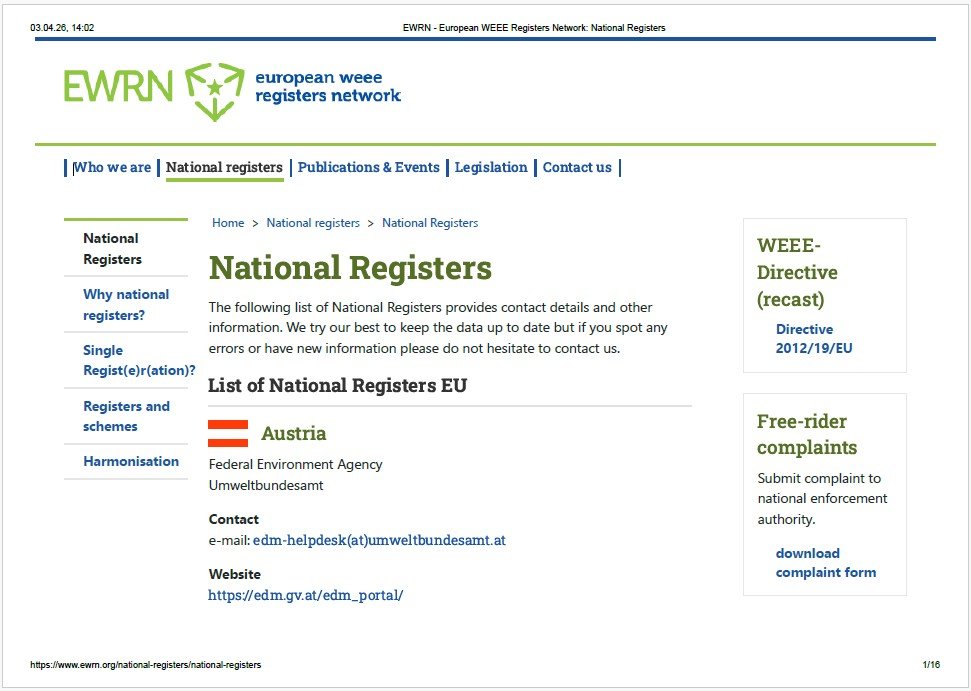
What is the European WEEE Registers Network (EWRN) ?
The European WEEE Registers Network (EWRN) connects national WEEE registers across Europe. The organization helps coordinate implementation of the WEEE Directive and ensures consistent data reporting between countries.
EWRN provides:
- A list of national WEEE registers
- Contact information for authorities
- Guidance for producers and compliance schemes
- Information on free-rider complaints (companies selling without registration)
This network helps regulators and producers maintain transparency and compliance across the European market.
Why National WEEE Registers Are Important
Under EU law, every producer placing electrical or electronic equipment on the market must register with the relevant national authority.
Registration ensures:
- Proper collection and recycling of electronic waste
- Tracking of EEE placed on the market
- Monitoring of producer responsibility obligations
- Prevention of free-riding companies avoiding environmental responsibilities
Failure to register can result in:
- Sales bans
- Significant fines
- Removal from marketplaces such as Amazon or eBay
- Legal enforcement actions
Example: WEEE Register in Germany
In Germany, the official WEEE register is managed by:
Stiftung Elektro-Altgeräte Register (EAR)
Address: Nordostpark 72, 90411 Nuremberg, Germany
Website: https://www.stiftung-ear.de
The Stiftung EAR authority is responsible for:
- Registering producers of electrical equipment
- Issuing WEEE registration numbers
- Monitoring compliance with Germany’s ElektroG law
- Maintaining a public list of registered manufacturers
Any company selling electronics in Germany must obtain a WEEE number before selling products.
Examples of WEEE National Registers in Europe
Each EU country has its own authority responsible for WEEE registration.
Austria
Authority: Federal Environment Agency
Website: https://edm.gv.at/edm_portal/
Denmark
Authority: Dansk Producentansvar (DPA)
Website: https://producentansvar.dk
France
Authority: ADEME – French Environment and Energy Management Agency
Website: https://www.syderep.ademe.fr
Netherlands
Authority: Nationaal WEEE Register
Website: https://www.nationaalweeeregister.nl
Ireland
Authority: National Producer Registration Body
Website: https://www.producerregister.ie
Sweden
Authority: Swedish Environmental Protection Agency
Website: https://www.naturvardsverket.se
These authorities maintain national databases of registered producers and ensure compliance with the WEEE Directive.
Do You Need Multiple WEEE Registrations ?
Yes.
Unlike some EU regulations, WEEE registration is not centralized.
If you sell products in multiple EU countries, you must:
- Register in each country where products are sold
- Appoint an Authorized Representative (AR) if you are a non-EU company
- Submit regular sales and recycling reports
For example, if you sell electronics in:
- Germany
- France
- Netherlands
You must register separately in all three countries.
WEEE Compliance Requirements for Producers
To remain compliant, producers must fulfill several obligations:
1. Register with the national WEEE authority
Before selling products in the country.
2. Obtain a WEEE registration number
This number may be required by marketplaces such as Amazon.
3. Join a recycling scheme
Producers must finance recycling and disposal of electronic waste.
4. Submit periodic reports
Reports usually include:
- Amount of equipment placed on the market
- Categories of electronic products
- Recycling and recovery data
5. Mark products with the WEEE symbol
Products must display the crossed-out wheeled bin symbol.
What Happens if You Don’t Register?
Non-compliance can lead to serious consequences:
- Marketplace product delisting
- Government penalties
- Import restrictions
- Environmental enforcement actions
- Free-rider complaints filed with regulators
Authorities actively monitor unregistered sellers through customs and online marketplace checks.
How Complico Consulting Can Help
Navigating multi-country WEEE compliance can be complex, especially for international companies selling electronics across Europe.
Complico Consulting GmbH helps businesses with:
- WEEE registration across the EU
- Authorized Representative services
- Recycling scheme setup
- Compliance reporting
- Marketplace compliance (Amazon, Shopify, etc.)
Our experts ensure your products meet EU environmental regulations while allowing you to focus on growing your business.
Conclusion
The European WEEE Registers Network provides an important framework for coordinating national registers and ensuring compliance with the EU WEEE Directive. However, producers must still register individually in each country where they sell electronics.
Understanding these requirements and working with experienced compliance partners can help companies avoid penalties and operate successfully in the European market.
✔ If your company sells electronics in Europe, WEEE registration is mandatory.
Partnering with compliance experts like Complico Consulting GmbH can simplify the process and ensure full regulatory compliance.
.
2026 Download complete WEEE List