


.

.
If your business manufactures, imports, or sells everyday convenience products in Germany, the regulatory landscape has officially shifted. Environmental compliance in the European Union is becoming stricter, and Germany is leading the charge with its latest legislation targeting Single use plastic.
The introduction of the Single-Use Plastics Fund Act (Einwegkunststofffondsgesetz, or EWKFondsG) has completely transformed Extended Producer Responsibility (EPR) in the country. From mandatory registrations on the new DIVID platform to annual levy payments and strict reporting deadlines, navigating this new legal framework can feel overwhelming.
Whether you are a domestic producer or a foreign manufacturer exporting to the German market, understanding the Germany Single use plastic registration process is no longer optional—it is a legal requirement.
At complico consulting gmbh, we understand that keeping up with complex environmental laws takes valuable time away from running your core business. In this comprehensive guide, we will break down exactly what the EWKFondsG is, which Single use plastic products are affected, how the DIVID platform works, and how our expert team can help you achieve seamless compliance.
1. What is the Single-Use Plastics Fund Act (EWKFondsG)?
To combat environmental pollution and littering, the European Union introduced the EU Single-Use Plastics Directive (EU) 2019/904. Germany transposed this directive into national law through the EWKFondsG, which officially took effect in its operational phases between 2024 and 2025.
The core philosophy behind this act is Extended Producer Responsibility (EPR). The law dictates that the companies profiting from placing Single use plastic on the market must also bear the financial burden of its end-of-life environmental impact.
Historically, cities and municipalities bore the heavy costs of cleaning up parks, streets, and public waste bins filled with discarded food wrappers, cups, and cigarette butts. Now, the EWKFondsG shifts this financial responsibility back to the producers.
The Mechanism of the Law
Manufacturers and distributors of specific Single use plastic products are now required to pay a special environmental levy into a centralized federal fund. The Federal Environment Agency (Umweltbundesamt, or UBA) manages this fund. The money collected from these levies is then distributed to public waste management authorities, cities, and municipalities to reimburse them for the costs of waste collection, cleaning, and public awareness campaigns related to Single use plastic litter.
2. Who is Required to Complete the Germany Single Use Plastic Registration?
A common misconception is that this law only applies to the factories that physically mold and create plastic. In reality, the legal definition of a “Producer” under the EWKFondsG is much broader.
You are legally obligated to complete the Germany Single use plastic registration if your company falls into any of the following categories:
- Domestic Manufacturers: Any business established in Germany that commercially manufactures, fills, sells, or imports affected Single use plastic products and places them on the German market for the first time.
- Importers: Companies bringing these products into Germany from other countries and placing them on the market.
- Foreign E-commerce Sellers: Companies with no physical branch in Germany that sell affected Single use plastic products directly to German private consumers or trade users via distance communication (e.g., online shops, marketplaces).
The Challenge for Foreign Producers
If your company is not based in Germany but you sell affected products into the German market, you face a unique hurdle. The law mandates that foreign companies must appoint an Authorized Representative (Bevollmächtigter) legally established in Germany. This representative assumes the legal and financial responsibilities on your behalf.
Expert Tip: Finding a reliable Authorized Representative is critical. At complico consulting gmbh, we specialize in acting as the official Authorized Representative for international clients, ensuring your business remains compliant without needing a physical office in Germany.
3. Which Single Use Plastic Products are Affected?
Not all plastics are treated equally under the EWKFondsG. The legislation specifically targets the most frequently littered items found in public spaces. If your business deals with any of the products listed in Annex 1 of the law, you must register.
Here is the definitive list of affected Single use plastic items, along with their corresponding levy rates (which are calculated per kilogram of material placed on the market):
1. Food Containers (€ 0.177 per kg)
Receptacles such as boxes, with or without a cover, used to contain food intended for immediate, on-the-spot, or take-away consumption. This includes fast-food containers and salad bowls that require no further preparation (like heating or boiling).
2. Packets and Flexible Foil Packaging (€ 0.876 per kg)
Wrappers and flexible material bags containing food meant for immediate consumption directly from the packet, such as candy wrappers, chips bags, or sandwich foils.
3. Beverage Containers up to 3 Liters
Receptacles used to hold liquids, including their plastic caps and lids.
- Without Deposit: € 0.181 per kg
- With Deposit: € 0.001 per kg
4. Beverage Cups (€ 1.236 per kg)
Any cup meant for beverages, including coffee-to-go cups, along with their plastic covers and lids.
5. Lightweight Plastic Carrier Bags (€ 3.801 per kg)
Plastic shopping bags with a wall thickness of less than 50 micrometers offered to consumers at the point of sale. (Note: Standard garbage bags or household freezer bags are exempt).
6. Wet Wipes (€ 0.061 per kg)
Pre-wetted personal care wipes, cosmetic wipes, and domestic cleaning wipes that contain plastic fibers.
7. Balloons (€ 4.340 per kg)
Standard consumer balloons. Industrial or professional weather balloons that are not distributed to the general public are exempt.
8. Tobacco Products with Filters (€ 8.972 per kg)
Cigarettes with plastic filters, as well as separate filters sold for use with tobacco products.
9. Fireworks (Starting 2026)
As of January 1, 2026, fireworks containing Single use plastic components will also fall under the mandatory reporting and levy system.
4. Navigating the DIVID Platform
To manage this massive bureaucratic undertaking, the German Federal Environment Agency (UBA) launched a digital platform called DIVID (Einwegkunststofffonds-Plattform). DIVID is the central hub for all Germany Single use plastic registration, reporting, and levy payments.
Think of DIVID as the counterpart to the LUCID packaging register, but specifically tailored for the Single use plastic fund.
Registration Deadlines
- Existing Businesses: If your company was already placing affected Single use plastic on the market before January 1, 2024, your deadline to register on DIVID was December 31, 2024.
- New Businesses: If you started operations or began selling these products on or after January 1, 2024, you are required to register immediately before placing products on the market.
- Fireworks Producers: Must complete registration by December 31, 2026.
The Annual Reporting Cycle
Registration is only the first step. The EWKFondsG requires ongoing compliance through annual quantity reporting.
Starting in 2025, producers must report the exact mass (in kilograms) of the affected Single use plastic products they placed on the German market in the previous calendar year.
- Annual Deadline: May 15th of every year.
- First Reporting Period: By May 15, 2025, you must report the quantities placed on the market during the 2024 calendar year.
The 100kg Audit Threshold
The law does not have a “minimum threshold” for registration—if you place even 1 kg of a relevant Single use plastic product on the market, you must register on DIVID.
However, if your company places more than 100 kg of affected Single use plastic on the market within a single calendar year, your annual data declaration cannot simply be self-reported. It must be accompanied by a qualified verification report from an officially registered auditor or expert (similar to the Declaration of Completeness under the German Packaging Act).
5. The Risks of Non-Compliance: Penalties and Fines
Environmental compliance in Germany is heavily monitored, and the authorities take the EWKFondsG very seriously. Failing to understand your obligations regarding Single use plastic can lead to severe financial and operational consequences.
If you fail to complete your Germany Single use plastic registration, submit incorrect volume reports, miss the May 15th deadline, or fail to pay the required levies, your business may face:
- Administrative Fines: Penalties can reach up to €100,000 per violation.
- Sales Bans: The authorities have the power to prohibit you from selling your products on the German market entirely.
- Confiscation of Goods: Unregistered products may be seized at customs or pulled from retail shelves.
- Reputational Damage: Being publicly flagged for environmental non-compliance can severely damage your brand’s reputation with eco-conscious consumers and B2B partners.
6. How complico consulting gmbh Can Ensure Your Compliance
The intersection of the German Packaging Act (VerpackG) and the new Single-Use Plastics Fund Act (EWKFondsG) creates a highly complex regulatory web. Determining exactly which products fall under the definition of Single use plastic, calculating precise weights, navigating the DIVID platform, and coordinating with auditors is a full-time job.
That is where complico consulting gmbh steps in. We offer a full-service, end-to-end compliance solution designed to protect your business, minimize your administrative burden, and ensure absolute legal certainty.
Here is how we help our clients master their Single use plastic obligations:
1. Authorized Representative Service for Foreign Companies
If you are located outside of Germany, you legally cannot fulfill these obligations on your own. complico consulting gmbh will act as your legally mandated Authorized Representative. We handle all communications with the Federal Environment Agency (UBA) and manage your DIVID account, allowing you to legally export your goods to Germany without opening a local branch.
2. Product Classification and Assessment
Not sure if your composite packaging counts as a beverage container or a food box? Unsure if your specific foil wrapper triggers the levy? Our experts will conduct a deep-dive analysis of your entire product portfolio to legally classify your items under the EWKFondsG guidelines. We ensure you only pay for what you legally owe—and not a cent more.
3. DIVID Platform Management and Registration
We take over the entire Germany Single use plastic registration process. From setting up your DIVID profile to ensuring all master data is perfectly aligned with your existing LUCID packaging registrations, we handle the bureaucracy so you don’t have to.
4. Quantity Reporting and Audit Support
Calculating your annual Single use plastic volumes requires meticulous data management. We help you set up reliable internal tracking systems. If your volumes exceed the 100kg threshold, complico consulting gmbh coordinates directly with certified external auditors to verify your reports before the strict May 15th deadline, ensuring a smooth, audit-proof submission.
5. Seamless EPR Integration
Single use plastic compliance does not exist in a vacuum. It overlaps heavily with WEEE (electronics), Battery, and standard Packaging Extended Producer Responsibility. As a holistic consulting firm, we align your EWKFondsG strategy with your broader environmental compliance goals, creating a unified, cost-effective approach for the entire European market.
7. A Step-by-Step Checklist for Manufacturers
To help you assess your immediate needs, we have created a quick checklist. If you answer “Yes” to any of the following questions, it is time to take action on your Single use plastic compliance:
- Do you manufacture, import, or sell food or beverage packaging, tobacco products, wet wipes, or light plastic bags in Germany ?
- Do your products contain artificially produced polymers (plastics) ?
- Are these products designed to be thrown away after a single use ?
- Are you an international company selling these items into Germany without a local office ?
- Have you missed the DIVID registration deadlines from 2024 ?
If you checked any of these boxes, the clock is ticking toward the next annual reporting deadline.
Conclusion: Don’t Let Single Use Plastic Regulations Slow You Down
The transition toward a circular economy is accelerating, and the financial responsibility for public waste has permanently shifted to producers. The Germany Single use plastic registration and the EWKFondsG are strict, complex, and strictly enforced. Attempting to navigate the DIVID platform, source auditors, and classify borderline products internally can lead to costly mistakes and devastating fines.
You don’t have to face German environmental bureaucracy alone.
At complico consulting gmbh, we combine deep regulatory expertise with hands-on operational support. We transform complex Single use plastic legislation into a streamlined, stress-free process for your business. Whether you need an Authorized Representative, a complete portfolio audit, or full management of your DIVID reporting, our team is ready to secure your compliance and protect your market access.
Ready to secure your compliance ?
Contact complico consulting gmbh today for a personalized consultation on your EWKFondsG obligations. Let us handle the regulations so you can focus on growing your business.
More about Germany Single use plastic registration Resources
- DIVID: The Official Registration Portal
- Umweltbundesamt (UBA) Information Page
- Official Product Categorization (Annex 1)
Related Posts:
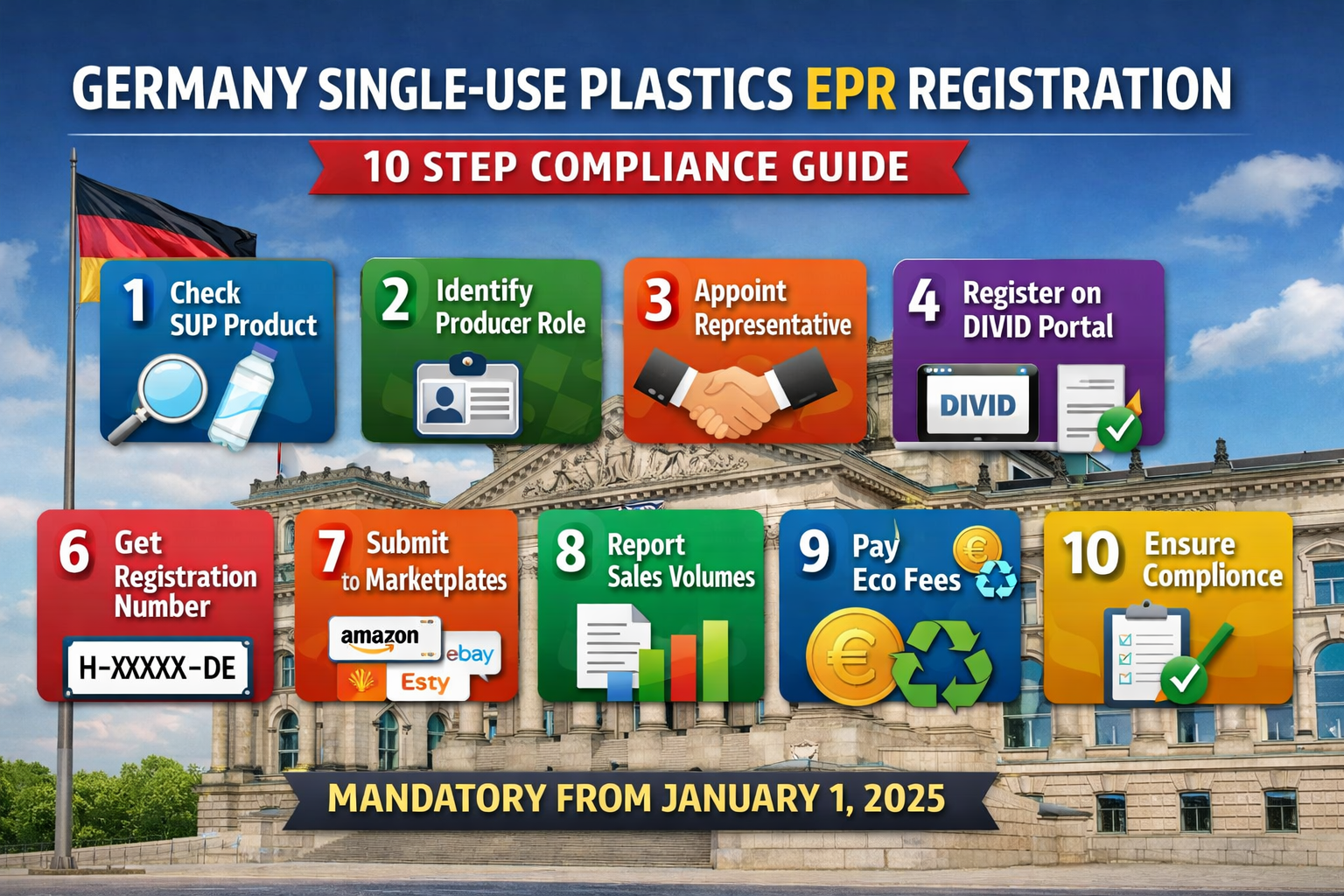
10 Step–Germany Single-Use Plastics (SUP) EPR Registration

The Ultimate Guide to Appointing an EPR Authorized Representative in Europe

WEEE Registration Compliance Guide in Germany: A Complete Guide for Producers
The Ultimate Guide to Getting Your WEEE Number France

WEEE Reporting Explained: Navigating Monthly, Quarterly, and Annual Obligations in 2026
