


.
Selling consumer products in the European Union offers access to one of the most lucrative and diverse markets in the world. But along with that immense opportunity comes a notoriously complex regulatory landscape. Whether you are an e-commerce seller leveraging Amazon FBA, an international manufacturer, or a brand expanding into Europe, navigating the rules can feel like learning a new language.
If you want to keep your products on the digital shelves and avoid hefty fines, mastering EU product compliance is no longer optional—it is the foundation of your business operations.
With sweeping changes to regulations like the General Product Safety Regulation (GPSR) and new sustainability mandates shaping the 2026 market, the stakes have never been higher. This comprehensive guide will walk you through exactly what you need to know about EU product compliance, the key regulations you must follow, and the step-by-step process to ensure your products are safe, legal, and ready for European consumers.
1. What Exactly is EU Product Compliance?
At its core, EU product compliance is the process of ensuring that any good manufactured, imported, or sold within the European Economic Area (EEA) meets the region’s stringent health, safety, and environmental standards.
It is not just about slapping a logo on your packaging. True compliance requires a lifecycle approach. It means your product is designed safely, manufactured without banned chemicals, tested by certified labs, packaged sustainably, and accompanied by transparent, traceable documentation.
The European Union operates on the principle of the “Internal Market,” meaning that once a product is legally compliant in one member state, it can generally be sold across all 27 member states. However, the gatekeeping to get into that market is rigorous, and market surveillance authorities—along with e-commerce giants like Amazon, eBay, and TikTok Shop—are cracking down harder than ever.
2. The 2026 Landscape: Why the Rules are Getting Stricter
The compliance environment has shifted dramatically in recent years. If you are operating on outdated advice from even two years ago, your business is at risk. Here are the major shifts defining the current landscape:
The General Product Safety Regulation (GPSR)
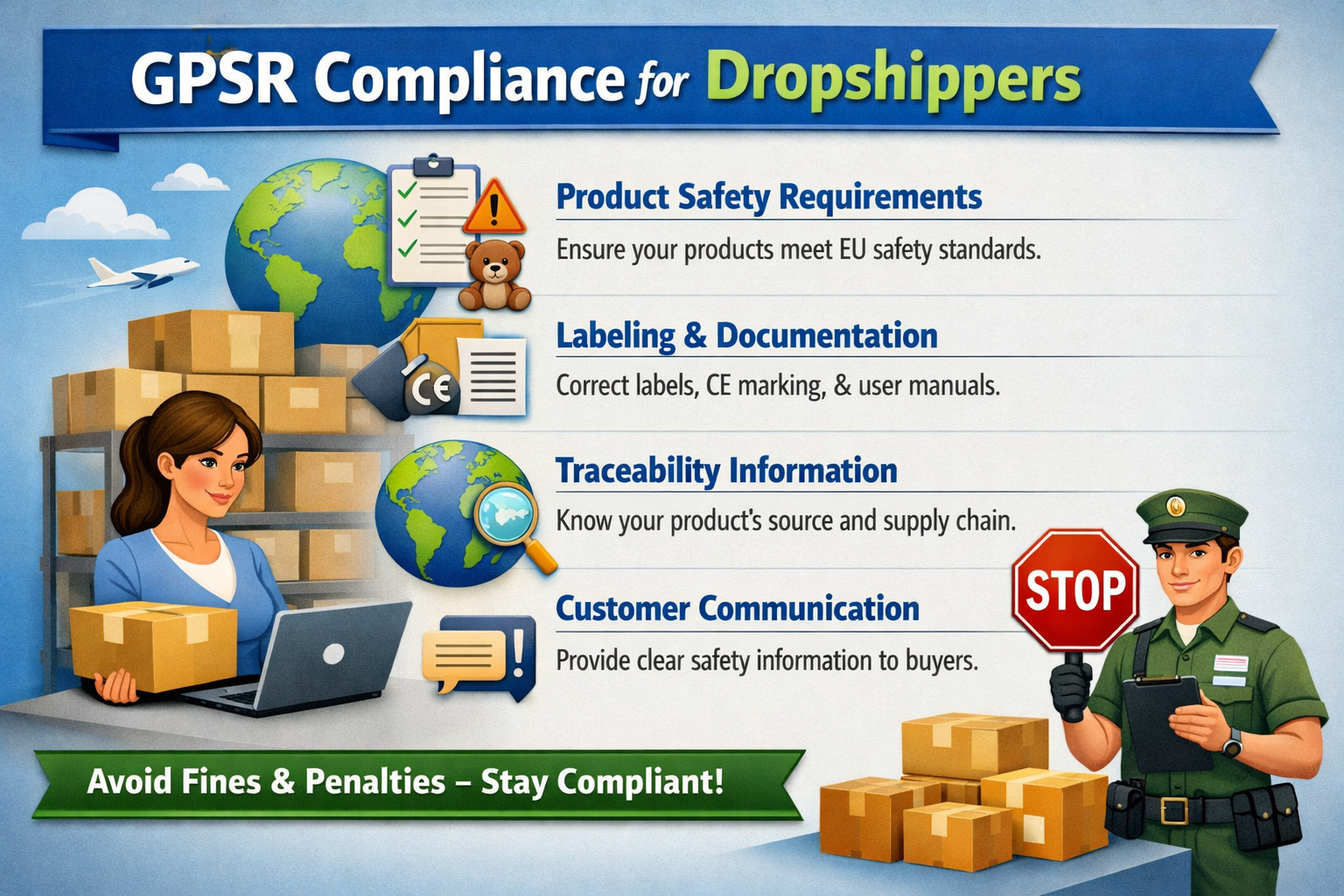
Replacing the outdated 2001 directive, the GPSR represents the most significant overhaul of EU safety laws in decades. It applies to almost all consumer products and requires strict risk assessments, technical documentation, and traceability. Under the GPSR, if you are a non-EU manufacturer, you must have a responsible economic operator based in the EU (such as an Authorized Representative or Importer) to sell your goods. Furthermore, e-commerce platforms are legally required to verify this information, which is why non-compliant listings are being suspended en masse.
The Push for Digital Traceability
The era of paper trails is ending. The EU is rolling out the Digital Product Passport (DPP) under the Ecodesign for Sustainable Products Regulation (ESPR). This means that in the near future, consumers and regulators will be able to scan a QR code on a product to see its entire lifecycle, material composition, and compliance data.
Sustainability and the Circular Economy
Regulations are expanding beyond just human safety to environmental safety. Deforestation rules, battery life-cycle tracking, and right-to-repair mandates mean that EU product compliance now heavily involves proving that your product doesn’t harm the planet.
3. The Pillars of EU Product Compliance
To successfully navigate the European market, you need to understand the big regulatory frameworks. Depending on what you sell—whether it’s children’s books, cosmetics, colored powders, or electronics—different rules will apply.
A. CE Marking: The Passport for Your Product
The CE mark is perhaps the most recognizable symbol of EU compliance. It acts as a declaration by the manufacturer that the product meets all applicable EU health, safety, and environmental protection directives.
- Who needs it? Not every product requires a CE mark. It is mandatory for specific categories like electronics, toys, medical devices, machinery, and personal protective equipment (PPE).
- The Trap: Affixing a CE mark to a product that doesn’t require one (like general apparel or standard furniture) is actually illegal.
B. Extended Producer Responsibility (EPR)
EPR is a vital environmental policy that makes the manufacturer or importer financially and physically responsible for a product’s entire life cycle, especially its end-of-life disposal.
- Packaging: Almost every physical product requires EPR registration for packaging. You must register in systems like LUCID in Germany or SYDEREP in France and pay eco-contributions based on the weight and material of your packaging.
- WEEE & Batteries: If you sell electronics, you must comply with Waste Electrical and Electronic Equipment (WEEE) regulations, ensuring the safe recycling of cords, plugs, and batteries.
- Textiles: An emerging category where sellers must fund the collection and recycling of garments and footwear.
C. REACH & RoHS: Chemical Safety
The EU has the strictest chemical safety laws in the world.
- REACH (Registration, Evaluation, Authorisation and Restriction of Chemicals): Applies to all products, from clothing to cosmetics to colored powders. It restricts the use of harmful substances like heavy metals, phthalates, and PFAS (“forever chemicals”).
- RoHS (Restriction of Hazardous Substances): Specifically limits the use of certain hazardous materials found in electrical and electronic products.
4. Your 5-Step Playbook for Achieving EU Product Compliance
Compliance can feel overwhelming, but it becomes manageable when broken down into a systematic process. Here is your actionable roadmap:
Step 1: Product Classification and Risk Analysis
Before you manufacture or ship anything, you must identify exactly which EU directives and regulations apply to your product. A child’s electronic toy will require CE marking under the Toy Safety Directive, WEEE registration, and REACH compliance. A wooden chair, however, falls under general GPSR rules. Conducting a thorough product risk analysis early saves thousands of euros in the long run.
Step 2: Testing and Certification
Never assume a factory’s word is enough. You must obtain testing reports from certified, independent laboratories proving your product meets EU harmonized standards. If you are sourcing from outside the EU, these test reports are your primary defense against customs rejections and marketplace bans.
Step 3: Compiling the Technical File and Safety Data Sheets (SDS)
Every compliant product needs a “Technical File.” This is a comprehensive dossier that includes:
- Detailed product descriptions and design diagrams.
- A list of the harmonized standards applied.
- Lab test reports.
- User manuals and safety instructions (translated into the local language of the market where the product is sold).
- For chemical products, cosmetics, or items like colored powders, a rigorously formatted Safety Data Sheet (SDS) is an absolute legal requirement.
Step 4: Traceability and Labeling
Your product and its packaging must be correctly labeled. Under the latest GPSR guidelines, this means clearly printing:
- The manufacturer’s name and registered address.
- The EU Authorized Representative’s name and address (if the manufacturer is outside the EU).
- Batch, type, or serial numbers for traceability.
- Appropriate hazard warnings and CE markings (if applicable).
Step 5: Appointing an EU Authorized Representative (EC REP)
If your business is not physically located within the European Union, you cannot legally sell goods there without an EU-based economic operator taking responsibility for the safety of your products. An Authorized Representative acts as the liaison between your company and EU market surveillance authorities, holding your Technical File and ensuring your brand remains compliant.
5. E-commerce Marketplaces: The Unforgiving Enforcers
In the past, some sellers tried to slip under the radar by selling directly through online marketplaces. Today, platforms like Amazon FBA, eBay, and TikTok Shop act as the primary enforcers of EU product compliance.
Due to the GPSR and market surveillance laws, these marketplaces can be held legally liable if they facilitate the sale of unsafe products. As a result, they have instituted automated compliance checks.
What happens if you ignore the rules?
- Listing Suspensions: Amazon will suppress your ASINs until you upload a valid Declaration of Conformity (DoC), EPR registration numbers, and proof of an EU Authorized Representative.
- Inventory Confiscation: Non-compliant inventory sitting in European fulfillment centers can be frozen or destroyed at your expense.
- Customs Seizures: Border authorities frequently intercept and destroy shipments that lack proper labeling or testing documentation.
Proactive compliance is the only way to ensure uninterrupted sales and maintain a healthy seller account metrics.
6. How Complico Consulting GmbH Can Safeguard Your Business
Navigating this web of directives, technical files, and marketplace demands takes time away from what you do best: growing your business. That is where we step in.
At Complico Consulting GmbH, located at Bahnhofstr 12, 63549, Ronneburg, Germany, we specialize in taking the headache out of European regulatory compliance. We don’t just quote the law; we provide actionable, commercial solutions tailored for modern e-commerce sellers, manufacturers, and importers.
Whether you need to get an Amazon listing unblocked, require a meticulously crafted Safety Data Sheet (SDS), or need a reliable EU Authorized Representative, our team of experts has you covered.
Our core services include:
- GPSR Readiness Audits: We ensure your products, packaging, and online listings meet the latest general safety regulations.
- EPR Registration & Management: From Germany’s LUCID to multi-country packaging and WEEE compliance, we handle the paperwork and reporting.
- EU Authorized Representative (EC REP) Services: We act as your legal compliance anchor within the EU, dealing with authorities so you don’t have to.
- Technical Documentation & SDS Creation: We review test reports and generate the required technical files and safety data sheets to keep your supply chain moving smoothly.
Conclusion
Achieving EU product compliance is a continuous journey of maintaining high standards in safety, sustainability, and transparency. As the regulatory landscape tightens in 2026, relying on guesswork is a recipe for blocked listings and seized inventory. By understanding your obligations, implementing proper testing, and partnering with experienced compliance experts, you can turn regulatory hurdles into a competitive advantage.
Ready to bulletproof your European sales strategy? Contact Complico Consulting GmbH today, and let us ensure your products are safe, compliant, and ready to dominate the EU market.
More About GPSR Resorces
- 1. The General Product Safety Regulation (GPSR)
- 2. CE Marking Requirements
- 3. REACH (Chemical Safety & Substances)