



.
If you are an international e-commerce seller, you already know that the German market is incredibly lucrative. It is the economic powerhouse of Europe and boasts a massive, purchasing-ready consumer base. But there is a catch: Germany also has some of the strictest environmental and recycling laws on the planet.
If you ship a physical product in a box, a polymailer, or a padded envelope to a consumer in Germany, you are legally responsible for the recycling cost of that packaging.
This brings us to the dreaded “LUCID number.” For many non-EU businesses trying to navigate Amazon Europe or independent Shopify stores, securing a LUCID registration Germany feels like trying to solve a Rubik’s Cube in the dark. The legal jargon is dense, the portals are in German, and the penalties for getting it wrong are severe—ranging from marketplace bans to €200,000 fines.
But here is the honest truth: while the system is highly bureaucratic, the underlying logic is entirely straightforward. It is based on the “polluter-pays principle.” You put packaging into the German waste stream, so you pay to clean it up.
In this comprehensive guide, we will break down exactly what LUCID registration Germany is, how the massive 2026 legislative updates (VerpackDG and PPWR) impact your business, and provide a step-by-step roadmap to getting compliant without losing your mind.
What is the German Packaging Act (VerpackG) and LUCID?
To understand LUCID, you first have to understand the law behind it. The German Packaging Act, originally known as the Verpackungsgesetz (VerpackG), was designed to shift the financial burden of recycling away from municipal taxpayers and onto the businesses that actually generate the packaging waste.
The ZSVR and the LUCID Register
To enforce this law, the German government created a regulatory body called the Zentrale Stelle Verpackungsregister (ZSVR) — the Central Agency Packaging Register.
The ZSVR operates a public, digital database called LUCID.
Think of LUCID as the master ledger of every company legally allowed to ship packaged goods into Germany. If your business name and VAT number are not in this public database, you are operating illegally. Period.
The 2026 Update: Enter the VerpackDG and PPWR
If you thought you had the rules figured out in 2024, it is time to hit refresh. In February 2026, the German government adopted the new Packaging Law Implementation Act (VerpackDG). This new act aligns German national law with the sweeping European Union Packaging and Packaging Waste Regulation (PPWR).
What does this mean for you as an international seller?
Starting August 12, 2026, the responsibility for packaging is tightening significantly:
- The Importer Rule: If you are a company that imports packaged products into Germany from abroad without a domestic intermediary, you must take on the system participation. You cannot pass the buck to your manufacturer in China or your dropshipping supplier.
- Waste Prevention Mandates: The new law forces dual systems and producers to fund waste prevention and reuse systems. The cost of compliance is likely to rise to fund these initiatives.
- Stricter Authorized Representative Rules: If your company does not have a physical branch in Germany (or the EU), you are severely restricted in how you manage compliance. You must appoint a legally bound Authorized Representative to act on your behalf.
Who Actually Needs a LUCID Registration in Germany?
A common misconception among international sellers is: “I only sell 50 items a month to Germany. Surely this law only applies to massive corporations like Apple or Nike?”
False. There is no minimum threshold for LUCID registration Germany.
Whether you ship one hundred thousand pallets a year or a single pair of hand-knitted socks in a small cardboard box once a year, the registration requirement applies to you.
You must register if you meet the definition of a “Producer” putting packaging onto the German market for the first time. In the eyes of the law, you are a producer if you are:
- An E-commerce Retailer: Selling directly to German consumers via Shopify, WooCommerce, or Magento.
- A Marketplace Seller: Operating on Amazon FBA, eBay, Etsy, Zalando, or TikTok Shop.
- An Importer: Bringing goods from outside the EU into Germany.
- A Dropshipper: Even if you never touch the physical product, if you are the seller of record, you are responsible for the packaging your supplier uses.
What Types of Packaging Must Be Licensed?
The law concerns “sales packaging” — meaning anything that ultimately ends up in the trash bin of a German private consumer. This includes:
- Product Packaging: The retail box your product sits inside (e.g., the cardboard box holding a pair of shoes, or the plastic blister pack holding a phone case).
- Shipment Packaging: The outer shipping box, the polymailer bag, the bubble wrap, the packing peanuts, and even the packing tape used to seal the box.
- Service Packaging: Carrier bags, coffee-to-go cups, or food wrappers (mostly applicable to brick-and-mortar stores, but occasionally relevant to food delivery e-commerce).
Note: It does not matter if your packaging is “100% biodegradable” or “eco-friendly.” You still have to register it, weigh it, and pay for it.
The Consequences of Ignoring LUCID Registration Germany
Let’s be candid: ignoring this regulation is one of the fastest ways to destroy your European sales channels. Enforcement is no longer a manual process carried out by tired customs agents; it is automated, ruthless, and digital.
- Marketplace Bans (The Amazon/eBay Block): Under the German Packaging Act, marketplaces are legally liable if their sellers are non-compliant. Therefore, Amazon and eBay have built automated verification systems. If you cannot provide a valid LUCID number that matches your business details exactly, your listings will be blocked from being visible to German buyers.
- Massive Fines: The ZSVR actively hunts down non-compliant sellers. Fines for failing to register can reach up to €100,000, and fines for failing to participate in a dual system can reach up to €200,000.
- Customs Seizures: Goods shipped from outside the EU without proper EPR (Extended Producer Responsibility) documentation can be seized at the border, leading to total inventory loss and unhappy customers.
- Competitor Reporting: Because the LUCID database is public, your competitors can literally search for your company name. If they don’t find you, they can (and do) report you to the authorities to eliminate competition.
Step-by-Step Guide: How to Get Your LUCID Registration Germany
Getting compliant involves a strange “three-way handshake” between your business, the government (ZSVR), and a private recycling company (a Dual System).
Here is the exact roadmap to achieving LUCID registration Germany compliance.
Step 1: Register with the ZSVR on the LUCID Portal
Your first step is to create an account on the official LUCID register. This step is completely free.
- Go to the official ZSVR website (verpackungsregister.org).
- Enter your company details, VAT number (or national tax ID), and contact information.
- List all the brand names you sell under.
- Declare the types of packaging you use.
- Crucial for Non-EU Sellers: If you are based in the US, UK, China, or anywhere outside the EU, you will likely need to designate an Authorized Representative (AR) during this process to take legal responsibility for your compliance.
- Once completed, you will immediately receive an email with your EPR Number (LUCID Registration Number). It usually starts with “DE” followed by 13 digits.
Step 2: Buy a Packaging License from a “Dual System”
Having a LUCID number is only half the battle. You have registered, but you haven’t paid for the recycling yet. To do this, you must contract with a “Dual System.”
Dual Systems are private recycling companies (like Lizenzero, Der Grüne Punkt, Reclay, or Landbell) that physically manage the yellow recycling bins across Germany.
- You must estimate the total weight (in kilograms) of the packaging materials (cardboard, plastic, glass, aluminum) you plan to ship to Germany over the calendar year.
- You enter these weights into the Dual System’s calculator.
- You pay an annual licensing fee based on that weight. (For small sellers, this can be as low as €30-€50 a year; for large sellers, it scales up into the thousands).
- Upon payment, the Dual System gives you a confirmation certificate.
Step 3: The Data Match (Data Reporting)
This is where 90% of sellers mess up. You must ensure that the government and the recycling company have the exact same numbers.
- Take the estimated weights you just paid for at your Dual System.
- Log back into the government’s LUCID portal.
- Enter the exact same weights and indicate which Dual System you purchased your license from.
- The ZSVR then cross-references your report with the Dual System’s report. If the numbers match, you are fully compliant.
Step 4: Submit Your Number to Marketplaces
Finally, take your newly minted LUCID registration number and input it into the EPR compliance portals on your Amazon Seller Central or eBay dashboard to lift any selling restrictions.
Common Pitfalls and Mistakes Non-EU Sellers Make
Even when sellers try to do the right thing, the bureaucratic friction of LUCID registration Germany can lead to costly errors. Here are the most common mistakes we see at Complico Consulting:
1. The “Ghost” Authorized Representative
Many non-EU companies try to bypass the Authorized Representative requirement by using a random mail-forwarding PO Box in Germany. The ZSVR is cracking down on this aggressively in 2026. Your AR must be a legally established entity willing to assume the financial and legal liability for your packaging waste. A PO Box will result in your registration being revoked.
2. Forgetting Amazon FBA Packaging
If you use Amazon FBA, Amazon packs your product in their own brown boxes with their tape. Who pays for that packaging?
Historically, Amazon paid for it. However, under the newer regulations, Amazon has shifted this responsibility in many cases. You must carefully check your Amazon EPR reports. You are always responsible for your primary product box, but you must ensure you are accounting for the secondary shipping materials if the marketplace is charging you a “Pay on Behalf” fee or requiring you to license it yourself.
3. Asymmetrical Data Reporting
Remember Step 3? If you report 50kg of cardboard to your Dual System, but forget to log into LUCID and report that same 50kg, the ZSVR views you as non-compliant. The two databases must mirror each other perfectly. At the end of the year, you must also submit a “Year-End Volume Report” detailing the actual amount you shipped versus what you estimated.
4. Ignoring the Rest of Europe
Germany is the strictest, but it is not the only country with these rules. France (SYDEREP), Spain, Austria, and Italy all have their own complex EPR and packaging laws. A common mistake is securing a LUCID registration Germany and assuming you are covered for the whole European Union. You are not.
The 2026 Reality: Waste Prevention and The Future
As we look past the August 2026 implementation of the PPWR in Germany, the regulatory landscape is shifting from mere “recycling” to “waste prevention.”
Dual systems are now mandated to fund reusable packaging systems and promote refill solutions. This means the cost per kilogram of single-use plastics and non-recyclable materials is going to skyrocket.
The smartest thing an e-commerce brand can do right now is audit their packaging. Can you reduce the size of your cardboard box? Can you swap out non-recyclable foam inserts for corrugated paper? Lowering your packaging weight doesn’t just help the environment; it directly lowers your annual LUCID licensing fees.
How Complico Consulting Simplifies Your Compliance
Let’s be honest: you didn’t start an e-commerce business because you are passionate about German waste management legislation. You want to source great products, build your brand, and drive sales.
Navigating the nuances of LUCID registration Germany, matching data reports, and staying ahead of the 2026 PPWR updates is a full-time job.
At Complico Consulting GmbH, we take the entire burden off your shoulders. Based directly in Germany, we act as the operational bridge between international sellers and European authorities.
What We Do for You:
- Act as Your Legal Authorized Representative: For non-EU businesses, we serve as your legally mandated proxy in Germany, satisfying all ZSVR requirements.
- End-to-End LUCID Management: We handle your initial ZSVR registration, secure the most cost-effective Dual System contracts, and perform all mandatory data synchronizations.
- Multi-Country EPR Solutions: We don’t just stop at Germany. We handle your packaging, WEEE (electronics), and Battery registrations across France, Spain, the UK, and beyond.
- Marketplace Unblocking: We ensure your compliance data is properly uploaded to Amazon, eBay, and TikTok Shop to prevent account suspensions.
Stop Guessing. Start Scaling.
Do not let a missing registration number lock you out of the largest economy in Europe. Let our experts handle the bureaucracy while you handle the growth.
Reach out to us today for a free compliance audit:
- Email: info@complicoconsulting.com
- WhatsApp: +49 160 7959362
- Address: Bahnhofstr 12, 63549, Ronneburg, Germany
- VAT ID: DE459923379
Complico Consulting GmbH – Your Compliance, Simplified.
Frequently Asked Questions (FAQ)
Q: Does LUCID registration cost money?
A: Registering on the LUCID portal (the government database) is free. However, participating in a Dual System to acquire a packaging license costs money. The fee depends entirely on the volume and type of packaging material you sell.
Q: I only sell B2B (Business-to-Business). Do I still need to register?
A: Yes, but the rules are slightly different. The mandatory dual system participation is primarily for B2C (sales to private households). However, B2B sellers must still register in LUCID, declare their B2B packaging, and ensure they have a take-back infrastructure in place.
Q: Can I use my UK or US company address for the LUCID registration?
A: You can use your international address to create the account, but under the updated regulations, non-EU companies must appoint an Authorized Representative physically located in Germany to take legal responsibility for the account.
Q: What happens if I estimate my packaging weights incorrectly?
A: It is normal to estimate at the beginning of the year. The system allows you to adjust your volumes throughout the year. At the beginning of the following year, you must submit an “Actual Volume Report” to correct any discrepancies between your estimates and your actual sales data.
More About GPSR Resources
- 1. The Official ZSVR (LUCID) Portal
- 2. The European Commission: Packaging and Packaging Waste
- 3. Der Grüne Punkt (The Green Dot) – Dual System Overview
Related Posts:

EU Compliance Guide for Consumer Products: Everything You Need to Know

GPSR Penalties Explained: How to Avoid Fines and Product Recalls in the EU
EU Product Recall Guide: How to Stay Compliant with GPSR Rules
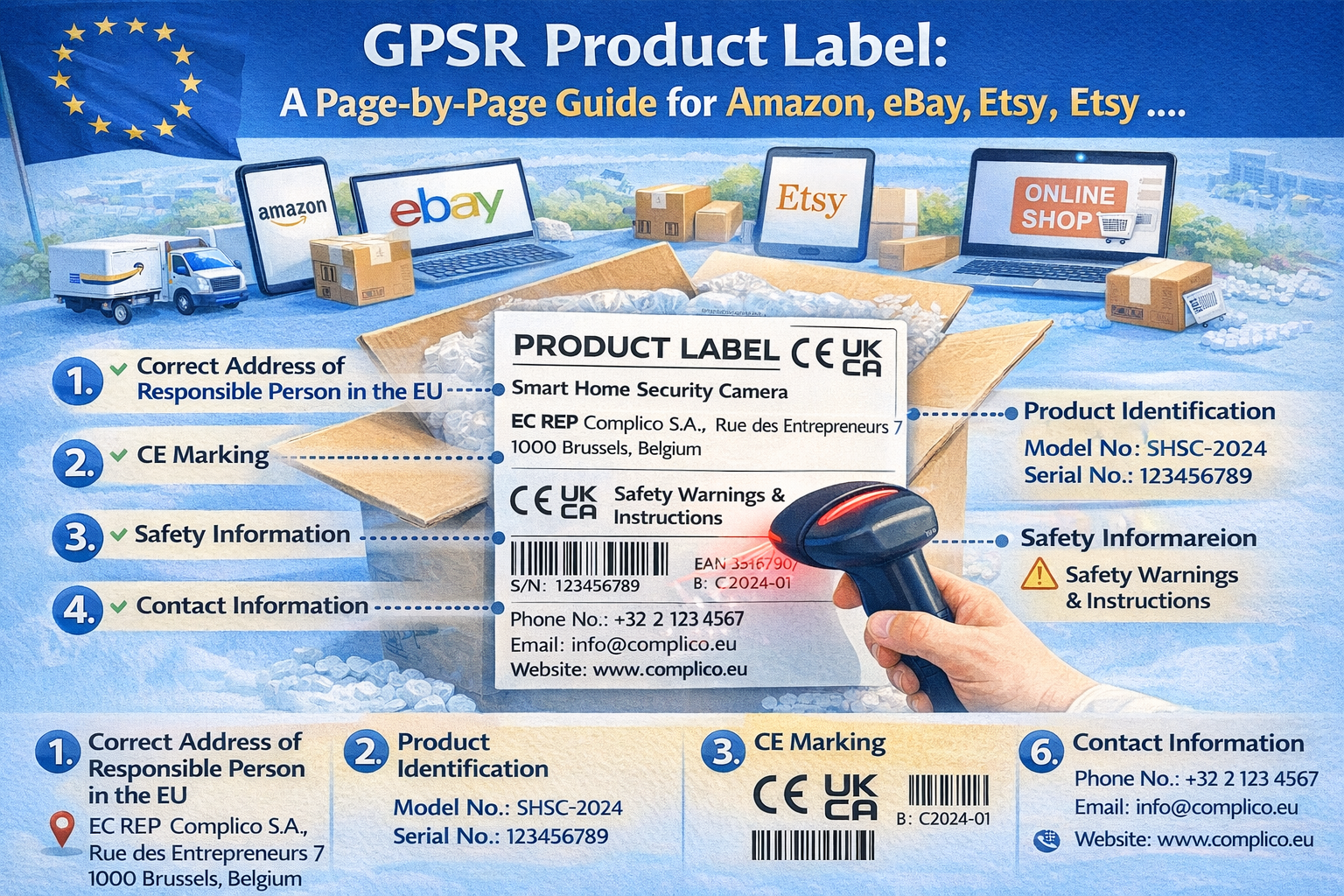
GPSR Product Label: A Page-by-Page Guide for Amazon, eBay, Etsy

EU Authorities Increase Fines for Combined GPSR and EPR Violations: The Cost of Non-Compliance in 2026
