


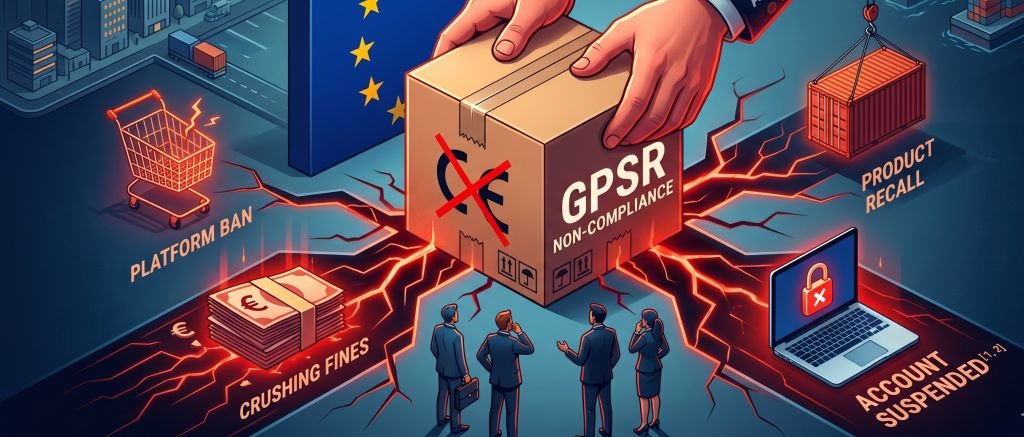
Selling products in the European Union has always come with a strict set of rules, but the landscape is currently undergoing its most significant shift in two decades. The General Product Safety Regulation (GPSR) is the new gold standard for consumer safety, replacing outdated directives and casting a much wider net over digital marketplaces. But what happens when businesses fail to adapt ? The reality is stark: GPSR non compliance is not merely a bureaucratic misstep; it is an existential threat to your e-commerce operations in Europe.
Whether you are an international seller utilizing Amazon FBA, a thriving brand on TikTok Shop, or a specialized retailer on eBay and Etsy, ignoring these updated safety mandates will have swift and severe consequences. At Complico Consulting GmbH, we have witnessed firsthand how rapidly platforms and customs authorities are cracking down on unprepared sellers. In this comprehensive guide, we will unpack exactly what happens if you fail to meet these new standards, exploring the financial, operational, and legal risks of GPSR non compliance.
Understanding the Shift: Why GPSR Matters Now
To understand the penalties, we first need to understand the intent behind the law. The GPSR replaces the older General Product Safety Directive (GPSD). The primary reason for this sweeping change? The explosion of e-commerce. The previous directive was written before the era of drop-shipping, algorithmic marketplaces, and cross-border direct-to-consumer sales. Regulators noticed a massive influx of unsafe products—ranging from faulty electronics to hazardous toys—entering the EU market undetected.
The GPSR introduces a modernized framework designed to hold everyone in the supply chain accountable. It explicitly targets online sales, forcing platforms like Amazon and eBay to act as gatekeepers. This means that GPSR non compliance is no longer just a matter between you and a distant regulatory body; it is a direct violation of the terms of service of the very platforms you rely on to generate revenue.
The Anatomy of GPSR Non Compliance
Before diving into the penalties, what actually constitutes non-compliance ? Regulators and platforms aren’t just looking for dangerous products; they are actively hunting for administrative shortcomings. You can be penalized for GPSR non compliance even if your product is perfectly safe, provided you lack the necessary paperwork. Common violations include:
- Missing an EU Responsible Person: If you are based outside the EU, you MUST have an established economic operator within the bloc. Failing to appoint an EU Responsible Person or an Authorized Representative is the fastest way to trigger a compliance strike.
- Inadequate Technical Documentation: You must maintain comprehensive technical files proving your product’s safety. Missing risk assessments or lab test reports is a critical failure.
- Improper Labeling and Traceability: Products must bear clear traceability information, including batch numbers, manufacturer details, and the contact information of the EU Responsible Person.
- Missing Online Safety Warnings: Under GPSR, safety warnings and instructions that appear on the physical product must also be clearly visible on the digital product listing.
Compliance is no longer just a physical requirement. A product that is physically compliant but lacks digital compliance on its online listing is still in direct violation of the GPSR.
Immediate E-Commerce Consequences: Platform Suspensions
For most e-commerce sellers, the earliest and most painful consequence of GPSR non compliance won’t come from a government official—it will come from an automated algorithm on Amazon, eBay, or Etsy. These platforms face heavy fines if they allow non-compliant products to be sold, which means they are adopting a “shoot first, ask questions later” approach.
1. Listing Deactivation and ASIN Suppression
If your listing lacks the required EU Responsible Person information or fails to display necessary safety warnings, platforms will simply deactivate it. On Amazon, this means your ASIN is suppressed. You will lose your search ranking, your advertising campaigns will halt, and your sales will drop to zero overnight. Recovering a suppressed ASIN can take weeks of back-and-forth with seller support, during which time your competitors will capture your market share.
2. Stranded Inventory in Fulfillment Centers
If you use services like Amazon FBA or third-party logistics (3PL) providers within the EU, GPSR non compliance creates a massive logistical nightmare. Fulfillment centers are instructed to freeze inventory that lacks proper compliance documentation or traceability labels. You will be paying exorbitant storage fees for products you cannot legally sell. Eventually, platforms will force you to either remove the inventory at your own expense or pay to have it destroyed.
3. Total Account Suspension
Repeated instances of non-compliance, or a failure to rectify issues within a given timeframe, will lead to complete account suspension. Marketplaces have zero tolerance for sellers who expose them to regulatory liability. Once an account is banned for safety regulation violations, reinstating it is incredibly difficult and often impossible without legal intervention.
Regulatory Penalties: Fines and Legal Action
Beyond platform-level enforcement, market surveillance authorities across EU member states are ramping up their policing efforts. Each member state enforces the GPSR through its own national agencies, meaning the penalties for GPSR non compliance can vary, but they are universally severe.
Crushing Financial Fines
Unlike minor administrative slaps on the wrist, fines for violating EU consumer safety laws are designed to be punitive. In Germany, authorities can levy fines running into the tens or hundreds of thousands of euros for severe infractions, especially if the non-compliance led to consumer injury. These fines can bankrupt a small to medium-sized enterprise.
Mandatory Product Recalls
If an authority determines your product poses a risk, they will order a mandatory recall. A product recall is a financial catastrophe. You are responsible for notifying consumers, covering the cost of return shipping, issuing full refunds, and paying for the secure disposal of the recalled items. Furthermore, the recall will be published on the EU’s Safety Gate (formerly RAPEX) portal, a public database of dangerous products. Having your brand listed here destroys consumer trust and alerts every other marketplace to ban your items.
Border Control and Supply Chain Blockages
The EU has heavily integrated its customs checkpoints with its market surveillance databases. This spells trouble for international sellers importing goods into the bloc. When dealing with Importer of Record (IOR) and Export of Record (EOR) services, compliance is non-negotiable.
Customs officials routinely inspect shipments for CE marking, traceability labels, and the presence of an EU Responsible Person’s contact details. If your shipment exhibits signs of GPSR non compliance, it will be denied entry. The goods will be held at the border, incurring daily demurrage and detention charges. If you cannot produce the required compliance documentation quickly, customs authorities have the right to seize and destroy the shipment entirely, leaving you with a total loss of capital.
High-Risk Categories: Where Non-Compliance Hits Hardest
While the GPSR applies broadly to all non-food consumer products, certain categories are under microscopic scrutiny. If you sell in these niches, the risks of GPSR non compliance are magnified tenfold:
- Toys and Children’s Products: The most heavily regulated category. Missing safety warnings (e.g., choking hazard labels) or lacking heavy metal testing documentation will trigger immediate platform bans and potential legal action.
- Electronics and WEEE: Beyond basic safety, electronics are scrutinized for compliance with the Waste Electrical and Electronic Equipment (WEEE) directive. If your electronics lack proper documentation, you face overlapping fines from multiple regulatory bodies.
- Cosmetics and Skincare: Because these products are applied directly to the body, ingredient transparency and batch traceability are aggressively enforced.
- Furniture and Home Goods: Often overlooked by sellers, furniture must comply with strict flammability and structural safety standards. Lack of testing reports here is a common compliance trap.
Long-Term Business Risks: The Hidden Costs
The immediate sting of a suppressed listing or a seized shipment is painful, but the long-term effects of GPSR non compliance can permanently cripple your brand.
Reputational Damage and Loss of Trust
Modern consumers are highly informed. If your product is recalled or flagged for safety violations, it leaves a permanent digital footprint. Negative Trustpilot reviews, warnings on social media, and poor seller feedback will destroy your brand equity. In e-commerce, trust is your most valuable currency; once it is lost due to safety negligence, it is rarely recovered.
Legal Liability and Consumer Lawsuits
If a non-compliant product causes property damage or personal injury to an EU consumer, the situation escalates from administrative fines to civil and potentially criminal liability. Under EU law, consumers have strong avenues to seek compensation. If you lack an EU Responsible Person, authorities will target your distributors or the platform itself, ensuring you are blacklisted from the European market permanently.
Your GPSR Compliance Checklist: How to Protect Your Business
The risks are severe, but they are entirely avoidable. Proactive compliance is an investment that protects your revenue and gives you a competitive edge over sellers who are too slow to adapt. Here is your roadmap to avoiding GPSR non compliance:
- Appoint an EU Responsible Person: If you are based outside the EU, immediately partner with a reputable compliance firm to act as your Authorized Representative. Their name and address must appear on your product or packaging.
- Audit Your Technical Files: Ensure you have up-to-date risk assessments, lab test reports, and declarations of conformity for every product you sell.
- Update Your Labeling: Verify that your products feature clear batch numbers, manufacturer details, and all necessary hazard warnings in the language of the target market.
- Optimize Your E-Commerce Listings: Do not hide safety warnings in the fine print. Ensure that all physical warnings are duplicated clearly in your online product descriptions and images on Amazon, eBay, TikTok Shop, etc.
- Implement Traceability Systems: Build internal processes to track which batches of products went to which fulfillment centers, allowing you to execute targeted recalls if ever necessary.
Secure Your EU Market Presence Today
Navigating the complexities of the General Product Safety Regulation shouldn’t distract you from growing your business. Do not let GPSR non compliance put your hard-earned revenue at risk.
At Complico Consulting GmbH, we specialize in EU regulatory compliance, Extended Producer Responsibility (EPR), and WEEE directives. We serve as your dedicated EU Responsible Person and guide you through the intricacies of e-commerce regulations.
Complico Consulting GmbH Bahnhofstr 12, 63549, Ronneburg, Germany
VAT: DE459923379
Email: info@complicoconsulting.com
WhatsApp: +49 160 7959362
more about gpsr resources
- Official GPSR Legislation Text (EUR-Lex)
- European Commission Product Safety Hub
- EU Safety Gate Portal (Formerly RAPEX)
- Official EU CE Marking Directives & Requirements
- EU Market Surveillance and Compliance Framework
Related Posts:

REACH, RoHS & POPs Explained: Chemical Testing Requirements for EU Compliance

List of EU Authorised Representative Companies (2026)
GPSR Technical File Documentation Guide for EU Product Compliance (2026)

eBay GPSR Requirements: The Ultimate Compliance Guide for Sellers in 2026
Navigating CE Marking Requirements for Product Compliance in the European Union