



.
The regulatory landscape in the European Union has shifted. If you are selling products in the EU, the acronym “GPSR” (General Product Safety Regulation) is likely burned into your retina by now. But while many sellers focus on the “Responsible Person” or the labeling requirements, there is a sleeping giant in the documentation pile: the GPSR risk assessment.
Under Regulation (EU) 2023/988, a product is no longer “safe” just because you say it is. It is safe because you have scientifically proven it through a structured analysis. At Complico Consulting GmbH, we see dozens of e-commerce sellers on Amazon, eBay, and Etsy struggling to bridge the gap between “it’s a good product” and “here is the legal proof of its safety.”
This guide will walk you through the anatomy of a professional GPSR risk assessment, ensuring your technical documentation is audit-ready and your business remains compliant.
What is a GPSR Risk Assessment?
In the simplest terms, a GPSR risk assessment is a systematic process where you identify potential hazards associated with a product, estimate the likelihood of those hazards causing harm, and determine the severity of that harm.
Article 9 of the GPSR mandates that manufacturers (and in many cases, importers or fulfillment service providers acting as the “Responsible Person”) must conduct a risk analysis and draw up technical documentation before placing a product on the market.
Why It’s More Than Just a “Checklist”
Gone are the days of “common sense” safety. The EU now requires a proactive approach. You aren’t just looking for sharp edges; you are looking at:
- Target Groups: Who uses the product? (Children, the elderly, people with disabilities?)
- Predictable Misuse: What happens if a user uses the product in a way you didn’t intend?
- Digital Security: For smart devices, does a software glitch create a physical safety risk?
Step-by-Step: How to Perform a Product Safety Analysis
Performing a GPSR risk assessment doesn’t require a PhD in engineering, but it does require a disciplined methodology. Most experts follow the framework laid out in ISO 12100 or the RAPEX (Rapid Alert System for non-food consumer products) methodology.
Step 1: Define the Product Limits and User Groups
Before you look for hazards, you must define what the product is and who is touching it.
- Intended Use: What is the primary function?
- Reasonably Foreseeable Misuse: Will a toddler put this in their mouth? Will someone use this indoor heater in a tent?
- Vulnerable Consumers: Does the product pose a specific risk to children or seniors?
Step 2: Hazard Identification
This is the “What could go wrong?” phase. You must categorize hazards into several buckets:
- Mechanical Hazards: Sharp edges, pinch points, stability (tipping over), or small parts (choking).
- Chemical Hazards: Does the material contain lead, phthalates, or allergens?
- Electrical Hazards: Short circuits, fire risks, or lack of insulation.
- Thermal Hazards: Does the surface get hot enough to burn skin?
- Radioactivity/Radiation: (Common in lasers or certain electronics).
Step 3: Risk Estimation (Probability vs. Severity)
Once a hazard is identified, you calculate the risk. A common tool is the Risk Matrix.
| Probability | Slight Injury | Serious Injury | Fatal/Permanent Injury |
| High | Medium Risk | High Risk | Critical Risk |
| Medium | Low Risk | Medium Risk | High Risk |
| Low | Very Low Risk | Low Risk | Medium Risk |
- Severity: How bad is the injury? (e.g., a small scratch vs. a broken bone vs. death).
- Probability: How likely is it to happen during the product’s lifespan?
Step 4: Risk Evaluation
Is the remaining risk “acceptable”? In the EU, if a risk is “High” or “Critical,” you cannot sell the product. You must implement “Risk Reduction” measures until the residual risk is as low as reasonably possible.
Drafting the Technical Documentation
Your GPSR risk assessment is the heart of your Technical File. If a market surveillance authority (like the Bundesnetzagentur in Germany) knocks on your door, they will ask for this document.
What must be included in the file?
- A general description of the product.
- The list of harmonized standards applied (e.g., EN 71 for toys).
- The actual risk analysis results.
- Test reports from laboratories (showing the product passed safety thresholds).
- The instruction manual and safety information (in the language of the country where it’s sold).
Pro Tip for Amazon Sellers: Amazon is increasingly requesting these documents for high-risk categories like toys, electronics, and baby products. Having a pre-prepared GPSR risk assessment is the difference between a thriving store and a suspended account.
Common Pitfalls in GPSR Compliance
1. Ignoring “Foreseeable Misuse”
Manufacturers often argue, “The product is safe if used correctly.” The EU doesn’t care. The GPSR explicitly states that you must account for how people actually use products. If a shelf looks like a ladder to a three-year-old, you must account for the risk of it tipping over.
2. Copy-Pasting Generic Assessments
A “one-size-fits-all” document is a red flag for regulators. Your assessment for a wooden cutting board should look vastly different from an assessment for a power bank.
3. Language Barriers
Your risk assessment can be in English or German for internal files, but the safety information provided to the consumer must be in the national language. If you sell in France, that risk mitigation (the warning label) better be in French.
The Role of the EU Responsible Person
If you are a non-EU manufacturer (e.g., based in the USA or China), you must have an EU Responsible Person. This entity is legally liable for ensuring that the GPSR risk assessment and technical documentation are available.
At Complico Consulting, we act as the bridge between international sellers and EU regulators. We don’t just “hold” your documents; we verify that your risk analysis meets the standard of the 2026 regulatory environment.
Checklists: Are You GPSR Ready?
Before you hit “publish” on your next product listing, run through this checklist:
- [ ] Have I identified all mechanical, chemical, and electrical hazards?
- [ ] Does my technical file include a signed risk analysis?
- [ ] Are my safety instructions translated into the languages of my target markets?
- [ ] Do I have an EU-based Responsible Person listed on the product/packaging?
- [ ] Have I archived my test reports for at least 10 years?
How Complico Consulting GmbH Can Help
Navigating the GPSR risk assessment process can feel like walking through a legal minefield. One wrong step can lead to product recalls, heavy fines, or being banned from major e-commerce platforms.
We specialize in:
- Creating Custom Risk Assessments: Tailored to your specific product category.
- Technical Documentation Review: Ensuring your “Tech File” is actually compliant.
- EU Authorized Representative Services: Providing the legal presence you need in Europe.
- EPR & WEEE Support: Handling your environmental obligations alongside product safety.
more about gpsr resources
- 1. The Official European Commission Safety Gate Risk Assessment Guidelines
- 2. The Official Legal Text of the GPSR on EUR-Lex
- 3. The EU Safety Gate (RAPEX) Risk Assessment Guidelines
Related Posts:
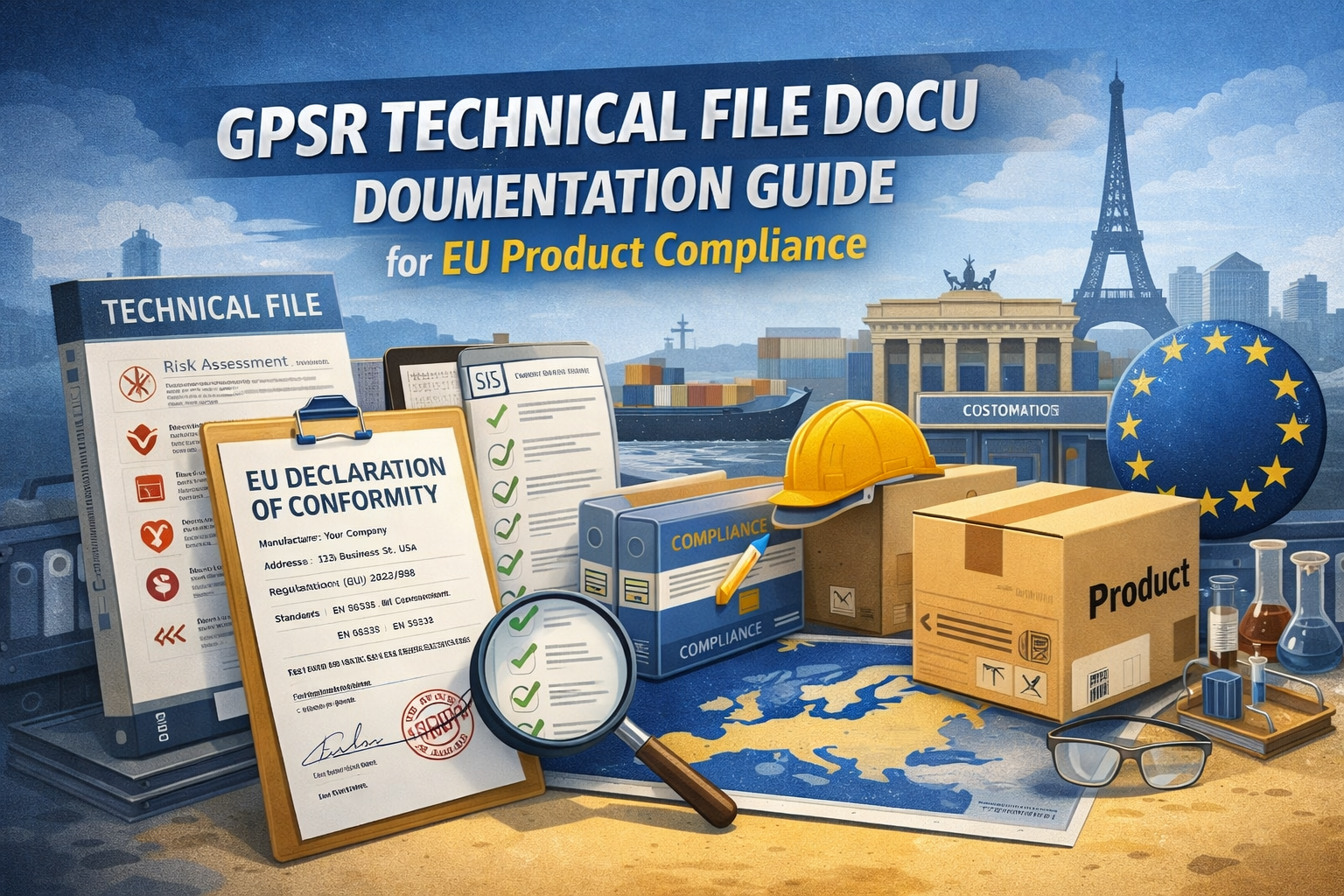
GPSR Technical File Documentation Guide for EU Product Compliance (2026)

Complete Guide to EU Responsible Person Requirements Under GPSR for Sellers
How to Appoint an EU Responsible Person: Complete Guide for Non-EU Sellers

REACH, RoHS & POPs Explained: Chemical Testing Requirements for EU Compliance

The Complete Guide to the EU Responsible Person Under GPSR: Roles, Duties & Legal Requirements
