



.
If you are manufacturing, importing, or distributing products destined for the European market, you have likely encountered the familiar “CE” logo. But behind those two letters lies a complex web of legal obligations, safety standards, and rigorous documentation. Understanding the CE Marking Requirements is not just a regulatory hurdle; it is the fundamental key to unlocking the European Economic Area (EEA), a market of nearly 500 million consumers.
At Complico Consulting GmbH, we frequently see businesses struggle to decipher whether their product needs a CE mark, how to test it, and what documentation is legally required to prove compliance. Navigating this landscape without a clear roadmap can lead to seized goods, hefty fines, and damaged reputations.
In this comprehensive guide, we will break down the essential CE Marking Requirements for product compliance in the European Union, guide you through the mandatory steps for certification, and highlight upcoming 2026 regulatory changes you need to prepare for today.
What Does the CE Mark Actually Mean?
The CE mark (Conformité Européenne) is a mandatory conformity marking for certain products sold within the EEA. When a manufacturer affixes the CE mark to their product, they are making a legally binding declaration that the product complies with all applicable European health, safety, and environmental protection legislation.
It is crucial to dispel a common myth right away: The CE mark is not a quality indicator. It does not mean a product is “high quality” or “premium.” It simply means the product meets the baseline legal requirements to be sold safely within the European Union. It acts as a trade passport, allowing goods to move freely across the borders of 32 European countries without facing additional national testing.
Does Your Product Need a CE Mark?
One of the most frequent mistakes companies make is assuming every product needs a CE mark. Affixing a CE mark to a product that does not legally require one is just as illegal as omitting it from a product that does.
CE marking is only mandatory for products covered by specific harmonized EU rules (Directives or Regulations). If your product does not fall under these categories, it must not bear the CE mark. Instead, it will likely fall under the General Product Safety Regulation (GPSR), which ensures general consumer safety.
Common Product Categories Requiring CE Marking:
- Medical Devices
- Machinery and Industrial Equipment
- Electrical and Electronic Equipment (Low Voltage Directive)
- Toys
- Personal Protective Equipment (PPE)
- Construction Products
- Pressure Equipment
- Radio and Telecommunications Terminal Equipment
Common Product Categories NOT Requiring CE Marking:
- Ordinary packaging materials (though subject to the upcoming PPWR)
- Food and drink
- Textiles and clothing (unless they are protective clothing/PPE)
- General furniture
- Cosmetics
The 6 Essential Steps to Meet CE Marking Requirements
Achieving compliance is not a guessing game. The European Commission outlines a clear framework that manufacturers must follow. Here are the six steps you must take to fulfill the CE Marking Requirements.
1. Identify the Applicable EU Directives and Harmonized Standards
The very first step is to pinpoint exactly which EU Directives apply to your product. A single product may be subject to multiple directives. For example, an electronic toy must comply with both the Toy Safety Directive and the Electromagnetic Compatibility (EMC) Directive.
Once the directives are identified, you must look up the relevant “harmonized standards.” These are technical specifications that provide a presumption of conformity. While using harmonized standards is often voluntary, it is the most straightforward way to prove your product meets the essential safety requirements.
2. Verify the Product’s Specific Requirements
Every directive contains “essential requirements” regarding health, safety, and environmental protection. You must evaluate your product’s design, manufacturing process, and intended use against these requirements. This involves conducting a thorough risk assessment to identify potential hazards associated with your product and documenting how your design mitigates those risks.
3. Determine if an Independent Conformity Assessment is Required
Can you self-certify, or do you need a third party? This is a critical juncture in meeting CE Marking Requirements.
- Self-Declaration: For lower-risk products (like basic electronics under the Low Voltage Directive), manufacturers can self-assess their products, declare conformity, and affix the CE mark themselves.
- Notified Body Involvement: For high-risk products (such as Class III medical devices, complex pressure equipment, or certain PPE), you are legally required to use a “Notified Body.” A Notified Body is an independent, EU-authorized organization designated by an EU country to assess the conformity of certain products before being placed on the market. You can find authorized testing bodies via the EU’s official NANDO database.
4. Test the Product and Check Conformity
Whether you are self-certifying or using a Notified Body, the product must be rigorously tested. These tests evaluate the product’s performance against the identified harmonized standards. You must ensure that all materials used comply with relevant chemical restrictions (such as RoHS for electronics) and conduct functional tests to simulate real-world use and abuse. If any non-conformities are found during this testing phase, the product design or manufacturing process must be corrected before proceeding.
5. Compile the Technical Documentation and Declaration of Conformity
To prove you have met all CE Marking Requirements, you must create and maintain a Technical File. This file must be kept for at least 10 years after the last product has been placed on the market and must be readily available to market surveillance authorities upon request.
Your Technical File should include:
- A general description of the product.
- Conceptual design and manufacturing drawings.
- Descriptions and explanations necessary to understand the drawings.
- A list of harmonized standards applied in full or in part.
- Results of design calculations and risk assessments.
- Official test reports.
Finally, you must draw up and sign the EU Declaration of Conformity (DoC). This one-page legal document details your company information, product identification, applied directives, and a formal statement taking full responsibility for the product’s compliance.
6. Affix the CE Mark Correctly
Once the first five steps are complete, you can finally affix the CE mark to your product. The EU has strict design rules for the logo itself:
- It must consist of the initials “CE” in the standard, recognizable font.
- It must be a minimum of 5 millimeters in height (unless specific product rules dictate otherwise).
- It must be visible, legible, and indelible (it cannot be easily rubbed off or removed).
- If a Notified Body was involved in the production control phase, their 4-digit identification number must be placed immediately adjacent to the CE mark.
If the product is too small or its nature makes it impossible to affix the mark directly, the CE mark must be placed on the packaging and the accompanying documentation.
Looking Ahead: 2026 Regulatory Updates
At Complico Consulting GmbH, we constantly monitor the legislative horizon to ensure our clients are never caught off guard. The landscape of CE Marking Requirements is not static; it evolves to address new technological, environmental, and safety concerns. Here is what you need to prepare for as we approach 2026.
The New Construction Products Regulation (CPR 2024)
The European Union has published the updated Construction Products Regulation, which officially enters into force and begins to apply to certain product groups starting January 2026.
Historically, the CE mark for construction products focused purely on technical performance and safety. The new CPR introduces a paradigm shift: it mandates environmental reporting. Manufacturers will now need to declare how their product performs regarding sustainability indicators, such as Global Warming Potential (GWP), based on life-cycle information. This aligns the CE marking process for construction materials directly with the EU’s broader sustainability goals.
Packaging and Packaging Waste Regulation (PPWR)
While ordinary packaging does not require a CE mark, a massive shift is occurring in August 2026 under the new PPWR. From this date, all packaging placed on the EU market must have its own EU Declaration of Conformity to demonstrate compliance with strict recyclability and chemical safety limits (such as upcoming PFAS bans). If your CE-marked product is shipped in a box, the product needs its CE documentation, and the box itself will soon require its own distinct compliance paperwork.
Supply Chain Responsibilities: Who is Accountable?
Compliance is a shared burden across the supply chain, though the heaviest weight falls on the manufacturer.
- Manufacturers: Hold the ultimate responsibility for ensuring the product meets all CE Marking Requirements, creating the technical documentation, signing the DoC, and affixing the mark. If you have a product manufactured in Asia but sell it in the EU under your own brand name, the EU considers you the manufacturer.
- Importers: Must verify that the manufacturer has completed all required conformity assessments, drawn up the technical documentation, and correctly applied the CE mark. The importer must also place their name and contact address on the product or packaging.
- Distributors: Must act with due care. Before making a product available on the market, they must verify that the product bears the CE mark and is accompanied by the required documentation (like safety instructions in the local language of the consumer).
The Risks of Non-Compliance
The European Union takes product safety incredibly seriously. Market surveillance authorities across member states actively monitor goods entering the borders and available on retail shelves.
Failing to meet CE Marking Requirements—whether by forging a mark, using a mark on an unregulated product, or failing to produce a Technical File upon request—carries severe consequences. Penalties vary by member state but typically include:
- Immediate mandatory product recalls.
- Total withdrawal of the product from the EU market.
- Border seizures and destruction of goods.
- Substantial financial fines.
- In cases involving injury or death, criminal prosecution and imprisonment.
Beyond the legal penalties, the damage to your brand’s reputation and the loss of trust from B2B partners and consumers can be devastating and irreversible.
How Complico Consulting GmbH Can Secure Your EU Market Access
Decoding CE Marking Requirements is a complex, multi-disciplinary task requiring legal comprehension, technical engineering insight, and meticulous documentation management. You do not have to navigate this labyrinth alone.
At Complico Consulting GmbH, we specialize in streamlining the European compliance journey for global businesses. Our services ensure that your products not only enter the European market legally but stay there without interruption. We offer:
- Directive Identification & Mapping: We analyze your product portfolio and determine exactly which EU Directives and harmonized standards apply.
- Risk Assessment Facilitation: We guide your engineering teams through the mandatory hazard analysis protocols.
- Technical File Creation: We help you build robust, audit-proof Technical Documentation and draft your EU Declaration of Conformity.
- Regulatory Monitoring: We keep your business ahead of the curve, preparing you for upcoming shifts like the 2026 CPR and PPWR implementations.
Product compliance is not merely a legal obligation; it is a competitive advantage. Buyers, distributors, and consumers trust products that demonstrably prioritize safety and regulatory alignment.
Frequently Asked Questions (FAQ) About CE Marking Requirements
How much does it cost to get a CE mark ?
The CE mark itself is free to affix; you do not buy the logo. The costs associated with CE marking come from the conformity assessment process. If you can self-certify, the cost is simply your internal time for risk assessment and documentation. If you require a Notified Body for testing and certification, costs can range from a few thousand to tens of thousands of euros, depending on the complexity of the product and the extent of laboratory testing required.
How long is a CE mark valid ?
The CE mark does not technically “expire.” However, your Declaration of Conformity is a living document. It states that your product met the EU requirements at the moment it was placed on the market. If the product’s design changes, or if the underlying EU Directives or harmonized standards are updated, you must reassess the product, update the technical documentation, and issue a new DoC to maintain compliance.
Is CE marking recognized in the UK post-Brexit ?
Since the UK left the European Union, they have introduced their own marking system: the UKCA (UK Conformity Assessed) mark. While the UK government has announced indefinite recognition of the CE mark for many general product categories (allowing businesses to continue using the CE mark for the GB market), specific high-risk sectors (like medical devices and construction products) have their own distinct transition timelines and requirements. If you are selling to both markets, it is vital to assess the requirements for both CE and UKCA marks.
Can a non-EU manufacturer affix the CE mark ?
Yes. Regardless of where a product is physically manufactured (e.g., China, the USA, India), if it is intended for the European market, it must comply with CE Marking Requirements. The non-EU manufacturer must complete the conformity steps. In many cases, particularly under the Market Surveillance Regulation (EU) 2019/1020, a non-EU manufacturer must appoint an EU-based Authorized Representative or an EU importer to act as the legal point of contact for market surveillance authorities.
More about CE Marking Requirements Resources
- CE marking – obtaining the certificate, EU requirements
- CE marking – European Commission official page
- CE Marking – EU Legal Framework (EUR-Lex)
Related Posts:
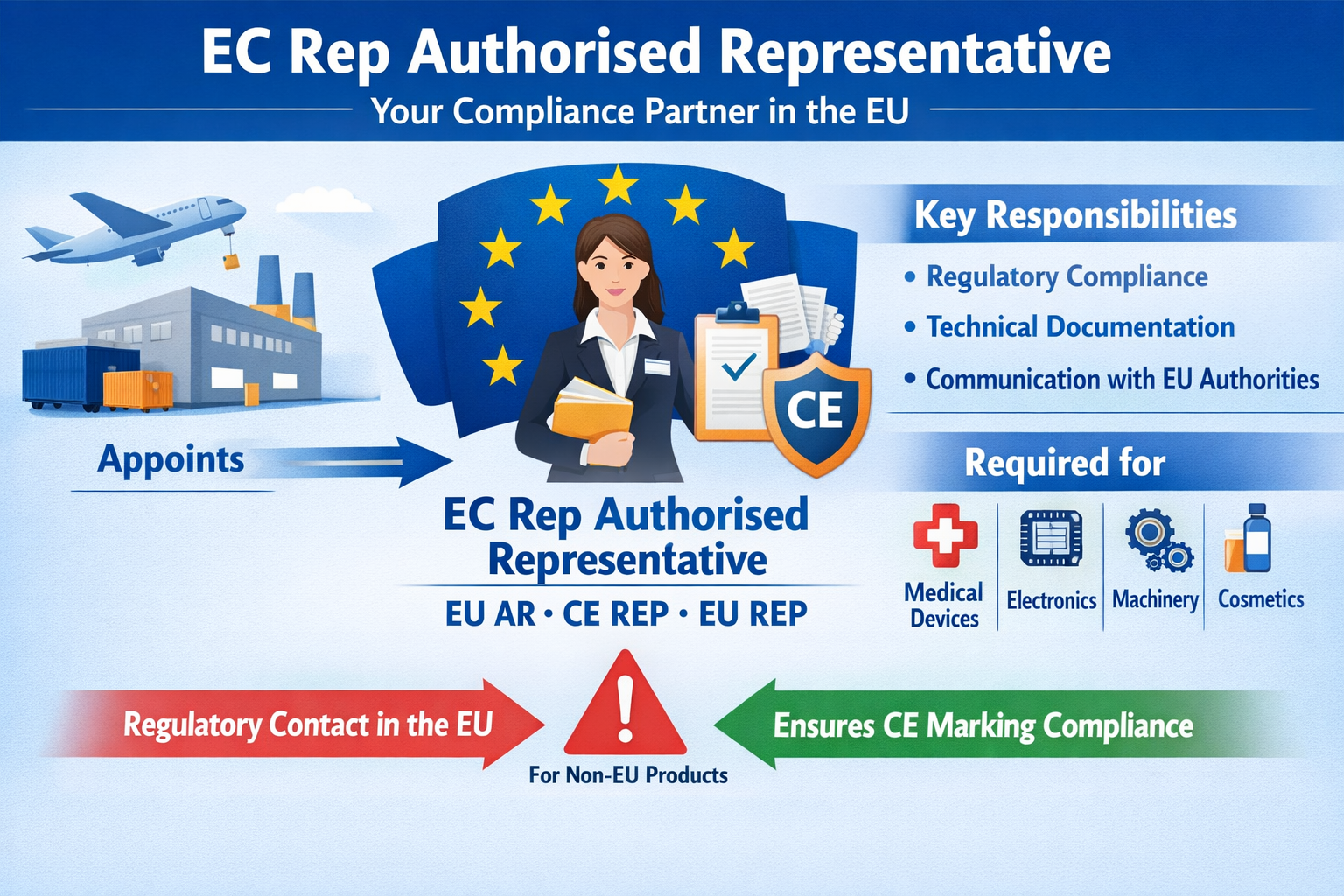
EU Authorised Representative (EU AR, EC REP, CE REP, EU REP & EAR): Complete Guide for Non-EU Manufacturers

eBay GPSR Requirements: The Ultimate Compliance Guide for Sellers in 2026

List of EU Authorised Representative Companies (2026)

Complete Guide to EU Responsible Person Requirements Under GPSR for Sellers
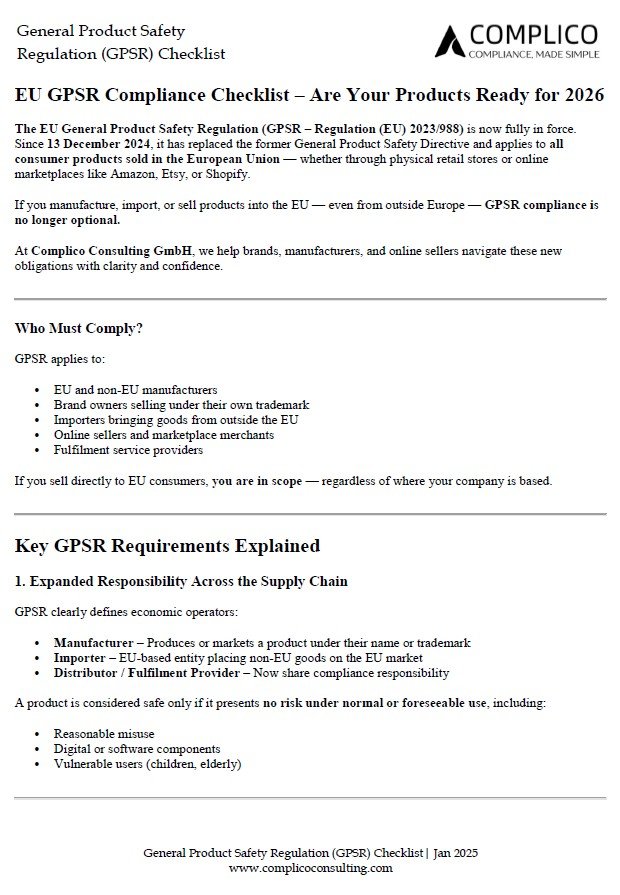
EU General Product Safety Regulation (GPSR): Complete Compliance Guide for Businesses
