



.
The electrification of our world is moving at lightning speed. From the electric vehicles (EVs) on our roads to the smart devices in our pockets and the e-bikes we ride to work, batteries are the hidden engines powering modern life. But as the demand for batteries skyrockets, so does the environmental impact of producing, using, and eventually disposing of them.
To address this, the European Union has completely overhauled its approach to battery lifecycles. If your business imports or sells batteries (or products containing batteries) in the European market, a critical deadline is rapidly approaching.
As of August 18, 2025, the EU battery regulation EPR (Extended Producer Responsibility) requirements will take full effect. This marks a seismic shift from the old Battery Directive (2006/66/EC) to a strict, comprehensive framework that holds importers and manufacturers financially and operationally responsible for the entire lifecycle of a battery—right down to its end-of-life recycling.
In this comprehensive guide, we will break down exactly what the EU Battery Regulation 2025 entails, how the new EPR obligations impact importers, and the actionable steps you must take to ensure uninterrupted market access.
What is the EU Battery Regulation 2025?
The EU Batteries Regulation (Regulation (EU) 2023/1542) officially entered into force in August 2023, but it was designed to be implemented in staggered phases. While some preliminary rules regarding safety and documentation have already rolled out, August 2025 is the turning point for waste management and Extended Producer Responsibility (EPR).
Unlike the previous directive, which left a lot of room for interpretation by individual Member States, the new regulation is a binding law that applies uniformly across the entire EU. Its primary goal is to create a true circular economy for batteries. This means ensuring that raw materials are sourced ethically, batteries are designed to last longer and be easily removed, and crucially, that they are properly collected and recycled when they die.
For businesses, the era of simply shipping a battery-powered product into the EU and forgetting about it is over.
Are You Considered a “Producer” or “Importer”?
A common point of confusion is who actually bears the responsibility under these new laws. In the context of the EU battery regulation EPR, the term “Producer” is used broadly. You are subject to these strict obligations if you fall into any of the following categories:
- Manufacturers: You produce batteries under your own name or trademark within the EU.
- Importers: You are established in the EU and place a battery (or a product containing a battery) from a third country onto the EU market for the first time.
- Brand Owners: You design or have batteries manufactured and supply them under your own brand.
- Distance Sellers: You sell batteries directly to end-users in the EU from a third country (e.g., via e-commerce platforms like Amazon, eBay, or your own website).
The Bottom Line: If you are the one introducing the battery to the European market—whether it is a standalone AA battery, a built-in lithium-ion battery in a smartphone, or a massive industrial energy storage unit—the EPR obligations fall on your shoulders.
The Core of the EU Battery Regulation EPR: What Changes on August 18, 2025?
The August 2025 deadline brings sweeping changes to how battery waste is managed. Here are the core obligations importers must prepare for:
1. Mandatory Multi-Country Registration
There is no “one-size-fits-all” EU registration portal. Every single EU Member State operates its own national EPR scheme.
- If you sell batteries in Germany, France, and Spain, you must register in Germany, France, and Spain separately.
- You must be registered before you place products on the market.
- If you are an importer based outside of the EU, you are legally required to appoint an Authorised Representative for EPR in every single Member State where you operate.
2. Financial and Operational Responsibility
Under the EU battery regulation EPR, you must finance the net costs of:
- Collecting waste batteries.
- Transporting them to treatment facilities.
- Recycling and treating the materials (achieving strict recovery targets for lithium, cobalt, nickel, and copper).
- Conducting public information campaigns about battery recycling.
Because building a pan-European waste collection network is impossible for most individual companies, the regulation allows (and practically necessitates) joining a Producer Responsibility Organisation (PRO). A PRO is an authorized body that handles the physical collection and recycling on your behalf, funded by the fees you pay them based on your sales volume.
3. Strict Take-Back Systems
Producers and their appointed PROs must establish take-back systems that cover the entirety of each Member State.
- You must offer the collection of waste batteries free of charge to the end-user.
- Distributors and retailers also have obligations to take back old batteries at their retail outlets, which are then handed over to the producers or PROs.
4. Overhauled Labeling and Marking
By August 18, 2025, any battery placed on the market must meet rigorous new labeling standards. Non-compliant packaging can lead to immediate customs blocks or product recalls.
- The Crossed-Out Wheeled Bin: The universal symbol for separate collection must cover at least 3% of the area of the largest side of the battery.
- Chemical Symbols: Batteries containing heavy metals must be marked with specific chemical symbols (e.g., Cd for cadmium, Pb for lead).
- Capacity Information: Clear, visible indications of the battery’s capacity.
- QR Codes: A scannable QR code that links directly to the product’s technical documentation and safety information.
The 5 Categories of Batteries Under the New Regulation
The rules you must follow depend heavily on the type of battery you import. The regulation categorizes all batteries into five distinct groups:
- Portable Batteries: Small, sealed batteries that you can easily carry (e.g., AA batteries, button cells, smartphone and laptop batteries).
- Light Means of Transport (LMT) Batteries: Batteries powering wheeled vehicles that are not heavily motorized, such as e-bikes, electric scooters, and hoverboards.
- Starting, Lighting, and Ignition (SLI) Batteries: Traditional batteries used to start the engine of vehicles, or to power lighting and ignition systems.
- Electric Vehicle (EV) Batteries: High-capacity batteries specifically designed to provide traction to hybrid and fully electric road vehicles.
- Industrial Batteries: Batteries designed for industrial uses, off-grid energy storage, or any battery weighing over 5 kg that doesn’t fit into the other categories.
Note: The regulation covers almost all batteries. The only exceptions are batteries explicitly designed for military equipment, space exploration, and nuclear safety facilities.
Why Importers Need to Act Now: The Friction Points
You might think you have time to prepare, but supply chain realities dictate otherwise. Here are the common friction points importers will face as the August 2025 deadline hits:
- Data Granularity: Standard sales reporting is no longer enough. EPR reporting requires granular, product-level detail. You must report exact chemistry types, weights, and specific battery categories broken down by individual market. If your current ERP or inventory software doesn’t track this, you have a massive data gap to close.
- Packaging Lead Times: Updating your labels to include the required QR codes, capacity info, and crossed-out bin symbols takes time. You have to coordinate with your manufacturers, update packaging designs, print new materials, and phase out old stock. Batteries hitting the market in August 2025 must already be compliant.
- Removability Requirements: Looking slightly ahead to 2027, portable batteries incorporated into appliances must be readily removable and replaceable by the end-user using commercially available tools. Importers of consumer electronics need to influence product design today to meet this future requirement.
A Step-by-Step Compliance Checklist for Importers
Navigating the EU battery regulation EPR doesn’t have to be overwhelming if you break it down into actionable steps. Use this checklist to safeguard your market access:
- [ ] Conduct a Product Audit: Identify every product in your portfolio that contains a battery. Classify them into one of the five regulatory categories (Portable, LMT, EV, SLI, or Industrial).
- [ ] Map Your Markets: List every EU Member State where your products are sold, including direct-to-consumer e-commerce sales.
- [ ] Audit Your Data Systems: Ensure your IT and reporting systems can track battery weight, chemistry, and sales volume by country.
- [ ] Appoint Authorised Representatives: If you are based outside the EU, secure an Authorised Representative for EPR in your target Member States.
- [ ] Join National PROs: Research and register with authorized Producer Responsibility Organisations (PROs) in each country to handle your physical waste collection obligations.
- [ ] Redesign Packaging and Labels: Work with your manufacturing partners to update product labels to include the mandatory CE mark, crossed-out wheeled bin, chemical symbols, capacity info, and compliance QR codes.
- [ ] Prepare Technical Documentation: Ensure that the data sitting behind your QR codes is accurate, accessible, and up to date with safety and durability parameters.
Beyond 2025: A Glimpse into Future Requirements
The August 2025 EPR deadline is just one milestone in the EU’s long-term environmental strategy. Importers should keep an eye on the horizon for upcoming regulations:
- Digital Battery Passports (2027): All EV, LMT, and industrial batteries over 2 kWh will require a digital passport storing lifecycle data, carbon footprint information, and material composition.
- Supply Chain Due Diligence (2027): Importers will be required to verify and report on the ethical sourcing of raw materials like cobalt, lithium, nickel, and graphite, proving mitigation of social and environmental risks.
- Recycled Content Thresholds (2031): Batteries will be mandated to contain minimum percentages of recycled materials.
How Complico Consulting GmbH Can Help
The intersection of e-commerce expansion and international regulatory compliance is incredibly complex. From the General Product Safety Regulation (GPSR) and GDPR to the nuanced, multi-country requirements of Extended Producer Responsibility (EPR) frameworks, staying compliant takes specialized knowledge.
At Complico Consulting GmbH, we specialize in transforming dense, complex legal requirements into clear, scannable, and actionable strategies for your business. Whether you are an Amazon seller, an independent e-commerce brand, or a large-scale distributor, we can guide you through the intricacies of the new EU Battery Regulation.
We don’t just tell you what the laws are; we help you implement them. From finding the right PROs across Europe to optimizing your technical documentation for seamless market entry, our team ensures your operations remain uninterrupted and fully compliant.
More About GPSR Resources
- Official EU Commission Overview on Batteries and Waste
- Full Legal Text: Regulation (EU) 2023/1542 (EUR-Lex)
- European Parliament: Legislative Train Schedule for the Battery Regulation
Related Posts:
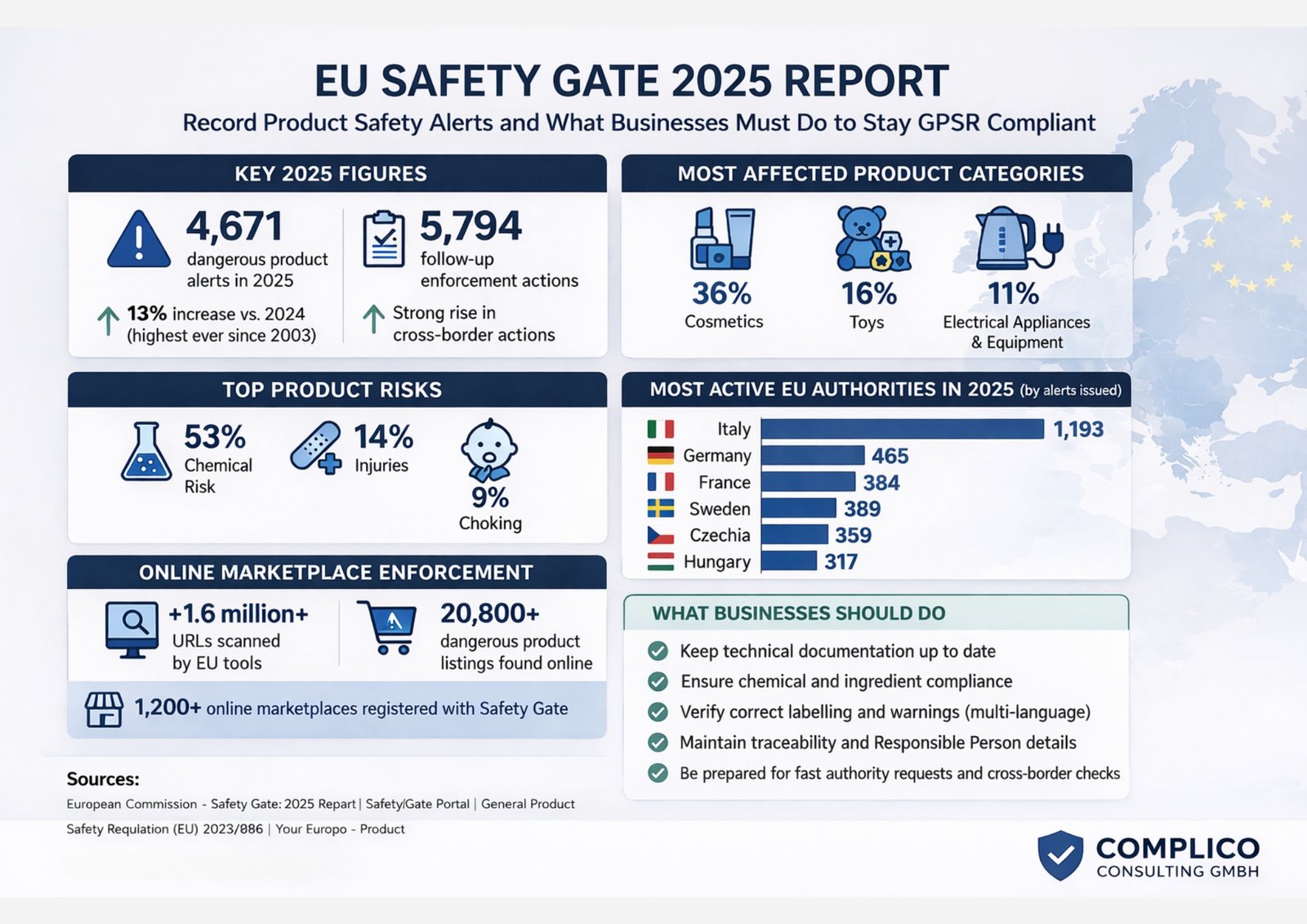
EU Safety Gate 2025 Report: Record Alerts and GPSR Compliance Guide

How Amazon is Enforcing EPR Rules Across EU Countries in 2025: The Ultimate Seller’s Guide

EPR EU PPWR: New Packaging Rules from August 2026 – Is Your Business Ready ?

Top 30 EPR Europe Authority Websites Every E-commerce Seller Must Know

Online Marketplaces Held Responsible for EPR Compliance in Europe: What Sellers Must Know
