



.
If you are selling products to European consumers through platforms like Amazon, eBay, AliExpress, or TikTok Shop, you have likely noticed a massive shift in how these platforms operate. The era of “list it and forget it” is officially over.
Over the last few years, the European Union has fundamentally changed its approach to environmental law and waste management. Instead of just chasing down individual, overseas sellers who skirt the rules, regulatory bodies have gone straight to the gatekeepers. Today, EPR marketplace responsibility is the new standard.
By making the platforms legally and financially liable for the non-compliance of their third-party sellers, Europe has created an ironclad enforcement net. If you cannot prove your Extended Producer Responsibility (EPR) compliance, the marketplace will simply pull the plug on your sales.
In this comprehensive guide, we are breaking down exactly what this shift means for your e-commerce business, which countries are leading the charge, and the exact steps you must take to keep your listings active and your business growing.
What is Extended Producer Responsibility (EPR)?
Before diving into marketplace liabilities, let’s establish a clear baseline. Extended Producer Responsibility (EPR) is an environmental policy approach in which a producer’s responsibility for a product is extended to the post-consumer stage of its life cycle.
In plain English: If you put a product (and its packaging) into the European market, you must pay for its eventual collection, recycling, and disposal.
This is not a tax; it is a framework designed to fund a circular economy. To comply, sellers must register with national authorities, join a Producer Responsibility Organization (PRO), report the volumes of materials they sell, and pay eco-contributions based on those volumes.
The Turning Point: The Rise of EPR Marketplace Responsibility
Historically, EPR laws existed, but enforcement was a logistical nightmare. A factory in Asia or a dropshipper in the US could easily sell thousands of plastic-wrapped items to consumers in France or Germany without paying a cent toward local recycling schemes. National authorities simply did not have the resources to track down hundreds of thousands of independent cross-border sellers.
The solution? Hold the marketplaces legally accountable.
EPR marketplace responsibility means that platforms like Amazon or eBay are legally designated as the “deemed producer” if the actual seller fails to comply. If a platform facilitates the sale of an un-registered product, the platform itself can face massive fines and legal penalties.
Unsurprisingly, marketplaces are not willing to pay your recycling fees or face fines on your behalf. Their response has been swift and brutal: Provide proof of compliance, or we will block your account.
How Marketplaces Enforce the Rules
If you sell on a major platform, you have almost certainly encountered their compliance portals. The enforcement mechanism is highly automated and extremely strict. Here is how it works:
- The UIN Requirement: When you register for EPR in a specific country (like France or Germany), you are issued a Unique Identification Number (UIN) or a specific registration number (like a LUCID number in Germany).
- Mandatory Uploads: Marketplaces require you to upload this specific number to their compliance dashboard.
- Automated Verification: The marketplace pings the government database (e.g., the SYDEREP database in France) to verify that your number is valid, active, and matches your legal business entity.
- The Blockade: If your number is invalid, expired, or missing by the country’s legal deadline, the marketplace automatically suppresses your listings. European buyers will simply see your products as “Currently Unavailable.”
Key European Markets Enforcing Marketplace Liability
While the push for circularity is EU-wide, EPR is not a centralized system. Every single European country has its own national laws, registries, and thresholds. However, a few key countries have aggressively spearheaded the EPR marketplace responsibility movement.
1. Germany: The Trailblazer
Germany was one of the first to mandate marketplace verification through its Verpackungsgesetz (VerpackG) or Packaging Act.
- The Rule: Marketplaces are legally forbidden from allowing you to sell if you are not registered with the LUCID Packaging Register and participating in a dual system (a PRO).
- Beyond Packaging: Germany has also extended this marketplace check to Electrical and Electronic Equipment (WEEE) and Batteries.
2. France: The Most Comprehensive System
France’s Anti-Waste for a Circular Economy Law (AGEC) is arguably the most complex in the world.
- The Rule: Marketplaces must collect your Unique Identification Numbers (UINs) across a vast array of categories.
- Categories Covered: France requires EPR not just for packaging, WEEE, and batteries, but also for textiles, furniture, DIY and gardening articles, toys, sporting goods, and even printed paper.
3. Spain: The Newest Enforcement Heavyweight
Spain recently enacted its Royal Decree on Packaging and Packaging Waste, bringing it in line with the marketplace liability model.
- The Rule: Sellers must provide their registration number from the Registry of Product Producers (Registro de Productores de Productos).
- Impact: Marketplaces are actively auditing Spanish listings and suspending sellers who fail to provide valid environmental compliance numbers.
4. Austria and Beyond
Austria has also introduced strict packaging regulations requiring the appointment of an authorized representative for foreign distance sellers, and platforms are heavily monitoring this. We are seeing a domino effect: as one country successfully forces Amazon or eBay to act as the compliance police, neighboring nations rapidly adopt the same legislative playbook.
The Ripple Effects: Beyond Account Suspensions
The immediate threat of EPR marketplace responsibility is having your listings deactivated. However, the consequences of non-compliance run much deeper for ambitious e-commerce brands:
- Trapped Inventory: If you use Fulfillment by Amazon (FBA) or similar local warehousing services, a suspended listing means your inventory is stranded in a European warehouse, accumulating storage fees with no way to be sold.
- Frozen Funds: Marketplaces may hold your account disbursements if they suspect illegal trading or non-compliance with regional laws.
- Brand Reputation Damage: Modern consumers care deeply about sustainability. Having your products pulled for failing to meet basic environmental standards is a massive blow to brand trust.
- The Pay-on-Behalf Penalty: Some marketplaces offer a “pay on behalf” service where they will auto-enroll you and pay the fees for you. While this sounds convenient, the administrative fees they charge on top of the base eco-contributions are often exorbitant, eating directly into your profit margins.
The Intersection of EPR and the GPSR
It is impossible to talk about compliance in 2026 without mentioning how EPR overlaps with the General Product Safety Regulation (GPSR).
While EPR focuses on environmental impact and waste, the GPSR focuses on consumer safety and supply chain traceability. Both frameworks share a common goal: ensuring that every product entering the EU has a clear, identifiable, and accountable economic operator attached to it.
If you are an international seller, you cannot ignore either. The data you gather to prove your GPSR compliance (such as detailed product technical files, material compositions, and Authorized Representative appointments) is exactly the data you need to accurately calculate your EPR obligations and report your packaging weights. Treating these two massive regulatory frameworks as isolated chores will result in duplicated work and costly errors.
A Step-by-Step Action Plan for E-commerce Sellers
Navigating EPR marketplace responsibility can feel like drowning in paperwork, but it is manageable if you tackle it systematically. Here is the exact blueprint we use to help our clients achieve seamless compliance:
Step 1: Conduct a Catalog Audit
You cannot comply if you don’t know what you are selling. Analyze your entire product catalog.
- What are the products made of? (Textiles? Electronics?)
- Do they contain batteries?
- Exactly what type of packaging is used? (Cardboard boxes, plastic polybags, hangtags, bubble wrap?)
Step 2: Identify Your Target Markets
Where are your buyers located? If you are storing goods in a German warehouse but actively shipping to French and Austrian consumers, you have EPR obligations in all three countries.
Step 3: Appoint Authorized Representatives (If Required)
If your company is located outside of the European Union, many countries (like France and Austria) legally require you to appoint a local Authorized Representative to handle your EPR registration and assume legal liability on your behalf.
Step 4: Join Local PROs and Register
For each country and each product category, you must:
- Sign a contract with an approved Producer Responsibility Organization (PRO).
- Register with the national government database to receive your UIN or registration number.
Step 5: Upload and Validate
Take those registration numbers and input them immediately into your marketplace compliance dashboards. Monitor the portal to ensure the marketplace successfully validates the numbers with the national databases.
Step 6: Ongoing Volume Reporting
Compliance is not a one-time event. You must periodically (usually yearly or quarterly) report exactly how many kilograms of packaging, electronics, or batteries you sold into each country, and pay the corresponding eco-invoices to your PROs.
Stop Reacting, Start Strategizing
The era of “EPR marketplace responsibility” has completely rewritten the rules of European e-commerce. Marketplaces have made their position clear: they will not risk their business for yours.
Trying to navigate the overlapping, constantly updating, multi-country frameworks of European compliance on your own is a drain on your time and resources—time that should be spent marketing your products and growing your brand. You need systems that are as scannable, clear, and efficient as the content you read.
At Complico Consulting GmbH, we specialize in cutting through the bureaucratic noise. Whether you need urgent help unsuspending an Amazon listing, calculating your packaging weights, or developing a holistic strategy that covers both your EPR and GPSR obligations across Europe, we have you covered.
More About GPSR Resources
- Zentrale Stelle Verpackungsregister (ZSVR) – Official Guidance for Online Retailers & Marketplaces
- Citeo – EPR Obligations for Marketplaces in France
- European Commission – Waste Framework Directive ( WFD)
Related Posts:
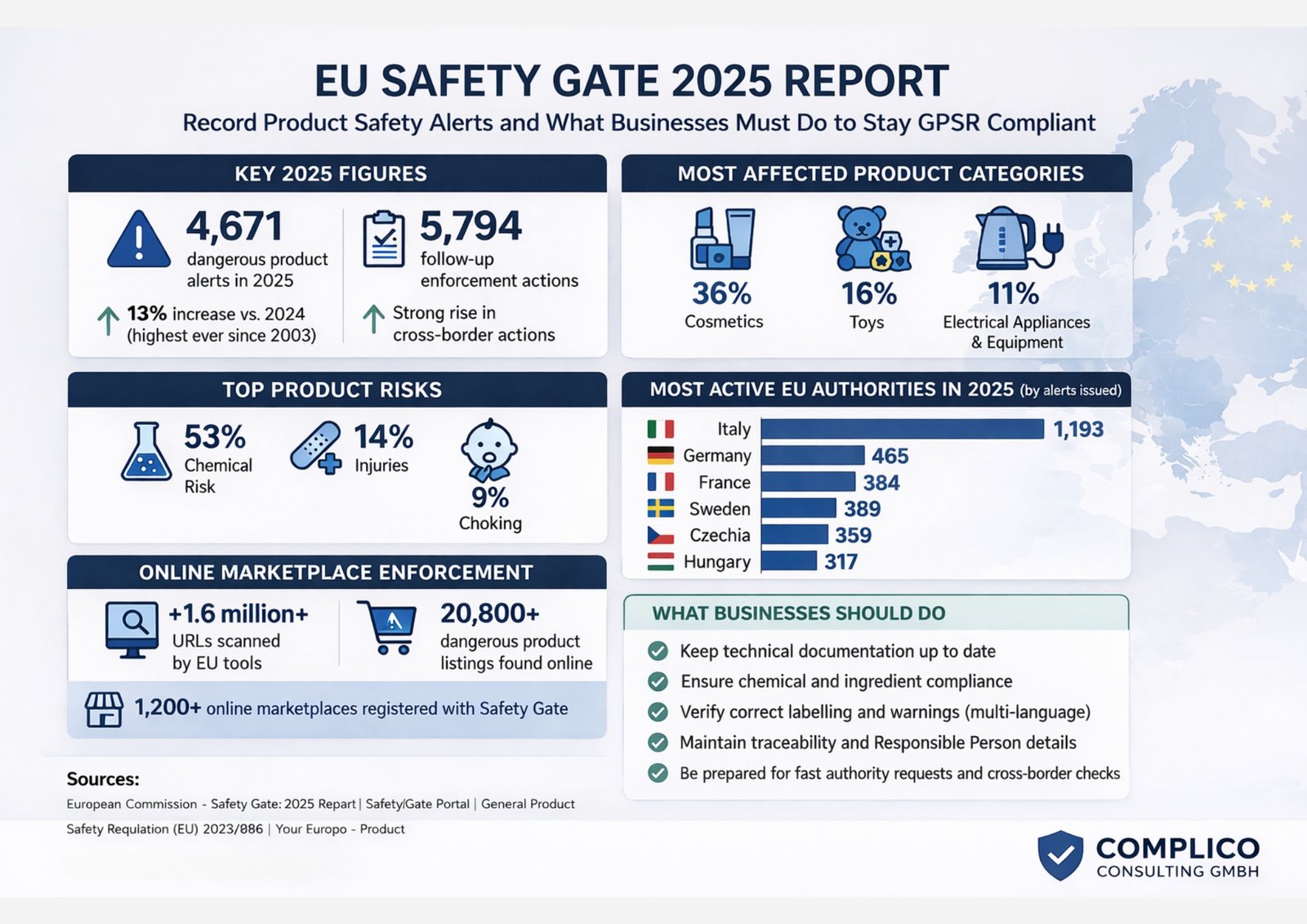
EU Safety Gate 2025 Report: Record Alerts and GPSR Compliance Guide

Top 30 EPR Europe Authority Websites Every E-commerce Seller Must Know

France EPR Rules Expanded: What International Sellers Need to Know

WEEE Compliance Crackdown in Europe: Authorities Target Non-Registered Sellers

EU Battery Regulation 2025: New EPR Obligations for Importers
