
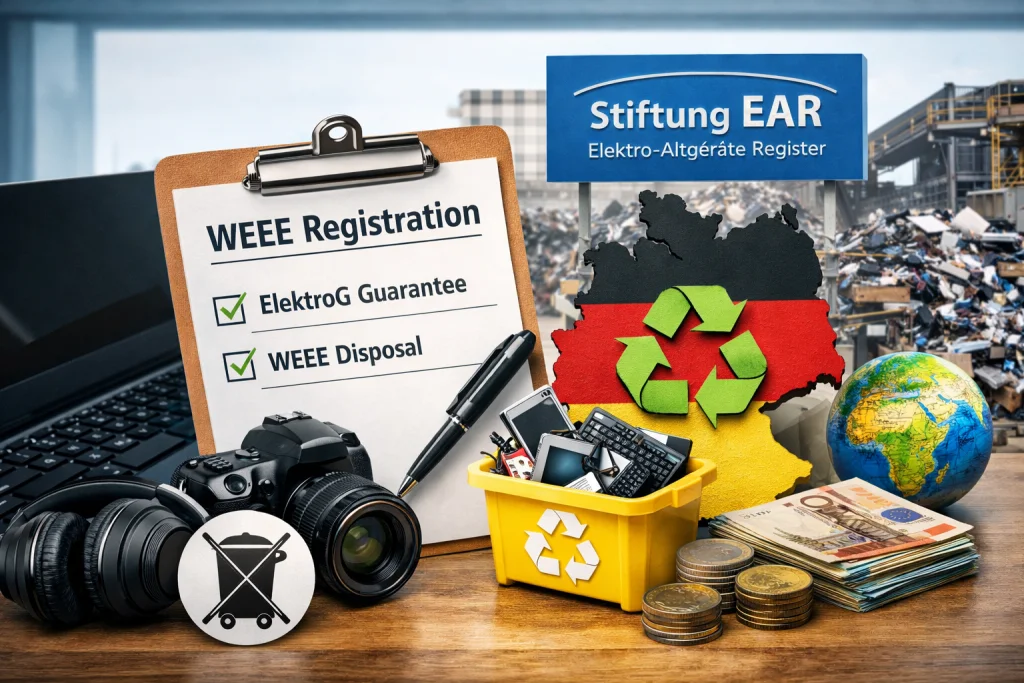
Complete Guide for Selling Electrical Products in Germany
If you plan to sell electrical or electronic equipment in Germany, WEEE registration is legally required before your products can enter the market. Many international sellers are surprised to learn that Germany has some of the strictest electronic waste compliance rules in Europe.
Under the German Electrical and Electronic Equipment Act (ElektroG), companies must register their products, provide financial guarantees, and organize proper disposal of electronic waste.
Failure to comply can result in:
- Sales bans on marketplaces like Amazon
- Heavy fines from authorities
- Product delisting
- Legal liability for environmental damage
In this guide, we explain everything you need to know about WEEE registration, ElektroG guarantees, and WEEE disposal in Germany.
What Is WEEE Registration ?
WEEE registration is the process of registering electrical and electronic equipment before selling it in Germany.
The registration is managed by the German authority:
Stiftung EAR
Every manufacturer, importer, or brand owner must register their products with Stiftung EAR to receive a WEEE registration number.
This number proves that the company complies with Germany's electronic waste recycling regulations.
Without this registration:
- You cannot legally sell electronics in Germany
- Marketplaces may automatically block listings
Which Products Require WEEE Registration ?
Under the Waste Electrical and Electronic Equipment Directive, most electrical products require WEEE registration.
Common categories include:
Small household appliances
Examples:
- Hair dryers
- Electric shavers
- Coffee machines
- Electric toothbrushes
IT and telecommunications equipment
- Laptops
- Routers
- Smartphones
- Tablets
Consumer electronics
- Headphones
- Speakers
- TVs
- Cameras
Lighting equipment
- LED lamps
- Fluorescent lights
Electrical tools
- Power drills
- Electric saws
Even products with built-in batteries or electronic components may require WEEE registration.
Who Must Register for WEEE in Germany ?
According to ElektroG, the following businesses must complete WEEE registration:
Manufacturers located in Germany
Companies producing electronics domestically.
Importers
Businesses importing electronics into Germany from outside the EU.
Online sellers
Companies selling directly to German consumers via marketplaces like:
- Amazon
- eBay
- Otto
Brand owners
Companies selling products under their own brand name.
If your company is located outside Germany, you must appoint an authorized representative to complete the registration.
What Is an ElektroG Guarantee ?
An ElektroG guarantee is a financial security requirement under German WEEE law.
This guarantee ensures that funds are available to cover the future recycling and disposal of electronic waste.
It protects the German recycling system in case a manufacturer:
- goes bankrupt
- leaves the market
- stops selling products
The guarantee must be provided before WEEE registration approval.
Common guarantee types include:
- Bank guarantees
- Insurance guarantees
- Recycling compliance schemes
Each product category requires its own financial calculation based on expected sales volume.
Understanding WEEE Disposal Obligations
WEEE disposal refers to the collection, recycling, and environmentally safe disposal of electronic waste.
Manufacturers are responsible for ensuring that their products are properly recycled when they reach end-of-life.
Germany operates a national recycling system where:
- Consumers return electronic waste to collection points
- Local authorities collect the products
- Recycling partners process the materials
Manufacturers must finance this system through WEEE compliance schemes.
These schemes manage:
- waste collection
- recycling logistics
- environmental reporting
Steps for WEEE Registration in Germany
Here is a simplified overview of the WEEE registration process.
Step 1 – Determine Product Category
Each product must be assigned to a specific WEEE category.
Step 2 – Appoint an Authorized Representative
Non-German companies must appoint a representative located in Germany.
Step 3 – Obtain an ElektroG Guarantee
A financial guarantee must be submitted to Stiftung EAR.
Step 4 – Submit Application to Stiftung EAR
All required documentation is submitted through the EAR portal.
Step 5 – Receive WEEE Registration Number
Once approved, you will receive your official WEEE Reg. Nr.
Example format:
DE12345678
Step 6 – Marketplace Compliance
You must provide your WEEE number to marketplaces.
Platforms like Amazon automatically verify the number with Stiftung EAR.
WEEE Marking Requirements
All electrical products must display the crossed-out wheeled bin symbol.
This marking indicates that the product:
- cannot be disposed of in household waste
- must be recycled through proper channels
Additional requirements may include:
- manufacturer identification
- date marking
Failure to apply correct labeling can result in market surveillance penalties.
WEEE Reporting Obligations
After registration, companies must submit regular reports.
Typical reporting requirements include:
- quantity of products placed on the market
- product category volumes
- recycling contributions
Reports are usually submitted monthly or quarterly depending on the product type.
Penalties for Non-Compliance
Violating WEEE regulations can lead to severe consequences.
Possible penalties include:
- fines up to €100,000
- product sales bans
- marketplace suspension
- legal enforcement actions
German authorities actively monitor compliance through Stiftung EAR.
How Complico Consulting GmbH Helps with WEEE Registration
Navigating WEEE compliance can be complex, especially for international companies.
Complico Consulting GmbH provides complete support for WEEE registration in Germany.
Services include:
- WEEE registration with Stiftung EAR
- ElektroG guarantee solutions
- Authorized representative services
- WEEE reporting support
- Compliance consultation for marketplaces
This allows companies to focus on selling products while ensuring full regulatory compliance.
Final Thoughts
Germany’s electronic waste regulations are among the most detailed in Europe. Businesses selling electrical products must ensure proper WEEE registration, ElektroG guarantee submission, and WEEE disposal compliance.
Without these requirements, companies risk sales bans and financial penalties.
Working with an experienced compliance partner such as Complico Consulting GmbH can simplify the process and help your business enter the German market smoothly.
FAQs:
What is WEEE registration in Germany ?
WEEE registration is a legal requirement for companies that sell electrical or electronic equipment in Germany. Businesses must register their products before placing them on the market. The registration is handled by Stiftung EAR, which issues an official WEEE registration number confirming compliance with Germany’s electronic waste regulations.
Who needs WEEE registration in Germany ?
Manufacturers, importers, brand owners, and online sellers that place electrical or electronic products on the German market must obtain WEEE registration. Companies located outside Germany are required to appoint an authorized representative based in Germany to complete the registration process.
What is Stiftung EAR ?
Stiftung EAR is the official German authority responsible for managing WEEE registrations. It ensures that companies comply with the requirements of the German Electrical and Electronic Equipment Act (ElektroG), including registration, reporting, and electronic waste recycling obligations.
What is an ElektroG guarantee ?
An ElektroG guarantee is a financial security required for WEEE registration in Germany. This guarantee ensures that funds are available to cover the future recycling and disposal costs of electronic waste if a manufacturer stops selling products or becomes insolvent.
What happens if a company sells electronics without WEEE registration ?
Selling electrical products in Germany without WEEE registration is illegal. Companies may face fines of up to €100,000, product sales bans, and removal of listings from online marketplaces.
How long does WEEE registration take in Germany ?
The WEEE registration process usually takes between 6 and 12 weeks. The timeframe depends on the product category, submission of required documentation, and approval by Stiftung EAR.
Do Amazon sellers need WEEE registration ?
Yes, sellers on marketplaces such as Amazon must provide a valid WEEE registration number before selling electrical products to customers in Germany. Marketplaces verify this number through the official registry.
How can Complico Consulting help with WEEE registration ?
Complico Consulting GmbH assis