


.
.
Entering the European market isn’t just about logistics—it’s about liability.
For non-EU businesses selling into Europe, one critical question determines whether your shipments flow smoothly or get blocked at the border:
Who is legally responsible for your goods ?
If you get this wrong, the consequences are serious—shipment delays, VAT losses, fines, or even product bans.
This guide breaks down the real difference between Importer of Record (IOR) and Indirect Representation, and how they fit into modern EU compliance frameworks like the Union Customs Code, General Product Safety Regulation (GPSR), and Extended Producer Responsibility (EPR).
1. Why Non-EU Companies Need EU Representation
Under the Union Customs Code, only an entity established in the EU can act as a customs declarant.
That creates a fundamental barrier:
- A US, UK, or Asian company cannot clear EU customs directly
- Even under DDP shipping, you still need an EU-based legal entity
- This entity must have an EORI number and legal presence
👉 So you need someone inside the EU to act on your behalf.
That’s where two roles come in:
- Importer of Record (IOR)
- Indirect Representative
They are often confused—but legally, they are completely different.
2. What is an Importer of Record (IOR) ?
An Importer of Record (IOR) is the entity legally responsible for bringing goods into the EU.
Think of the IOR as the “owner of responsibility” at the border.
Key Responsibilities
An IOR handles far more than just customs paperwork:
- Filing customs declarations
- Paying import duties and VAT
- Ensuring compliance with EU regulations
- Holding technical documentation
- Managing audits and record-keeping
Most importantly:
👉 The IOR is responsible for product compliance and safety
This includes:
- CE marking
- REACH / RoHS
- GPSR requirements
The Risk Factor
If something goes wrong:
- Unsafe product? → Authorities go after the IOR
- Missing compliance? → Fines, recalls
- IP violation? → Legal action
👉 The EU does NOT chase the overseas manufacturer first
👉 They go after the EU-based IOR
Who Acts as IOR ?
- EU-based buyer (B2B case)
- Your EU subsidiary
- Third-party IOR service provider
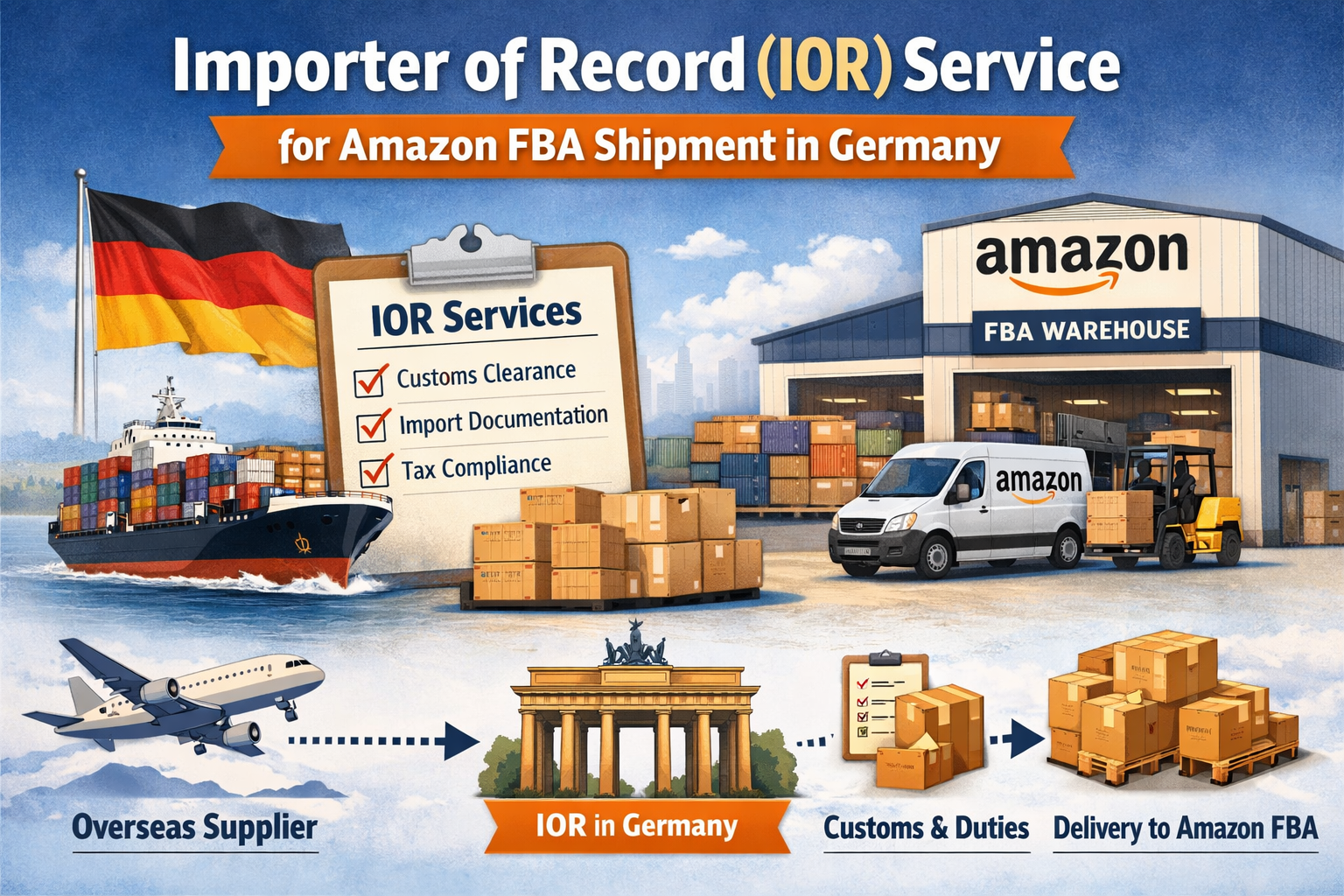
For e-commerce (e.g., Amazon FBA), it’s usually:
👉 A third-party IOR provider taking “flash title” of goods
That’s why IOR services are expensive—they carry full legal exposure.
3. What is an Indirect Representative ?
An Indirect Representative is a customs mechanism defined under the Union Customs Code.
It allows a customs broker to:
👉 Act in their own name, but on your behalf
This solves one problem:
✔ It allows non-EU companies to legally submit customs declarations
The Catch: Joint Liability
Under EU law:
👉 Both parties are jointly and severally liable for customs debt
That means:
- If duties are underpaid → broker is liable
- If valuation is wrong → broker is liable
- If VAT isn’t paid → broker is liable
👉 Customs can recover 100% from either side
Why Brokers Avoid It
Because of this risk, most brokers:
- Refuse indirect representation
- Require deposits or guarantees
- Only work with trusted clients
👉 This is why many shipments fail before they even start
4. IOR vs Indirect Representative — The Real Difference
Scope
- IOR → Full responsibility (customs + compliance + product safety)
- Indirect Rep → Only customs declaration
Liability
- IOR → Product + legal + regulatory liability
- Indirect Rep → Customs debt liability only
Ownership
- IOR → May take ownership (flash title)
- Indirect Rep → Never owns goods
Function
- IOR → Enables market access
- Indirect Rep → Enables customs clearance
👉 Key insight:
You often need BOTH—but they are not the same role
5. GPSR & EPR: Why This Matters More Than Ever
Modern EU regulations have changed the game.
GPSR (Product Safety)
Under the General Product Safety Regulation:
- Every product must have an EU-based economic operator
- This entity ensures safety compliance
- Must cooperate with authorities
👉 Without this, goods can be blocked at customs
EPR (Environmental Compliance)
Under Extended Producer Responsibility:
- You must register for:
- Packaging
- Electronics (WEEE)
- Batteries
👉 The “importer” is often treated as the producer
Critical Reality
- Indirect Representative → does NOT handle GPSR or EPR
- IOR → often becomes responsible for both
👉 Customs clearance alone is no longer enough
6. Real-World Scenarios
Scenario 1: Amazon FBA Seller (Non-EU)
- Amazon won’t act as IOR
- Seller has no EU entity
✅ Solution:
- Hire third-party IOR
- Broker acts as indirect rep
Scenario 2: EU Buyer (B2B)
- EU company buys goods
✅ Solution:
- Buyer acts as IOR
- Broker uses direct representation
Scenario 3: DDP Shipping (Non-EU Seller)
- Seller promises full delivery
✅ Solution:
- Broker acts as indirect rep
- Seller must handle compliance separately
7. Strategic Takeaways
✔ Do NOT assume brokers will take liability
✔ Customs and compliance are now interconnected
✔ GPSR makes EU presence mandatory
✔ EPR adds hidden operational costs
✔ Wrong setup = blocked goods + financial loss
8. Conclusion
The difference between an Importer of Record and an Indirect Representative is not technical—it’s strategic.
- One gets your goods into Europe legally
- The other ensures your goods are allowed to stay in the market
👉 If you misunderstand this, your entire supply chain is at risk
Secure Your EU Expansion with Complico
At Complico Consulting GmbH, we help non-EU businesses:
- Structure compliant IOR solutions
- Navigate indirect representation risks
- Align customs with GPSR & EPR
- Build scalable EU market entry strategies
Whether you’re shipping your first container or scaling across Europe, we ensure your operations are:
✔ Compliant
✔ Efficient
✔ Risk-proof
Related Posts:
Amazon Global Logistics: Importer of Record Service
What is an Importer of Record (IOR) ? EU Amazon Seller
Importer of Record: A Guide to Responsibilities & Services for the EU and UK
EOR Exporter of Record Services for Amazon Sellers in Europe
Importer of Record (IOR) Service for Amazon FBA Shipment in Germany
