
Summarize this article with:
Launching a product in the European Union is one of the most lucrative moves an e-commerce brand can make. However, the EU also boasts some of the strictest consumer protection laws in the world. With the full enforcement of the General Product Safety Regulation (EU) 2023/988 now a reality, 2025 is the year where regulatory loopholes will have officially closed. Whether you are selling via Amazon FBA, Shopify, or your own retail channels, treating compliance as an afterthought is a guaranteed path to stranded inventory, account suspensions, and hefty fines.
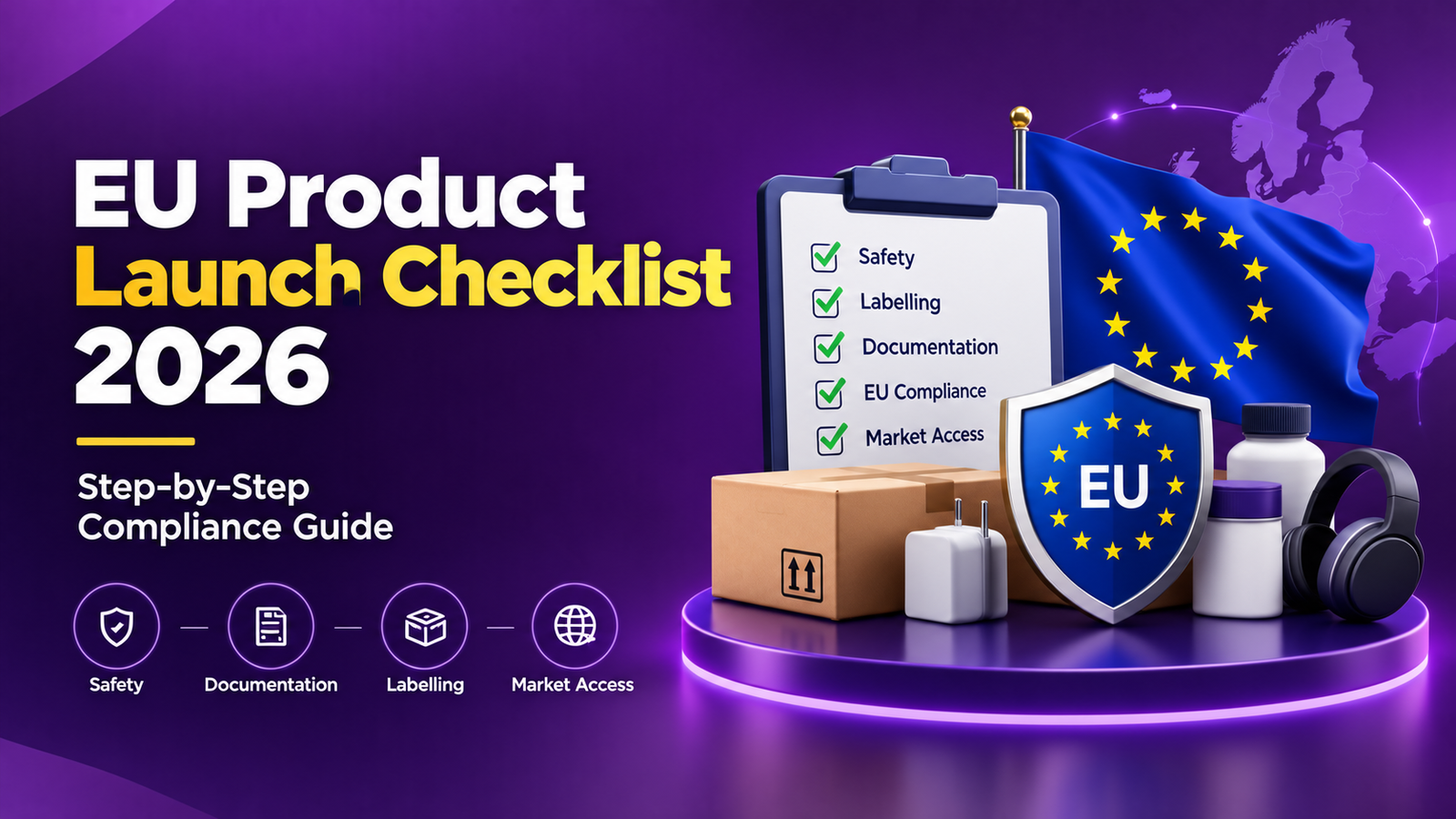
To help you navigate this complex landscape, our team at Complico Consulting GmbH has put together the ultimate EU product launch checklist. This step-by-step guide will walk you through everything from pre-launch risk assessments to post-market surveillance, ensuring your next product rollout is smooth, profitable, and 100% compliant.
Pre-Launch Strategy and Regulatory Mapping
Before you manufacture a single unit or book a freight forwarder, you must understand exactly which rules apply to your specific product. The EU does not have a "one size fits all" regulation; it relies on a framework of overlapping directives.
Identify Your Product Category and Applicable Directives
Your first task in the EU product launch checklist is to determine if your product requires a CE mark or if it falls under general safety rules.
- CE Marked Goods: Products like electronics, toys, medical devices, and personal protective equipment (PPE) must comply with specific harmonized directives (e.g., the Toy Safety Directive or the Electromagnetic Compatibility Directive), as outlined in the official EU CE marking requirements.
- Non-CE Marked Goods: If your product does not fall under a specific CE directive (like furniture, basic textiles, or manual kitchen tools), it still must comply with the General Product Safety Regulation (GPSR).
Appoint an EU Responsible Person (EURP)
If your company is based outside the EU, you cannot legally sell to European consumers without an economic operator located within the Union.
- Under Article 21 of the GPSR, you must appoint an EU Responsible Person.
- This person or entity acts as the direct contact point for EU market surveillance authorities.
- They are responsible for holding your technical documentation and supporting corrective actions, such as product recalls, if a safety issue arises.
Expert Tip from Complico Consulting: Do not use a "shell" company just to rent a European address. Authorities actively audit these setups. Your EURP must have actual access to your technical files and the expertise to communicate with regulatory bodies.
Testing, Certification, and The Technical File
The core of your compliance strategy lives in a digital folder known as the Technical File. Authorities and marketplaces will request this documentation to prove your item is safe.
Conduct Third-Party Laboratory Testing
You cannot simply claim your product is safe; you must prove it through accredited testing.
- Work with an ISO 17025 accredited laboratory to test your product against the specific EN (European Norm) standards identified in Phase 1.
- For electronics, this might involve RoHS testing (Restriction of Hazardous Substances).
- For items intended for children, strict chemical and mechanical testing is mandatory, in line with age restriction requirements.
Draft a GPSR Risk Assessment
A major update for 2025 is the strict requirement for a formal risk assessment. You must identify potential hazards related to your product's design, materials, and foreseeable consumer misuse. This assessment must be documented and included in your Technical File.
Prepare Product-Specific Documentation
Depending on your niche, you will need specialized paperwork:
- Safety Data Sheets (SDS): Required for anything containing chemicals or batteries. See our SDS service.
- Cosmetic Product Safety Report (CPSR): If you sell cosmetics or fragrances, an SDS is not enough; a CPSR prepared by a qualified toxicologist is legally mandatory.
- Declaration of Conformity (DoC): For CE-marked products, the manufacturer must sign a legally binding DoC stating that the item meets all applicable EU requirements.
Packaging, Labeling, and Traceability
A product can pass every lab test in the world, but if the packaging is wrong, it will be seized at customs or flagged by Amazon. Labeling errors are the most common reason for product launch delays.
Design Compliant Physical Labels
Your product packaging must feature specific, permanent information. According to our EU product launch checklist, your label must include:
- Manufacturer Details: Name and full postal address of the manufacturer.
- EURP Details: The name, full postal address, website, and email of your EU Responsible Person.
- Traceability Markers: A batch, lot, or serial number linking the physical item to its production records.
- Product Identification: A model number or SKU that exactly matches the information in your Technical File.
Translate Safety Warnings
The EU is a multilingual market. Safety warnings and user instructions must be clear, specific, and translated into the official language(s) of every member state where the product is sold. English-only warnings in countries like Germany or France will result in immediate non-compliance flags.
Extended Producer Responsibility (EPR) and WEEE
Environmental compliance is just as critical as consumer safety. The EU requires sellers to take financial responsibility for the lifecycle of their products, particularly concerning waste.
Register for EPR (Packaging)
If you are shipping a product in a box, a polybag, or even wrapping it in tape, you are introducing packaging waste into the EU market.
- You must register with the packaging registries of the specific countries you sell in (e.g., the LUCID database in Germany).
- You must pay eco-contributions based on the weight and material of your packaging.
- Ensure you display mandatory recycling logos, such as the Triman logo for France or the Tidyman logo where applicable.
Register for WEEE and Batteries (If Applicable)
If your product has a battery or a plug, it falls under the Waste Electrical and Electronic Equipment (WEEE) directive.
- You must register with the national WEEE registry in each target country.
- You must report the tonnage of electronics you place on the market.
- The "crossed-out wheelie bin" logo must be permanently printed on the product itself.
Digital Compliance and Marketplace Readiness
In 2025, compliance extends to your digital storefront. Marketplaces like Amazon are legally required to verify your documentation before allowing your listing to go live.
Update Online Listings for Distance Sales
Under GPSR, consumers must be able to see critical safety information before they click "Add to Cart". Your e-commerce listing must display:
- The manufacturer's name and contact information.
- The EU Responsible Person's details.
- Any relevant safety warnings or hazard pictograms in the local language.
Navigate the Amazon "Manage Your Compliance" Portal
If you are an Amazon FBA seller, expect to upload your documentation directly into Seller Central.
- Ensure the company name on your Declaration of Conformity or lab tests matches your Amazon seller entity exactly.
- Upload high-resolution images of your product packaging showing all sides, demonstrating that the CE mark, EURP info, and traceability numbers are physically present.
Post-Market Surveillance
Your responsibilities do not end when the product is sold.
Establish a Surveillance Plan
To maintain long-term compliance, you must actively monitor your product's performance in the real world.
- Track customer complaints and return reasons to identify potential safety defects.
- If a safety incident occurs, you must cooperate with authorities and, if necessary, coordinate a product recall via the EU's Safety Gate system.
- Regularly check your technical files to ensure testing certificates have not expired.
Secure Your European Market Entry
Tackling the EU product launch checklist can feel overwhelming, especially with the intricate demands of GPSR, EPR, and CE marking. Missing a single step can cost you thousands of euros in lost sales and regulatory fines.
You don't have to navigate this alone. At Complico Consulting GmbH, we specialize in turning complex European regulations into streamlined, actionable workflows for e-commerce brands. Whether you need a mandated EU Responsible Person, help drafting a GPSR risk assessment, or guidance on WEEE registration across member states, our experts are ready to protect your account health and keep your products selling.
Ready to launch in Europe with confidence? Reach out to Complico Consulting GmbH today to discuss your next product rollout or explore our full range of compliance services.
More About GPSR Resources
- CE Marking Requirements (European Commission)
- General Product Safety Regulation / GPSR (European Commission)
- Understanding REACH Compliance (European Chemicals Agency - ECHA)
FAQs
1. What is the EU Product Launch Checklist?
The EU Product Launch Checklist is a guide that helps businesses ensure their products meet all required EU safety, labeling, documentation, and regulatory standards before being sold in the European market.
2. Is GPSR compliance mandatory for products sold in the EU?
Yes. Under the General Product Safety Regulation (GPSR), all consumer products sold in the EU must meet strict safety requirements, even if they do not require CE marking.
3. Do I need an EU Responsible Person if my business is outside the EU?
Yes. Non-EU manufacturers and sellers must appoint an EU Responsible Person (EURP) to represent them and maintain compliance with EU regulations.
4. What documents are required before launching a product in the EU?
Commonly required documents include a Technical File, GPSR Risk Assessment, laboratory test reports, Declaration of Conformity (for CE products), and product labeling information.
5. Is CE marking required for every product?
No. CE marking is only required for products covered under specific EU directives, while other consumer products must comply with GPSR requirements.