
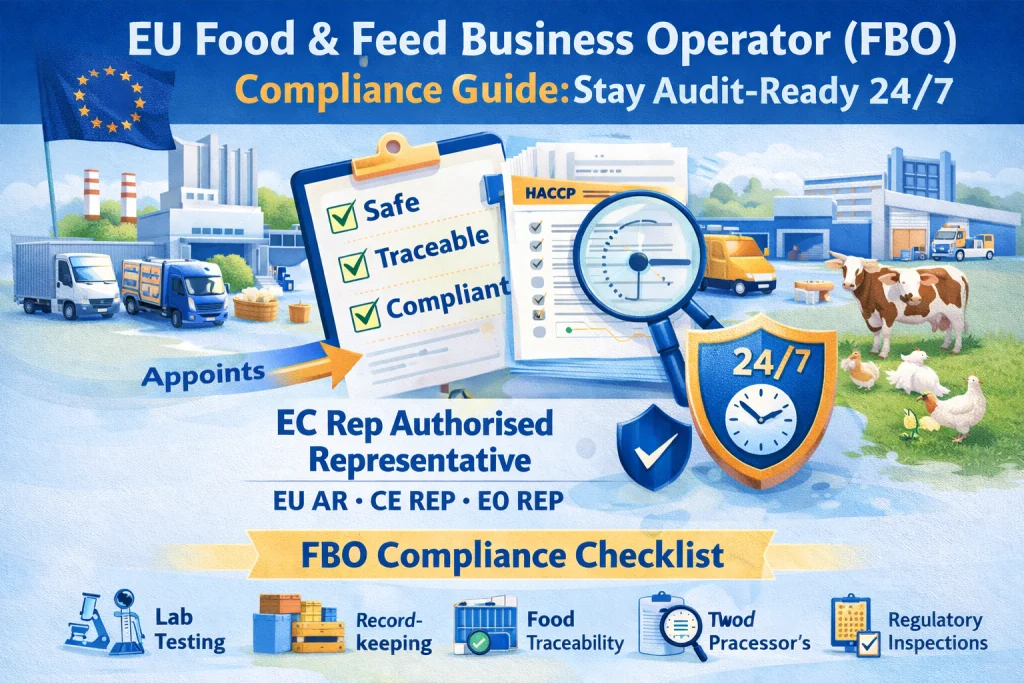
Operating within the European Union's food and feed supply chain means adhering to some of the strictest safety and traceability standards in the world. As regulatory frameworks evolve—especially with the recent 2025/2026 legislative updates maintaining your status as a compliant EU Food & Feed Business Operator requires more than just passing an annual inspection. It demands a culture of continuous, 24/7 audit readiness.
Whether you are importing raw agricultural materials, manufacturing complex compound feeds, or distributing consumer-packaged goods, the legal burden of product safety rests squarely on your shoulders. In this comprehensive guide, we will break down the core obligations under the General Food Law, explore what recent 2026 regulatory shifts mean for your operations, and provide actionable strategies to ensure your facility is always prepared for an unannounced inspection.
1. What Defines an EU Food & Feed Business Operator ?
Under the EU General Food Law (Regulation (EC) No 178/2002), an EU Food & Feed Business Operator is the natural or legal person responsible for ensuring that the requirements of food and feed law are met within the business under their control [1.2.3].
This definition is deliberately broad. You are considered an operator if your business is involved in any of the following stages:
Primary Production: Farming, harvesting, and rearing food-producing animals.
Processing & Manufacturing: Transforming raw ingredients into finished food or feed products.
Distribution & Import: Transporting, storing, or bringing food/feed products into the EU market from third countries.
Retail & Catering: Selling directly to the end consumer.
If your product crosses EU borders or moves through its internal market, you must register with national competent authorities and, in cases involving sensitive substances (like specific feed additives or foods of animal origin), obtain formal facility approval [1.1.4, 1.1.5]. Without a designated and compliant operator, products risk being blocked at customs, removed from marketplaces, or facing immediate recall [1.1.4].
2. The Core Legal Framework You Must Master
To stay audit-ready, every EU Food & Feed Business Operator must understand the foundational regulations governing the market. The legislation is designed to be preventative rather than reactive.
The General Food Law (Regulation (EC) No 178/2002)
This is the bedrock of all European food and feed legislation. It establishes the overarching principle that only safe food and feed can be placed on the Union market [1.2.2]. It legally obligates operators to:
Ensure safety requirements are met at every stage of production [1.2.2].
Implement strict, easily accessible traceability systems [1.2.2].
Initiate withdrawals and recalls immediately, and notify competent national authorities, if a product is deemed unsafe [1.2.2].
Food and Feed Hygiene Packages
Safety cannot be verified by end-product testing alone; it must be built into the manufacturing environment.
Regulation (EC) No 852/2004: Dictates the hygiene of foodstuffs, requiring businesses to implement food safety management systems based strictly on Hazard Analysis and Critical Control Points (HACCP) principles [1.2.5].
Regulation (EC) No 183/2005: Lays down parallel hygiene requirements for feed. It mandates the compulsory registration of all feed business operators and strict approval processes for facilities handling more sensitive materials, such as specific feed additives or premixtures [1.1.5].
3. The 5 Pillars of 24/7 Audit Readiness
Being audit-ready means your documentation, facility hygiene, and staff knowledge are always prepared for regulatory scrutiny. The Directorate-General for Health and Food Safety frequently evaluates national control authorities, who in turn conduct rigorous on-site audits of individual operators [1.2.1].
Here are the five critical pillars an EU Food & Feed Business Operator must consistently maintain.
Pillar 1: Impeccable Traceability
Traceability is the cornerstone of EU compliance. The law requires a "one step back, one step forward" approach [1.2.2]. You must be able to identify exactly who supplied your raw materials and exactly which businesses received your finished goods (with exceptions made for final retail consumers) [1.2.2].
Audit-Ready Actions:
Digitize your supply chain records to ensure rapid data retrieval during an emergency or unannounced inspection.
Conduct mock traceability exercises quarterly. An auditor will expect you to trace a specific batch from incoming raw material to outbound shipment within hours.
Ensure compliance with specific sector rules, such as Implementing Regulation (EU) No 931/2011 for traceability of foods of animal origin [1.2.2].
Pillar 2: Dynamic HACCP Systems
Your HACCP plan cannot be a static document gathering dust on a shelf. Regulators increasingly demand that HACCP systems reflect real-world use and reasonably foreseeable conditions [1.1.2].
Audit-Ready Actions:
Regularly validate critical control points (CCPs). If you change equipment, alter a recipe, or source a new ingredient, your HACCP plan must be formally reviewed and updated.
Ensure that hazard analyses account for consumer handling. Recent guidance emphasizes that systems must be robust enough to manage risks based on how consumers actually prepare products, not just intended ideal conditions [1.1.2].
Pillar 3: Stringent Environmental & Hygiene Monitoring
Routine cleaning is not enough. An EU Food & Feed Business Operator must prove that their hygiene protocols actually work through continuous scientific validation.
Audit-Ready Actions:
Implement a schedule of environmental swabbing for high-risk zones, specifically targeting the persistence of biofilms or pathogens like Listeria monocytogenes [1.1.2].
Validate shelf-life claims meticulously. You must present laboratory data demonstrating that products remain safe and pathogen levels stay within acceptable limits for the entirety of their intended storage and use [1.1.2].
Pillar 4: Precision in Labeling and Composition
Mislabeling is one of the leading causes of product recalls in the European Union. Labels must provide truthful, clear information regarding ingredients, allergens, nutritional values, and the exact name and address of the EU-based operator [1.1.4, 1.2.4].
Audit-Ready Actions:
Stay updated on shifting nomenclature. For instance, recent 2026 updates officially changed the authorized name of certain novel foods (e.g., from "rapeseed protein-fibre concentrate" to "defatted rapeseed powder") and mandated strict usage limitations across product categories [1.1.2].
Monitor maximum residue levels (MRLs). The European Commission frequently updates MRLs for pesticides (such as the June 2026 updates for substances like chlormequat and triclopyr), and operators must ensure their raw material suppliers comply before processing begins [1.1.2].
Pillar 5: Rapid Recall and Crisis Management
When a safety issue arises, hesitation can lead to severe penalties and public harm. The Rapid Alert System for Food and Feed (RASFF) operates 24/7 to quickly share health-related risk information across all member states [1.2.4]. If you discover a safety breach, you are legally obligated to notify authorities and initiate a withdrawal or recall [1.2.2].
Audit-Ready Actions:
Maintain a dedicated crisis management team with clear roles, rehearsed protocols, and standardized communication templates.
Establish direct, open lines of communication with your national food safety authority to facilitate transparent reporting the moment a suspicion arises.
4. Navigating the 2025/2026 Regulatory Shifts
The regulatory landscape is not static. A forward-thinking EU Food & Feed Business Operator must anticipate legislative changes to prevent sudden compliance gaps.
The Food and Feed Safety Simplification Package
Proposed in late 2025 and moving through legislative negotiations in 2026, the European Commission's Simplification Package aims to reduce administrative burdens on businesses by at least 25% without lowering high safety standards [1.1.1].
Key impacts for operators include:
Indefinite Authorizations: Historically, feed additive authorizations required renewal every ten years. The new package transitions most of these authorizations to an unlimited duration, significantly cutting down continuous paperwork [1.1.1].
Delegated Acts: Much of the technical and commercially significant detail regarding digital labeling, border logistics, and laboratory designations will be established through subsequent delegated acts [1.1.1]. Operators must track these secondary legislations closely—reading the primary omnibus text is only the starting point [1.1.1].
5. What Happens During an Official Audit ?
Understanding the methodology of an audit demystifies the process. While national authorities conduct routine local inspections, the European Commission's Directorate-General for Health and Food Safety deploys targeted audit teams to evaluate how effectively member states and non-EU exporting countries enforce EU law [1.2.1].
If your facility is selected for an accompanied site visit during a broader Commission or national audit, the team—typically composed of auditors and technical experts—will assess your operations comprehensively [1.2.1].
Common Audit Pitfalls vs. Best Practices
| Area of Assessment | Common Pitfall | Best Practice for Compliance |
|---|---|---|
| Traceability | Relying on fragmented, paper-based records that delay tracing. | Implementing automated supply chain software capable of instant batch tracking. |
| HACCP Maintenance | Failing to update the HACCP plan after introducing a new equipment line. | Treating HACCP as a living document, reviewed annually and triggered by operational changes. |
| Supplier Verification | Accepting raw materials without verifying the supplier's recent lab certificates. | Enforcing strict intake testing protocols and maintaining a rigorous supplier approval program. |
| Staff Training | Incomplete documentation of employee hygiene and safety training. | Maintaining digital, time-stamped logs of continuous education and competency checks. |
If an audit identifies serious non-compliances, authorities have the power to issue recommendations, take legal action, restrict the movement of your goods, or even impose outright bans [1.2.1].
6. Building a Culture of Compliance
True audit readiness is cultural. It requires every employee—from the procurement team sourcing raw agricultural ingredients to the warehouse staff loading finished pallets—to understand their role in food and feed safety.
Strategies for a Resilient Business:
Invest in Quality Management Systems (QMS): A robust QMS ensures procedures are clearly documented and consistently followed across your organization [1.2.5]. It centralizes your documentation, making it effortless to present organized records to an auditor upon arrival.
Conduct Internal Audits: Do not wait for the authorities to find your weak spots. Schedule unannounced internal audits conducted by cross-functional teams to identify blind spots in your hygiene practices or administrative record-keeping [1.2.5].
Prioritize Transparency: If a risk is identified, immediate collaboration with regulatory authorities is required. Full transparency protects your consumers and preserves your brand's integrity within the EU market [1.2.4].
7. Partner with Complico Consulting GmbH
The complexities of European legislation can overwhelm even the most diligent businesses. From navigating the overarching rules of the General Food Law to adapting to the latest 2026 mandates on feed additives, pesticide MRLs, and digital traceability, remaining a highly compliant EU Food & Feed Business Operator requires continuous expert oversight.
At Complico Consulting GmbH, we specialize in transforming heavy regulatory burdens into streamlined operational advantages. We help food and feed operators across the supply chain design robust HACCP plans, implement bulletproof traceability systems, and conduct rigorous mock audits to ensure you are ready for the real thing. Explore our full range of EU compliance services, including support with Safety Data Sheets and Extended Producer Responsibility registrations, or read our related guide on EU Food Business Operator services for online sellers. Contact our team today to get audit-ready.