
Summarize this article with:
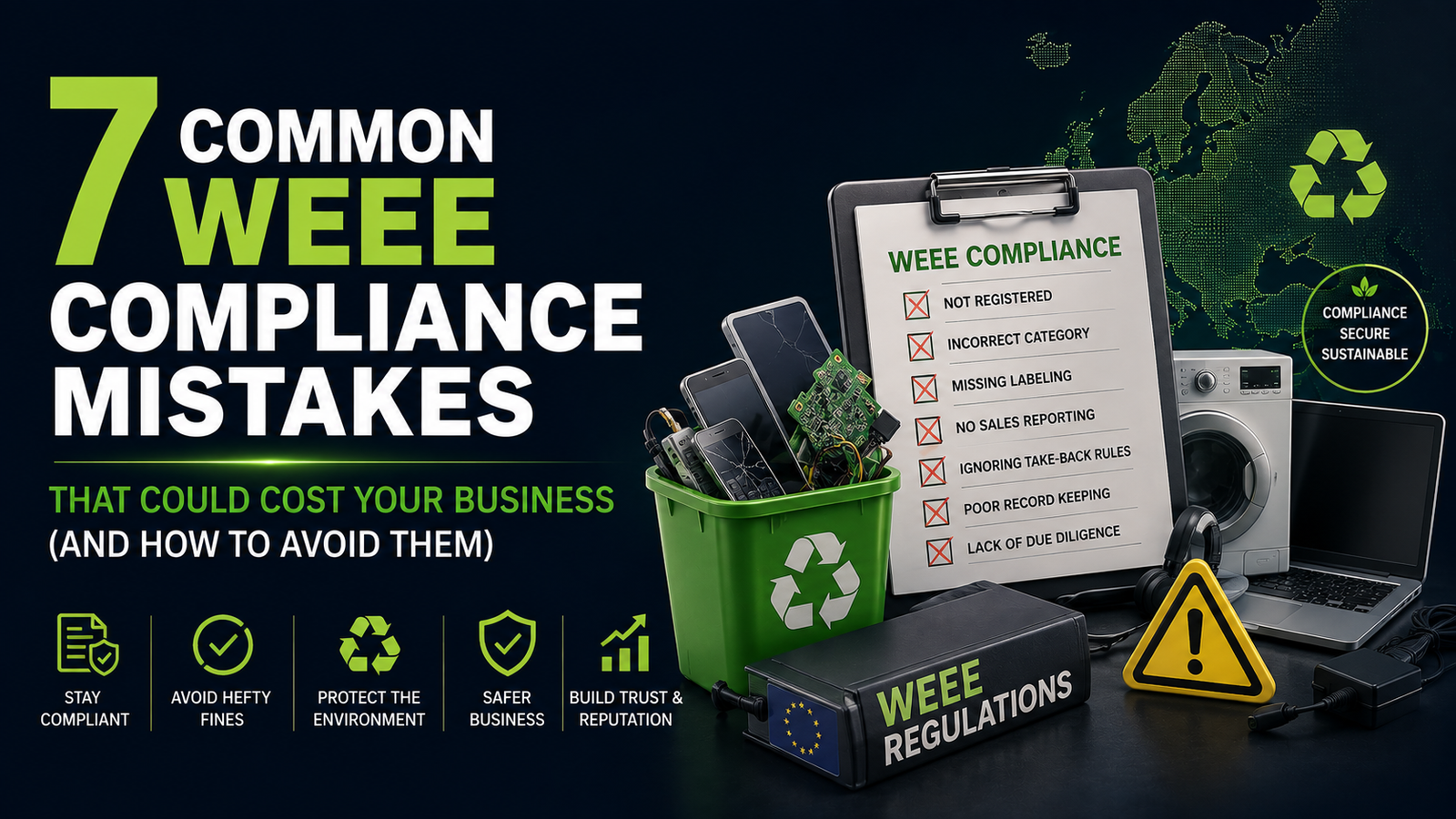
The electronic and electrical equipment (EEE) market is moving faster than ever, and unfortunately, so is the accumulation of electronic waste. Every year, the world generates upwards of 50 million metric tons of e-waste. To combat this, the European Union and other major global markets have instituted strict frameworks to ensure electronics are responsibly tracked, collected, and recycled at the end of their useful lives.
However, achieving WEEE Compliance (Waste from Electrical and Electronic Equipment) is rarely a straightforward task. While the directive may seem simple in theory if you sell electronics, you pay to recycle them the practical application is a maze of multi-country registrations, evolving product categorizations, and strict reporting deadlines.
As regulatory authorities step up their enforcement in 2026, driven by new targets under the upcoming Circular Economy Act and the glaring fact that many Member States are missing their e-waste collection goals, non-compliance is no longer an option. Failing to meet your obligations can result in blocked shipments, hefty fines, and severe reputational damage.
At Complico Consulting GmbH, we regularly audit businesses that believe they are fully compliant, only to discover critical gaps in their processes. In this comprehensive guide, we will break down the seven most common WEEE compliance mistakes companies make and provide actionable strategies to safeguard your business.
What is WEEE Compliance ? A Quick 2026 Refresher
Before diving into the mistakes, it is essential to establish a baseline. WEEE Compliance is the legal obligation stemming primarily from the European Union’s Directive 2012/19/EU. It places Extended Producer Responsibility (EPR) on businesses that manufacture, import, or sell electrical and electronic equipment.
The core principle is simple: the polluter pays. If you place an electronic product on the market, you are financially and logistically responsible for its end-of-life collection, recovery, and environmentally sound disposal.
Since August 2018, the directive has operated under an "open scope." This means that unless an item is specifically exempted (like military equipment or large-scale fixed industrial installations), any product dependent on an electric current or electromagnetic field falls under WEEE regulations.
Today, EEE is sorted into six broad categories:
- Temperature exchange equipment (e.g., refrigerators, air conditioners)
- Screens, monitors, and equipment containing screens larger than 100 cm²
- Lamps (e.g., fluorescent tubes, LEDs)
- Large equipment (e.g., washing machines, solar panels)
- Small equipment (e.g., vacuums, microwaves, audio gear)
- Small IT and telecommunication equipment (e.g., smartphones, routers, PCs)
Despite this structured approach, businesses routinely stumble over the execution. Here are the most frequent pitfalls we see.
Mistake 1: Misinterpreting the "Producer" Label
One of the most dangerous and common misconceptions is the belief that only original manufacturers have to worry about WEEE compliance. Many importers, distributors, and online sellers operate under the false assumption that compliance is the responsibility of the factory that built the product.
In the eyes of the law, a "Producer" is anyone who first places EEE on a specific national market on a professional basis.
You are a producer if you:
- Manufacture and sell EEE under your own brand.
- Resell equipment manufactured by someone else under your own brand (rebranding).
- Import EEE on a commercial basis from outside the country into the local market.
- Sell directly to end-users in a country via distance communication (e-commerce), without being established in that country.
- Operate an online marketplace (OMP) facilitating sales from non-registered overseas sellers (a major enforcement focus for 2025 and 2026).
How to Fix It:
Conduct a thorough supply chain audit. Map out exactly where your products originate and where they are being sold. If you are importing consumer electronics from Asia and selling them in Germany, you are the producer in Germany. Never assume the original manufacturer has handled the registration unless you have verified, documented proof that they have registered in your specific target country.
Mistake 2: The "One-Size-Fits-All" Europe Fallacy
Because the WEEE Directive was passed by the European Union, many companies mistakenly believe that a single European registration covers their entire operation.
This is factually incorrect. The EU provides the directive, but each of the 27 Member States implements it into their own national law.
Selling a smart thermostat in France, Germany, and Spain requires three completely separate registrations, with three different national registers (e.g., SYDEREP in France, Stiftung EAR in Germany). Each country has its own specific deadlines, fee structures, reporting formats, and Producer Responsibility Organizations (PROs).
How to Fix It:
Map your sales footprint. Wherever you place products on the market, you must understand the local legal framework. Centralize your WEEE management strategy but execute it locally. Working with a compliance partner like Complico Consulting GmbH allows you to manage multi-country obligations through a single point of contact, ensuring you do not miss obscure national deadlines or unique reporting quirks.
Mistake 3: Shoddy Data and Reporting Errors
WEEE reporting is the backbone of the entire system. Authorities rely on your data to calculate national recycling targets. Yet, many businesses treat reporting as an afterthought, leading to significant inaccuracies.
Common data errors include:
- Estimating weights: Guessing the weight of products rather than weighing them accurately. (Reporting must exclude packaging, which falls under separate Packaging EPR laws).
- Ignoring batteries: Many electronics contain batteries, which must be subtracted from the WEEE weight and reported separately under the Battery Directive.
- Misclassification: Placing an item in the wrong WEEE category, which can drastically alter your compliance costs since recycling fees vary by category.
- B2B vs. B2C confusion: Failing to distinguish between Business-to-Business (B2B) and Business-to-Consumer (B2C) sales. B2C typically requires joining a compliance scheme, while B2B often allows for individual, customized take-back agreements.
How to Fix It:
Integrate WEEE Compliance directly into your Enterprise Resource Planning (ERP) or product lifecycle systems. Establish a central "Master Data" file for every SKU that clearly outlines net weight, battery weight, dimensions, and WEEE category. Automating this data flow ensures that when a reporting deadline arrives, you pull accurate, verifiable numbers rather than scrambling for estimates.
Mistake 4: Missing the "Open Scope" Catch
Before 2018, the WEEE directive only applied to specific, listed categories of electronics. Today, we operate under an "open scope." The rule of thumb is: if it has a plug, a cable, or a battery, it is highly likely to be WEEE.
Many companies selling lifestyle or novelty products get caught off guard. We frequently see non-compliance in items like:
- Apparel with built-in LED lights or heating elements.
- RFID tags built into consumer packaging.
- Musical greeting cards.
- Motorized furniture (e.g., adjustable standing desks or massage chairs).
- E-cigarettes and vapes (which are now facing stringent, category-specific WEEE targets across Europe).
How to Fix It:
Train your procurement and product development teams on the open scope principle. If your company introduces a new product line that incorporates any electronic component—no matter how small or seemingly insignificant flag it for a WEEE assessment immediately.
Mistake 5: Neglecting Distributor Take-Back Obligations
Producers are not the only ones with WEEE obligations. Retailers and distributors also play a critical role, and many are failing to meet their legal take-back requirements.
To encourage consumer recycling, the law requires distributors to offer convenient disposal options.
- The 1:1 Rule: When a consumer buys a new electronic product, the retailer must offer to take back the old, equivalent product for free (e.g., buying a new washing machine means the retailer must haul away the old one).
- The 0:1 Rule: Retailers with a sales area for EEE greater than 400 square meters must accept small WEEE (under 25 cm on its longest side, like a smartphone or electric toothbrush) for free, even if the customer is not buying anything.
Many online retailers also forget that the 1:1 take-back rule applies to distance selling. If you ship a new TV to a customer, you must provide a free mechanism for them to return their old one.
How to Fix It:
Review your customer journey. Ensure your checkout process explicitly offers a take-back service. Partner with reverse logistics providers or local compliance schemes that specialize in picking up end-of-life products from households or local collection points. Provide clear, visible information on your website and physical store about how customers can dispose of their e-waste safely.
Mistake 6: Forgetting the Overlap with RoHS, Batteries, and GDPR
WEEE does not exist in a vacuum. A common mistake is solving the e-waste problem while inadvertently ignoring related regulatory frameworks, resulting in a false sense of security.
If you are dealing with electronics, you must also navigate:
- RoHS Directive (Restriction of Hazardous Substances): While WEEE manages the end-of-life phase, RoHS manages the beginning. It restricts the use of heavy metals (like lead, mercury, and cadmium) in the manufacturing of electronics. You cannot legally sell an item if it violates RoHS, regardless of your WEEE registration.
- Battery Directive: As mentioned earlier, batteries housed inside electronics must be accounted for and financed separately from the WEEE weight.
- GDPR (General Data Protection Regulation): For B2B companies disposing of IT assets (servers, laptops, smartphones), WEEE compliance intersects heavily with data security. Disposing of a hard drive responsibly for the environment is not enough; if customer data is not securely wiped, you risk GDPR fines that can reach up to 4% of your global turnover.
How to Fix It:
Adopt a holistic compliance strategy. Ensure your compliance teams are not working in silos. When evaluating a new product, run it through a comprehensive checklist: Does it meet RoHS chemical limits ? Are the batteries registered ? Is the WEEE reporting set up ? If disposing of internal B2B assets, utilize certified IT Asset Disposition (ITAD) vendors who provide certificates of secure data destruction alongside WEEE recycling certificates.
Mistake 7: Ignoring Eco-Design and the 2026 Circular Economy Push
Historically, WEEE Compliance was viewed purely as a downstream, end-of-life tax. Companies would simply pay their PRO invoices and move on. In 2026, this reactive approach is a costly mistake.
The European Commission and environmental watchdogs are shifting the focus upstream toward prevention, durability, and repairability under the forthcoming Circular Economy Act. A major tool being implemented is Eco-modulation.
Eco-modulation means that the financial fees you pay for WEEE compliance are tied directly to how environmentally friendly your product is. If your product is easily repairable, made from recycled plastics, and simple to dismantle, your compliance fees will be significantly lower. Conversely, if your product is glued together, contains hazardous components that complicate recycling, and cannot be repaired, you will be penalized with heavily inflated WEEE fees.
How to Fix It:
Stop viewing compliance as just an administrative hurdle and start using it as a design parameter. Involve your compliance experts in the early stages of product development. Designing for the circular economy by using standardized screws instead of adhesives, offering spare parts, and eliminating toxic chemicals will drastically reduce your long-term compliance costs and make your products more appealing to increasingly eco-conscious consumers.
The Hidden Costs of Non-Compliance
Making these mistakes does more than just trigger a warning letter. The penalties for failing to maintain strict WEEE Compliance are severe and multifaceted:
- Market Exclusion (Stop-Ship Orders): Customs authorities and major online marketplaces (like Amazon) cross-reference WEEE registration numbers. If your numbers are missing or invalid, your product listings can be suspended, or your goods can be seized at the border.
- Financial Penalties: Fines for non-compliance can range from thousands to hundreds of thousands of euros, depending on the severity and the country. Furthermore, authorities can demand retroactive payments for all the years you operated without registration.
- Reputational Damage: Consumers, B2B partners, and investors prioritize sustainability. Being publicly flagged for environmental non-compliance can instantly erode brand trust and cost you vital partnerships.
Navigating WEEE with Complico Consulting GmbH
The landscape of extended producer responsibility is shifting from a simple administrative task into a strategic operational requirement. As e-waste targets tighten and the push for a circular economy accelerates, patching compliance holes with guesswork is no longer viable.
At Complico Consulting GmbH, we specialize in removing the friction from international regulatory obligations. We do not just process paperwork; we provide strategic oversight. Our approach ensures that your data is accurate, your registrations are comprehensive across all active markets, and your business is prepared for the financial impacts of eco-modulation and the evolving Circular Economy Act.
Whether you are launching a new product, expanding into a new European market, or simply need an audit of your current EPR processes to ensure no hidden liabilities exist, we are here to provide clarity and security.
Frequently Asked Questions (FAQs)
1. What is GDPR Compliance ?
GDPR Compliance means adhering to the requirements of the General Data Protection Regulation (GDPR), the European Union's data protection law. It requires businesses to collect, process, store, and protect personal data lawfully while respecting the privacy rights of individuals within the EU.
2. Does GDPR apply to businesses outside the European Union ?
Yes. GDPR has an extraterritorial scope. If your business offers goods or services to people in the European Union or monitors their online behavior, GDPR applies regardless of where your company is located.
3. What are the penalties for non-compliance with GDPR ?
Organizations that fail to comply with GDPR may face fines of up to €20 million or 4% of their global annual turnover, whichever is higher. The amount depends on the severity, duration, and nature of the violation.
4. What is an Article 27 Representative under GDPR ?
An Article 27 Representative is a legally appointed representative based in the European Union who serves as the official point of contact between non-EU businesses, EU supervisory authorities, and individuals exercising their GDPR rights. Many companies without an EU establishment are legally required to appoint one.
5. Do Shopify, Amazon, and e-commerce sellers need GDPR Compliance ?
Yes. Businesses selling through Shopify, Amazon, Etsy, WooCommerce, or similar e-commerce platforms that collect or process personal data from EU customers must comply with GDPR. This includes obtaining valid consent where required, protecting customer information, and responding to data subject requests.
6. What is a Data Processing Agreement (DPA) ?
A Data Processing Agreement (DPA) is a legally binding contract between a data controller and a data processor. It defines how personal data will be processed and ensures both parties meet GDPR requirements for data security and privacy.
7. What is a Data Subject Access Request (DSAR) ?
A Data Subject Access Request (DSAR) allows individuals to request access to the personal data an organization holds about them. Under GDPR, businesses generally have 30 days to respond and may also need to correct, update, or delete personal data when legally required.
8. How can businesses legally transfer personal data outside the EU ?
Businesses can legally transfer personal data outside the EU by using approved safeguards such as Standard Contractual Clauses (SCCs), conducting Transfer Impact Assessments (TIAs), or relying on another lawful transfer mechanism recognized under GDPR.
9. Is cookie consent mandatory under GDPR ?
Yes. Websites that use non-essential cookies for analytics, advertising, or user tracking must obtain clear and informed user consent before those cookies are placed on a visitor's device.
10. How can Complico Consulting GmbH help with GDPR Compliance ?
Complico Consulting GmbH supports international businesses with comprehensive GDPR Compliance services, including Article 27 Representative services, GDPR compliance audits, privacy documentation, Data Processing Agreements (DPAs), cross-border data transfer assessments, and practical guidance for meeting European data protection requirements.
More About WEEE Compliance Resource:
- European Commission – Official WEEE Directive Overview
- Eurostat – EU E-Waste Statistics & Data
- Stiftung EAR – Germany’s Official WEEE Register
- ADEME SYDEREP – France’s Official EPR & WEEE Register
- UK Government (GOV.UK) – WEEE Producer Responsibilities Guidance