
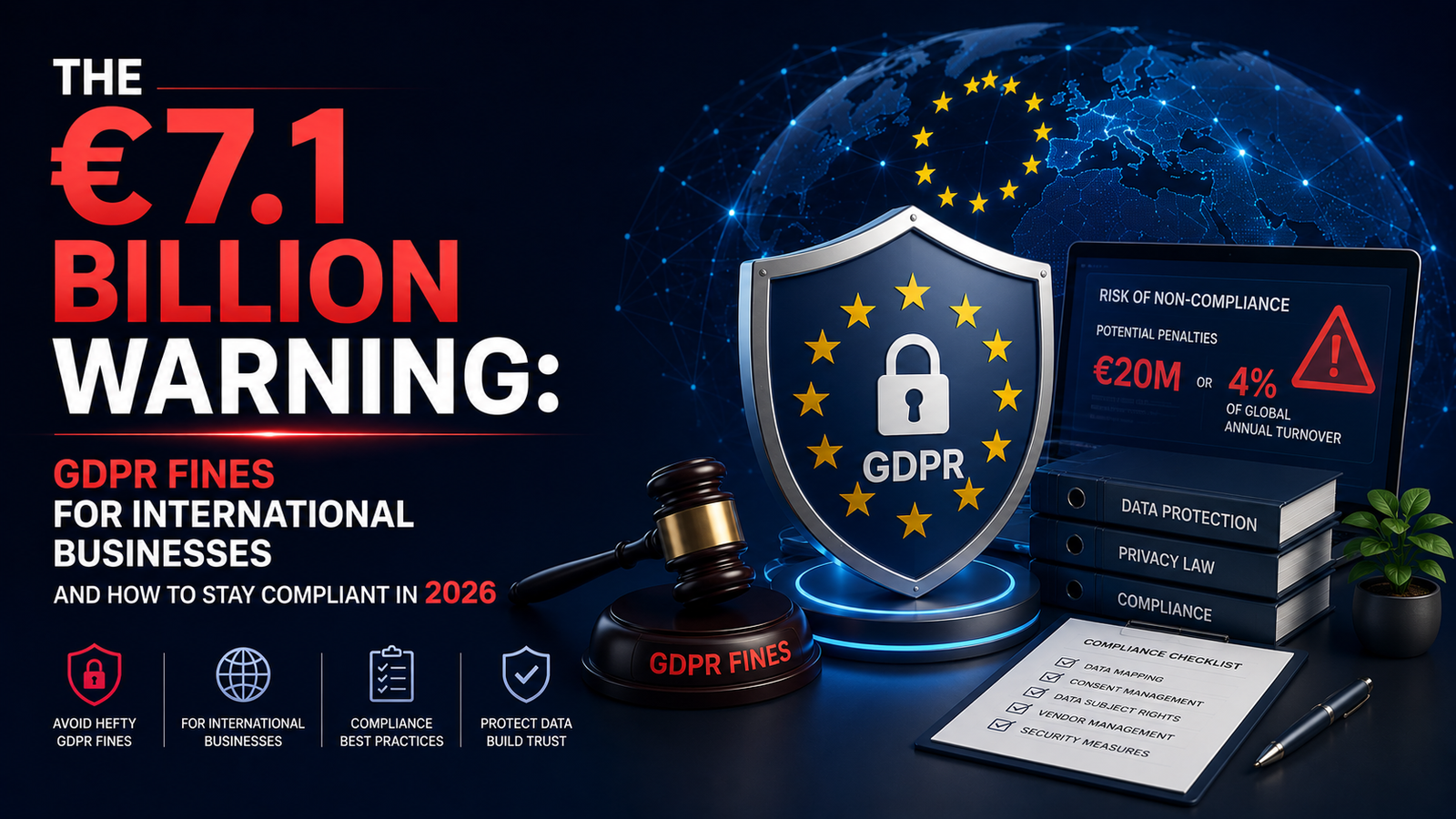
When the General Data Protection Regulation went into effect, many businesses outside of Europe assumed it was a localized rulebook. Fast forward to 2026, and data protection authorities across the EU have issued over €7.1 billion in cumulative penalties. More than 60% of that total has landed since January 2023, signaling a transition from sporadic enforcement to sustained, high-volume action.
For international manufacturers, global brands, and cross-border sellers operating in the European market, achieving strict GDPR Compliance is no longer a theoretical exercise it is a critical, non-negotiable operational requirement.
The Extraterritorial Reach of European Privacy Law
A common misconception among international businesses is that physical presence dictates jurisdiction. Article 3 of the regulation shatters this assumption: if you offer goods or services to data subjects within the European Union, or if you monitor their behavior, the rules apply to you entirely.
Whether you are an Amazon FBA seller operating out of Asia, a boutique manufacturer selling via Shopify from the United States, or an independent merchant scaling on TikTok Shop, processing the personal data of European residents brings you firmly under the regulatory umbrella. Shipping a product to a customer in France or dropping a tracking pixel on a website visitor from Germany triggers the exact same legal obligations as if your corporate headquarters were located in central Berlin.
Decoding the Biggest Enforcement Actions
While the headlines are dominated by multinational tech giants, the underlying legal principles applied in these massive fines dictate the enforcement strategy for businesses of all sizes.
- Meta (€1.2 Billion): The largest penalty to date was issued by the Irish Data Protection Commission for unlawfully transferring European user data to the United States without adequate technical safeguards.
- Amazon (€746 Million): Fined heavily by Luxembourg's regulator for executing aggressive ad targeting without valid, explicit user consent.
- TikTok (€530 Million): Penalized in 2025 for unlawfully transferring the data of European Economic Area users to servers in China.
- Shein (€150 Million): Fined by France's CNIL in late 2025 specifically for non-compliant cookie tracking and opaque consent mechanisms.
These cases share common, preventable threads: unlawful cross-border data transfers, deliberately confusing consent interfaces, and a failure to protect consumer data by default. Regulators are systematically dismantling the defense of "legitimate interests" when companies use it as a loophole to justify aggressive marketing and tracking.
Why International E-Commerce Sellers Are Vulnerable
In the modern e-commerce sector, data flows continuously. From the moment a user clicks a social media ad to the final mile of order fulfillment, personal data is collected, stored, and shared across continents.
- Marketplace Integrations: Selling on platforms like Amazon, eBay, and Etsy requires handling customer names, physical addresses, and order histories. While the marketplace handles the payment processing securely, you remain a designated data controller for any information you download, store in third-party inventory systems, or utilize for post-sale marketing.
- Cross-Border Data Transfers: If your customer support infrastructure is based in the Philippines, your primary servers are hosted in the US, and your customers reside in Germany, you are engaging in continuous international data transfers. Without implementing Standard Contractual Clauses (SCCs) and conducting transfer impact assessments, these data flows directly violate European law.
- Marketing and Analytics Tracking: The recent Shein penalty underscores how seriously European regulators take cookie consent. If your digital storefront loads tracking scripts for Meta, Google, or TikTok before a European user explicitly clicks an "Accept" button, your website is operating outside of GDPR Compliance. Review our cookie policy guidance for more detail.
The Financial Anatomy of a Penalty
The financial risk of non-compliance is structural and designed to be severely dissuasive to executive boards. Fines are divided into two primary tiers:
- Standard Violations: Up to €10 million or 2% of the company's global annual turnover from the preceding financial year, whichever is higher. These penalties typically relate to administrative failures, such as failing to maintain internal records of processing activities.
- Severe Violations: Up to €20 million or 4% of global annual turnover, whichever is higher. These apply to breaches of the regulation's core principles, such as processing data without a lawful basis, violating cross-border transfer rules, or ignoring the fundamental rights of data subjects.
Crucially, a company's "turnover" is assessed at the global group level. A corporate parent cannot shield itself from liability by placing its European sales operations into a separate, low-revenue subsidiary.
Understanding the Split: EU GDPR vs. UK GDPR
For international businesses, the European market is often viewed as a single commercial entity, but Brexit fundamentally altered the data privacy landscape. Today, companies must comply with two distinct, parallel legal frameworks: the EU GDPR and the UK GDPR.
While the core principles remain largely identical, the administrative requirements have cleanly diverged. If your e-commerce operations target consumers in both Germany and the United Kingdom, you must navigate dual regulatory environments. For example, if you lack a physical presence in both jurisdictions, you are legally required to appoint two separate representatives: an Article 27 Representative situated within an EU Member State, and a separate UK Representative recognized under UK law.
The Missing Link: GDPR Article 27 Representation
One of the most frequently overlooked requirements for international businesses is the strict mandate for local representation. If your company systematically processes the data of EU residents but does not have a registered physical establishment within the European Union, Article 27 legally requires you to appoint a representative located in one of the Member States where your data subjects reside.
This is not a simple mailbox or forwarding service. Your Article 27 Representative serves as the direct, legal liaison between your international company, European data protection authorities, and individual citizens exercising their data rights. Failing to appoint a representative is a glaring, easily identifiable violation that provides regulators with an immediate basis for enforcement action.
At Complico Consulting GmbH, operating from our headquarters in Ronneburg, Germany, we serve as the designated Article 27 Representative for international manufacturers and global e-commerce sellers. We provide a vital bridge, ensuring that your business has a recognized legal point of contact within the EU, instantly neutralizing a major, structural compliance vulnerability.
Core Pillars of GDPR Compliance in 2026
Achieving and maintaining robust GDPR Compliance requires a systematic, documented approach to global data governance.
1. Data Mapping and the RoPA
You cannot protect data systems you cannot see. The foundation of compliance is a comprehensive Record of Processing Activities (RoPA). This living document must detail exactly what personal data you collect, the specific legal justification for collecting it, where it is stored globally, who has internal access to it, and the timeline for its secure deletion.
2. Valid Consent and Lawful Basis
Every single data processing activity requires a defined legal basis under Article 6. If you rely on user consent particularly for email marketing campaigns or targeted behavioral advertising—that consent must be freely given, specific, informed, and highly unambiguous. Pre-ticked boxes, hidden opt-outs, or forced consent mechanisms are strictly prohibited.
3. Transparent Privacy Policies
Your outward-facing privacy policy must be easily accessible and written in plain, comprehensible language. It needs to explicitly detail your data retention periods, the rights of the data subjects, and the direct contact details of your Article 27 Representative. Vague language about sharing user data with "third-party affiliates" no longer passes regulatory scrutiny.
4. Robust Data Processing Agreements (DPAs)
Whenever you share European customer data with a third-party service provider whether it is an international logistics provider, a CRM software, or an email marketing platform you must have a legally binding Data Processing Agreement in place. This contract forces your vendors to adhere to the exact same strict data protection standards that you are legally obligated to follow.
5. Mastering Data Subject Access Requests (DSARs)
Under the regulation, any individual has the right to ask your company what personal data you hold about them, request a comprehensive copy of it, ask for it to be corrected, or demand its permanent deletion (the "Right to be Forgotten"). When a European consumer submits a DSAR, the clock starts immediately; you have exactly 30 days to fulfill the request. For international sellers managing data across Shopify, Amazon fulfillment centers, and marketing databases, locating and securely deleting a single user's footprint requires streamlined internal protocols.
6. Technical Security and Incident Response (Article 32 & 33)
Article 32 requires companies to implement appropriate technical measures to secure data, including encryption both in transit and at rest, alongside strict internal access controls based on the principle of least privilege. Furthermore, under Article 33, if a data breach occurs that poses a risk to individuals, you have exactly 72 hours to notify the relevant supervisory authority. This requires having a tested incident response plan ready to deploy instantly.
Securing Your European Market Entry
The regulatory landscape in Europe is continually expanding. Beyond data privacy, international sellers must seamlessly navigate the General Product Safety Regulation (GPSR), Extended Producer Responsibility (EPR) packaging laws, and stringent CE marking requirements. Data privacy does not exist in a vacuum; it is part of a broader, unified European strategy to protect consumers both physically and digitally.
Ignoring European data protection laws is a strategic gamble with odds that worsen every year. With the deployment of automated scanning tools, a sharp rise in consumer complaints, and heavily coordinated regulatory actions across Member States, the likelihood of an international business operating under the radar is rapidly approaching zero.
Building a defensible, sustainable compliance posture requires localized expertise. At Complico Consulting GmbH, we guide international businesses through the deep complexities of the European regulatory framework. Whether you need an appointed Article 27 Representative, a technical audit of your cross-border data transfers, or a comprehensive strategy for achieving GDPR Compliance alongside your GPSR and EPR obligations, our team in Germany provides the authoritative, practical support necessary to protect your revenue and your brand's reputation in the European market.
Frequently Asked Questions (FAQs)
1. What is GDPR Compliance ?
GDPR Compliance means following the requirements of the General Data Protection Regulation (GDPR), the European Union's data protection law. It requires businesses to collect, process, store, and protect personal data lawfully while respecting the privacy rights of EU residents.
2. Does GDPR apply to businesses outside the European Union ?
Yes. GDPR has an extraterritorial scope. If your business offers products or services to people in the EU or monitors their online behavior, you must comply with GDPR even if your company is located outside Europe.
3. What are the penalties for non-compliance with GDPR?
GDPR violations can result in fines of up to €20 million or 4% of a company's global annual turnover, whichever is higher. The exact penalty depends on the severity and nature of the violation.
4. What is an Article 27 Representative under GDPR ?
An Article 27 Representative is a legally appointed representative located in the European Union who acts as the official contact between non-EU businesses, EU data protection authorities, and individuals exercising their data rights. Many businesses without an EU establishment are legally required to appoint one.
5. Do Shopify, Amazon, and e-commerce sellers need GDPR Compliance ?
Yes. Online sellers using platforms such as Shopify, Amazon, Etsy, or WooCommerce that collect personal data from EU customers must comply with GDPR. This includes obtaining valid consent, protecting customer data, and responding to data subject requests.
6. What is a Data Processing Agreement (DPA) ?
A Data Processing Agreement (DPA) is a legally binding contract between a business (data controller) and a service provider (data processor). It ensures that customer data is processed according to GDPR requirements and appropriate security standards.
7. What is a Data Subject Access Request (DSAR) ?
A DSAR allows individuals to request access to the personal data a company holds about them. Businesses generally have 30 days to respond and may also need to correct or delete personal data if requested under GDPR.
8. How do businesses legally transfer personal data outside the EU ?
International data transfers usually require approved safeguards such as Standard Contractual Clauses (SCCs), Transfer Impact Assessments (TIAs), or another lawful transfer mechanism recognized under GDPR.
9. Is cookie consent mandatory under GDPR ?
Yes. If your website uses non-essential cookies for analytics, advertising, or tracking, users must provide informed and explicit consent before those cookies are placed on their devices.
10. How can Complico Consulting GmbH help with GDPR Compliance ?
Complico Consulting GmbH helps international businesses achieve GDPR Compliance by providing Article 27 Representative services, GDPR audits, privacy documentation, cross-border data transfer assessments, Data Processing Agreements (DPAs), and practical compliance support for companies operating in the European market.
More About GDPR Compliance Resources:
- The Official GDPR Legal Text (EUR-Lex)
- The GDPR Enforcement Tracker Database
- The European Commission GDPR Compliance Portal
- The UK Information Commissioner's Office (ICO)
- The European Data Protection Board (EDPB)
Ready to close the gap on your GDPR obligations? Explore our services overview, check our compliance pricing, or contact our team for a tailored GDPR audit. You may also find our guides on Article 27 representation and the biggest GDPR fines in Europe useful, or browse more insights on our blog.