
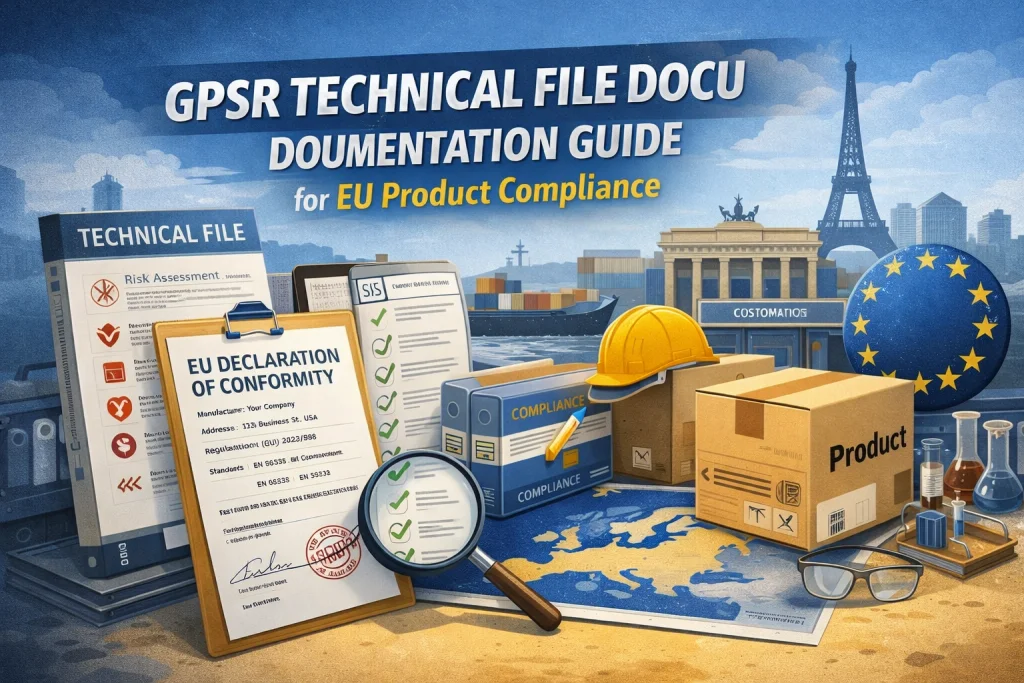
Introduction
Under the EU General Product Safety Regulation (GPSR), manufacturers and importers placing products on the European Union market must maintain a technical file for each product.
This documentation, often referred to as part of the Digital Product Passport, demonstrates that a product complies with EU safety requirements. It serves as proof that the product has been properly assessed for safety before being made available to consumers.
The technical file typically contains product specifications, risk assessments, testing reports, safety instructions, and the EU Declaration of Conformity. Authorities may request this documentation at any time to verify compliance.
At Complico Consulting GmbH, we assist global companies and eCommerce sellers in preparing GPSR-compliant technical documentation for products sold across Europe.
What is a GPSR Technical File ?
A GPSR technical file is a collection of documents that demonstrates how a product meets EU safety standards.
Manufacturers and importers must prepare this documentation before placing a product on the market.
The purpose of the technical file is to provide sufficient information to determine whether the product can be considered safe according to EU product safety rules.
Key Components of a GPSR Technical File
A complete technical file should include the following sections.
1. Product Identification
This section clearly identifies the product and its variants.
Typical information includes:
- Product name and model number
- SKU or variant identification
- Labels and packaging artwork
- Product manuals or instructions
- High-quality photos or diagrams of the product
These elements ensure that the product can be easily identified by authorities and consumers.
2. Product Description and Specifications
The documentation should include a detailed explanation of the product’s characteristics.
Important information includes:
- Technical specifications
- Intended use of the product
- Reasonably foreseeable misuse scenarios
- Materials used in manufacturing
- Bill of Materials (BOM)
Providing detailed specifications helps authorities understand how the product was designed and manufactured.
3. Risk Assessment and Safety Measures
A documented risk assessment is one of the most important parts of GPSR compliance.
Manufacturers must evaluate potential hazards during:
- Normal product use
- Misuse scenarios
- Product interactions with other items
Risk mitigation measures should include:
- Safety warnings
- Product design improvements
- Clear user instructions
- Compliant labeling
Supporting evidence such as test reports or Safety Data Sheets should also be included when applicable.
4. Compliance with EU Legislation and Standards
The technical documentation should reference all relevant EU laws and standards used during product development.
Examples may include standards under:
- Toy Safety Directive 2009/48/EC
- Low Voltage Directive 2014/35/EU
- Electromagnetic Compatibility Directive 2014/30/EU
Including these references demonstrates that the product has been designed according to recognized safety guidelines.
5. Testing and Certification
Testing documentation is essential for proving compliance.
The technical file should include:
- Laboratory test reports
- Testing methods used
- Dates and locations of testing
- Accredited testing laboratory details
Examples of common testing standards include:
- EN 71 for toy safety
- EN 60335 for electrical appliances
- EN 12520 for furniture safety
Testing should be conducted by competent and accredited laboratories to ensure reliability.
6. Traceability and Market Responsibility
Traceability is required to identify the product’s origin and supply chain.
Documentation should include:
- Manufacturer details
- EU Responsible Person information
- Supplier records
- Batch or lot traceability logs
Additional regulatory obligations may also apply, such as:
- Waste Electrical and Electronic Equipment Directive (WEEE Directive) registration
- Packaging compliance requirements
- Product safety notification systems like Safety Gate
7. Ongoing Compliance and Quality Monitoring
GPSR compliance is not a one-time process. Manufacturers must maintain continuous safety monitoring.
This includes:
- Quality control procedures
- Incident tracking
- Product improvement records
- Corrective actions
- Recall documentation if necessary
Maintaining updated documentation is also important for the upcoming EU Product Liability rules.
Internal Risk Assessment Requirements
Manufacturers must perform an internal safety analysis when preparing technical documentation.
Key product aspects to evaluate include:
- General product characteristics
- Design and product presentation
- Intended users (children, elderly, general consumers)
- Interactions with other products
- Cybersecurity features if applicable
- Software updates or evolving product functionalities
The goal of this analysis is to confirm that the product does not pose safety risks to consumers.
GPSR Technical Documentation Template
The European Commission has provided a recommended structure for preparing GPSR technical documentation.
The template typically includes:
Product Identification
- Brand name
- Product name
- Model or serial number
- Product description
- Product images
- Packaging description
Product Characteristics
- Material composition
- Physical and functional characteristics
Risk Analysis
- Identification of potential hazards
- Measures taken to reduce or eliminate risks
Compliance Documentation
- Applicable European standards
- Product warnings and instructions for use
Is Laboratory Testing Required?
The GPSR requires that all products sold in the EU meet general safety requirements.
In many cases, compliance is demonstrated by applying European harmonized standards.
Examples include:
- EN 71 series for toys
- EN 12520 for seating furniture
- EN 60335 for household electrical appliances
If a product falls within these categories, relevant laboratory testing reports should be included in the technical file.
Testing must be conducted by accredited laboratories to ensure regulatory acceptance.
EU Declaration of Conformity (DoC)
A critical document within the technical file is the EU Declaration of Conformity.
The DoC is a formal statement confirming that a product complies with applicable EU legislation.
The document must include:
- Manufacturer or importer name and address
- Product description
- Reference to relevant EU legislation (such as Regulation (EU) 2023/988)
- Applicable standards
- Name and signature of the responsible person
- Date of issue
Authorities may request this document at any time, and it must also be accessible to the EU Responsible Person.
Responsible Person Under GPSR
The Responsible Person ensures that the product complies with EU regulations before being sold in the market.
The role depends on the business structure:
- EU manufacturers automatically act as Responsible Persons
- EU importers take responsibility when manufacturers are outside the EU
- Fulfillment service providers may act as Responsible Persons for online sellers
- Manufacturers can appoint an Authorized Representative
The Responsible Person must maintain access to the technical documentation and cooperate with regulatory authorities.
Who Reviews GPSR Technical Documentation?
Technical files are usually not submitted for approval in advance.
However, they must be available for review by national market surveillance authorities.
Documentation may be requested during:
- Customs inspections
- Product safety investigations
- Market surveillance audits
- Consumer complaints
Online marketplaces such as Amazon may also request compliance documentation for certain products.
Consequences of Non-Compliance
Failure to maintain proper technical documentation may result in serious consequences, including:
- Product recalls
- Market access restrictions
- Listing removal from online marketplaces
- Regulatory fines and penalties
The GPSR aims to ensure that all consumer products sold in the EU meet high safety standards.
How Complico Consulting GmbH Supports Businesses
Complico Consulting GmbH provides expert support to manufacturers, importers, and online sellers navigating EU product safety regulations.
Our services include:
- GPSR compliance consulting
- EU Responsible Person services
- Technical documentation preparation
- Product safety labeling guidance
- Compliance support for Amazon and eCommerce sellers
We help businesses ensure their products meet EU safety requirements before entering the European market.
FAQ – GPSR Technical Documentation
1. What is a GPSR technical file?
A GPSR technical file is a collection of documents that proves a product complies with the requirements of the EU General Product Safety Regulation (GPSR). It typically includes product specifications, risk assessments, test reports, labeling details, and the EU Declaration of Conformity.
2. Who must prepare GPSR technical documentation?
Manufacturers and importers placing products on the market in the European Union must prepare and maintain technical documentation to demonstrate that their products meet EU safety requirements.
3. What documents should be included in a GPSR technical file?
A complete technical file usually includes:
- Product identification details
- Product specifications and materials list
- Risk assessment documentation
- Laboratory test reports
- Safety instructions and labeling
- EU Declaration of Conformity
- Traceability information for the supply chain
4. Is laboratory testing required under GPSR?
Testing may be required depending on the product category. Products such as toys, electronics, or household appliances may require testing based on applicable European safety standards.
5. What is the EU Declaration of Conformity?
The EU Declaration of Conformity is a formal document where the manufacturer or importer confirms that the product complies with relevant EU legislation, including the EU General Product Safety Regulation (GPSR).
6. Who is the Responsible Person under GPSR?
The Responsible Person is the entity responsible for ensuring product compliance in the EU. This may be:
- The manufacturer located in the EU
- An importer in the EU
- An appointed authorized representative
- A fulfillment service provider in certain cases
7. How long must GPSR technical documentation be kept?
Manufacturers and importers must typically keep technical documentation for at least 10 years after the product has been placed on the market to ensure it can be provided to authorities if requested.
8. Who reviews GPSR technical documentation?
Technical documentation may be reviewed by national market surveillance authorities in EU member states or requested by online marketplaces such as Amazon when verifying product compliance.
9. What happens if a product does not have proper technical documentation?
If a company cannot provide required technical documentation, authorities may:
- Block the product from entering the EU market
- Require product recalls
- Impose regulatory penalties
- Remove listings from online marketplaces
10. Do Amazon sellers need GPSR technical documentation?
Yes. Sellers listing products on marketplaces like Amazon must ensure their products comply with EU product safety regulations and maintain proper technical documentation when requested.
References