
Summarize this article with:
The European Union represents one of the most lucrative consumer markets in the world, boasting over 440 million consumers with high purchasing power. However, for businesses based outside the EU—whether you operate from the United States, the UK, Australia, or Asia—accessing this market is not as simple as launching a localized website and shipping international orders.
The EU operates under a highly sophisticated, rigorously enforced regulatory framework. Over the next few years, specifically leading into 2026, the regulatory landscape is shifting dramatically from passive compliance to active, digital traceability. If you are an eCommerce brand, a B2B supplier, or a manufacturer, ignorance of these laws is not a valid defense. Fines are steep, market bans are swift, and border rejections are becoming commonplace for non-compliant goods.
Mastering sell in EU compliance is no longer just a legal box to check; it is a fundamental competitive advantage. This comprehensive guide, brought to you by Complico Consulting GmbH, breaks down the core pillars of EU product compliance, the critical 2026 updates, and the exact steps non-EU businesses must take to operate legally and profitably in the European market.
The 2026 Paradigm Shift: Why Traceability is the New Standard
If you have been selling into the EU for years, you might assume your current compliance strategies are sufficient. They likely aren't.
2026 is shaping up to be a watershed year for European product compliance. The EU is rolling out a wave of new directives and regulations that share a unified theme: transparency. It is no longer enough to simply declare that a product is safe or environmentally friendly. You must be able to prove it digitally, tracking materials, chemicals, and digital elements across highly complex supply chains.
What makes 2026 distinct is the sheer volume of overlapping deadlines. Environmental reporting, supply chain transparency, and strict AI governance are all converging simultaneously. For non-EU businesses, this means your documentation, your packaging, and your European legal representation must be perfectly aligned.
Pillar 1: General Product Safety and the "Responsible Person"
The absolute foundation of sell in EU compliance is ensuring that your product poses no risk to European consumers.
The General Product Safety Regulation (GPSR)
Replacing older directives, the General Product Safety Regulation (GPSR) went into effect in December 2024, with market surveillance intensifying heavily through 2025 and 2026. The GPSR is a horizontal safety net; it applies to virtually all consumer products, including hybrid and digital products.
Under the GPSR, risk assessments must be rigorous and documented throughout the product's entire lifecycle. Furthermore, product labeling must be crystal clear, including identification features, safety instructions, and the contact information of the responsible party.
The EU Authorized Representative (The "Responsible Person")
Here is the most critical hurdle for non-EU businesses: You cannot sell into the EU from the outside without an economic operator established inside the Union.
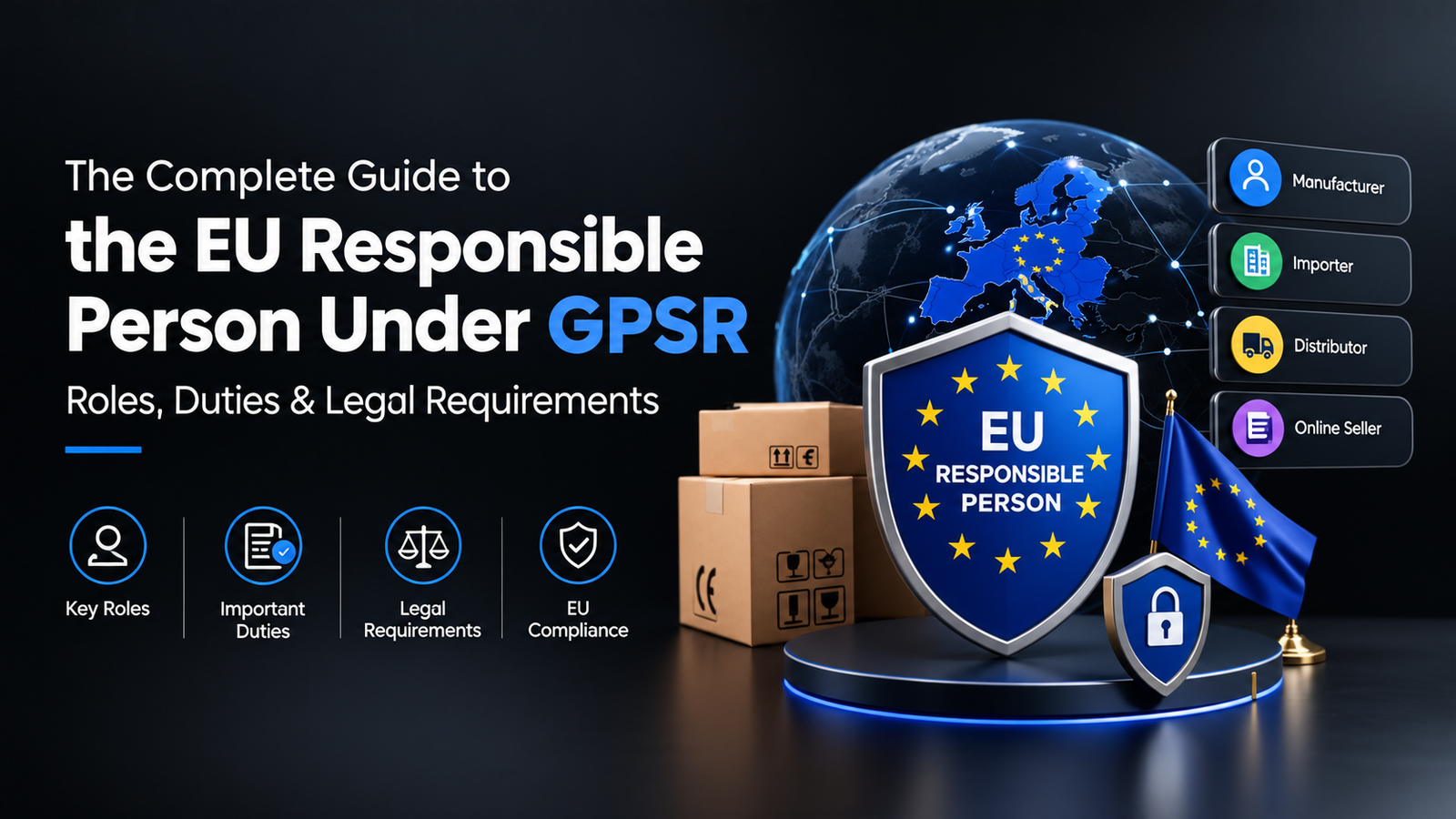
Under Article 16 of the GPSR, a "Responsible Person" must be entrusted with tasks relating to the safety of each product. If you do not have a physical subsidiary in an EU member state, you must appoint an EU Authorized Representative (EAR). This entity acts as your legal liaison with European market surveillance authorities. If a product is deemed unsafe, your EAR is the one held accountable on European soil. Marketplaces like Amazon now actively block listings that do not have a registered EU Responsible Person.
Pillar 2: Environmental Sustainability and Circularity
The EU is aggressively transitioning toward a circular economy. If you place physical goods on the European market, you are financially and legally responsible for the waste they eventually become.
Extended Producer Responsibility (EPR)
EPR dictates that whoever introduces a product or its packaging into an EU market bears the cost of its collection, sorting, and recycling.
A critical nuance for non-EU businesses is that EPR is not an EU-wide registration; it is regulated on a country-by-country basis. For example, if you sell into France and Germany, you must register with France's CITEO and Germany's LUCID database.
The regulations are becoming incredibly detailed at the national level. Take Sweden's rigorous EPR guidelines for Single-Use Plastics as a prime example: non-EU producers placing these items on the Swedish market face highly specific reporting obligations and must make financial contributions based on granular product lifecycle criteria. You must map exactly which countries you are shipping to and comply with the localized EPR laws of each specific member state.
Packaging and Packaging Waste Regulation (PPWR)
The new PPWR introduces massive changes for any business shipping packaged goods into the EU. Most provisions apply from August 12, 2026.
For non-EU eCommerce brands, the PPWR mandates the appointment of a formal, EU-based Authorized Representative per country specifically for packaging compliance. This is a distinct legal requirement separate from your product safety EAR. By August 2026, your producer registration number must appear on invoices and marketplace listings, and the packaging itself will be subject to strict recyclability standards and bans on specific "forever chemicals" (PFAS) in food-contact materials.
Ecodesign for Sustainable Products Regulation (ESPR)
Starting in mid-2026, the ESPR shifts the focus to product durability and circularity. Two major changes impact non-EU businesses:
Ban on Destruction: From July 19, 2026, businesses will be banned from destroying unsold consumer products, particularly clothing and footwear. You must track and report how unsold inventory is handled.
The Digital Product Passport (DPP): Rolling out through delegated acts starting in 2026, the Digital Product Passport will require products (starting with textiles, batteries, and certain electronics) to carry a data carrier—usually a QR code—that links to detailed, centralized lifecycle and sustainability data.
Pillar 3: Digital Compliance and Data Privacy
If your products are "smart," connected to an app, or if you simply monitor European consumers via your website, physical product safety is only half the battle.
GDPR and the Article 27 Representative
If your company is based outside the EU but monitors the behavior of EU citizens or offers them goods and services, you are subject to the General Data Protection Regulation (GDPR).
Much like the product safety rules, GDPR Article 27 requires non-EU controllers and processors to designate a local EU Representative to act as a contact point for data subjects and supervisory authorities. This is an essential step for non-EU eCommerce brands processing European customer data.
The EU AI Act and Cyber Resilience Act (CRA)
The regulatory net for digital products is tightening.
The EU AI Act: Applying broadly from August 2026, this act reaches beyond the Union's borders. If your product utilizes AI and is placed on the EU market, or if the system's output is used within the EU, you must comply with its risk-tiered obligations.
The Cyber Resilience Act (CRA): For products with digital elements (connected hardware or software), the CRA sets strict lifecycle cybersecurity requirements. Non-EU manufacturers must ensure security-by-design and report vulnerabilities to EU authorities.
New Consumer Digital Rights
On the purely eCommerce front, by June 19, 2026, the EU requires a mandatory "withdrawal button." Online traders must offer consumers a clear, easy-to-use cancellation mechanism for digital and distance contracts.
Pillar 4: CE Marking and Sector-Specific Regulations
Beyond the general safety and sustainability rules, specific categories of goods require CE marking. This marking is a manufacturer's self-declaration that the product meets the specific essential requirements of all relevant European directives.
If you sell machinery, medical devices, personal protective equipment (PPE), electronics, or toys, you fall under these strict sector-specific regimes.
Toys: The new EU Toy Safety Regulation applies from 2026 (with enforcement rolling out later) and relies heavily on the Digital Product Passport to replace traditional declarations of conformity.
Chemicals (REACH & RoHS): The REACH regulation strictly limits the presence of hazardous chemicals in products sold in the EU. You must be able to trace and verify the chemical composition of your products down to the base materials, supported by accurate safety data sheets.
The Non-EU Business Action Plan: 5 Steps to Achieving Compliance
Achieving sell in EU compliance can feel overwhelming, but it is highly manageable when approached systematically. Here is your operational roadmap for 2026 readiness:
Step 1: Audit Your Product Portfolio
Evaluate every product you intend to sell in the EU. Does it require a CE mark ? Does it fall under the upcoming Digital Product Passport sectors (like textiles or electronics) ? Identify the chemical composition to ensure REACH compliance, and review your digital touchpoints to assess your GDPR and AI Act exposure.
Step 2: Map Your Market Footprint
Because Extended Producer Responsibility (EPR) for packaging, electronics, and batteries is handled at the national level, you must know exactly which countries you are shipping to. Create a matrix of your target member states and identify the specific EPR registration portals (e.g., LUCID in Germany, CITEO in France) you need to register with.
Step 3: Appoint Your EU Representatives
Do not wait until your goods are held up at customs.
Secure an EU Authorized Representative (EAR) for general product safety and CE-marked goods.
Secure country-specific Packaging Authorized Representatives before the August 2026 PPWR deadline.
Appoint an Article 27 Representative for GDPR data compliance if you are directly tracking or marketing to EU consumers.
Step 4: Overhaul Packaging and Documentation
Your technical files must be immaculate. Ensure that your product labeling includes the contact details of your EU Responsible Person, applicable CE marks, and localized safety warnings. Begin preparing your supply chain for the Digital Product Passport by requesting exact material and recyclability data from your overseas manufacturers.
Step 5: Partner with Compliance Experts
EU regulations are not static; they are a constantly evolving ecosystem. Managing multi-country registrations, tracking rapid legislative changes, and maintaining technical files requires specialized expertise.
At Complico Consulting GmbH, we specialize in bridging the gap between non-EU businesses and European regulatory requirements. We provide the strategic oversight, technical documentation auditing, and localized representation required to keep your supply chain moving seamlessly.
Final Thoughts
The era of shipping products cross-border without a second thought is over. The European Union has drawn a hard line in the sand regarding consumer safety, digital privacy, and environmental sustainability. However, this strict regulatory environment should not be viewed purely as a barrier to entry.
By proactively investing in sell in EU compliance, you are future-proofing your business, building profound trust with European consumers, and positioning your brand as a premium, responsible player on the global stage. Start mapping your compliance roadmap today—2026 is closer than it appears.