
Summarize this article with:
Navigating the landscape of environmental compliance in Europe can feel like an uphill battle, especially with the rapid evolution of Extended Producer Responsibility (EPR) laws. If your business manufactures, imports, or sells certain plastic products in the German market, you are likely already aware of the seismic shift brought about by the Einwegkunststofffondsgesetz (EWKFondsG)—Germany's Single-Use Plastic Fund Act.
Whether you are an e-commerce seller, a traditional retailer, or a global manufacturer, complying with Germany's regulations for Single-Use Plastics is no longer optional; it is a strict legal requirement. Marketplaces like Amazon have already enforced strict verification checks, and the German Environment Agency (Umweltbundesamt, or UBA) is actively monitoring compliance via its central digital platform, DIVID.
At Complico Consulting GmbH, we understand that regulatory jargon and bureaucratic portals can drain your time and resources. We have developed this comprehensive, humanized, and highly detailed 10-step guide to help you master your Single-Use Plastics EPR registration in Germany.
Understanding the Legal Framework: The EWKFondsG
Before diving into the exact steps, it is essential to understand the "why" behind the regulation. The EWKFondsG was enacted to transpose the EU Directive on the reduction of the impact of certain plastic products on the environment. The core philosophy is simple: whoever introduces Single-Use Plastics into the German market must bear the financial responsibility for the cleanup, waste management, and public disposal of those items once they become litter in streets and parks.
To manage this, the UBA established a centralized digital fund management platform called DIVID. Through this platform, producers pay an annual eco-levy based on the volume of plastics they introduce to the market. These funds are then distributed to eligible municipalities and public waste management authorities who handle the physical cleanup.
Who is Considered a "Producer" ?
Under the law, the definition of a "producer" is incredibly broad. You are required to register if you are the first entity to commercially make specific Single-Use Plastics available on the German market. This includes:
Domestic Manufacturers: Companies producing and selling these items within Germany.
Importers: Businesses bringing these goods into Germany from abroad. If you need support with import formalities, our IOR/EOR service can help streamline the process.
Distance Sellers: International e-commerce merchants (e.g., selling via Amazon, Shopify, or eBay) who sell directly to German end-consumers.
If you fall into any of these categories, you must strictly follow the registration and reporting procedures.
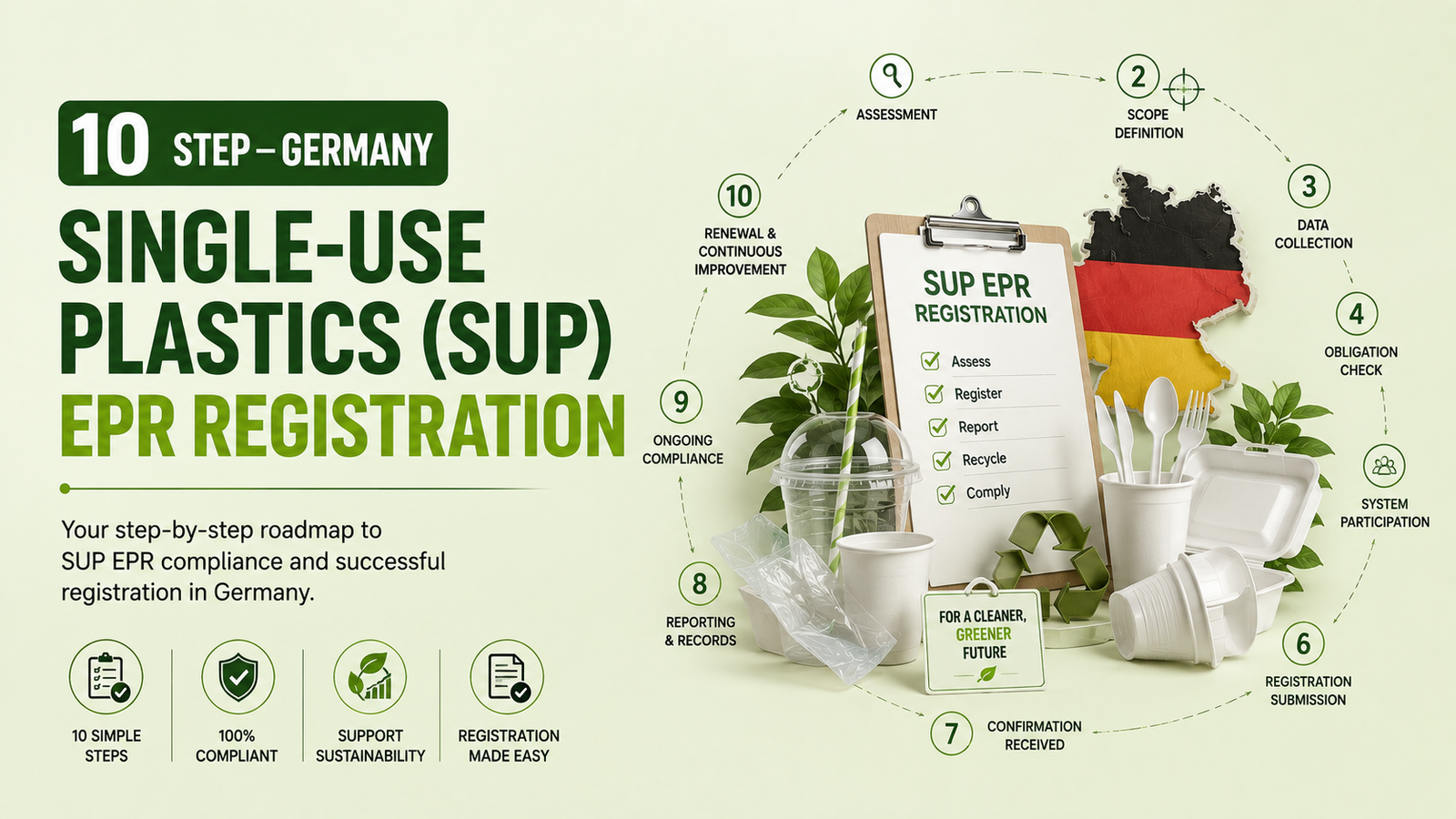
The 10-Step Germany Single-Use Plastics (SUP) EPR Registration Process
Completing your registration accurately is crucial to avoid severe operational disruptions. Here is the step-by-step roadmap to achieving full compliance.
Step 1: Determine Your Product Applicability
Not all plastics fall under this specific legislative umbrella. The very first step is to conduct a thorough portfolio audit to see if your products are classified as Single-Use Plastics subject to the eco-levy.
According to Annex 1 of the EWKFondsG, the affected product categories generally include:
Food Containers: Receptacles used for food intended for immediate consumption (e.g., take-out boxes, fast-food packaging).
Beverage Cups & Containers: Cups and containers holding up to 3 liters of liquid, including their caps and lids.
Flexible Packaging: Wrappers and film packaging containing food intended for immediate consumption. This overlaps with obligations under Germany's broader packaging law (VerpackG), so it's worth reviewing both regimes together.
Lightweight Carrier Bags: Plastic shopping bags with a wall thickness of less than 50 micrometers.
Wet Wipes: Pre-moistened wipes intended for personal care or household cleaning.
Balloons: Except for industrial balloons not intended for consumers.
Tobacco Filters: Tobacco products featuring filters, or filters intended for use with tobacco products.
If your inventory includes any of these items, you must proceed to the next steps.
Step 2: Define Your Corporate Registration Path
The registration pathway on the DIVID platform differs entirely based on where your company is legally established.
Established in Germany: You will register directly as a domestic entity.
Not Established in Germany: You cannot register directly under your own foreign corporate identity in the same way. The law dictates that foreign businesses must take an alternative route, which brings us directly to Step 3.
Step 3: Appoint an Authorized Representative (For Foreign Producers)
If your business is located outside of Germany, you are legally required to appoint an Authorized Representative (Bevollmächtigter) situated within Germany.
This representative acts as your legal proxy. They are responsible for handling your registration on the DIVID portal, managing communications with the UBA, and ensuring that all reporting deadlines are met. You cannot bypass this step; the DIVID system requires the valid credentials of a German entity to process foreign compliance. Partnering with a reliable compliance firm ensures that this proxy relationship is handled with absolute legal security.
Step 4: Secure Your ELSTER Certificate (For Domestic Producers)
If your business is based in Germany, the UBA requires strict identity verification to access the DIVID platform. You must log in using an ELSTER certificate (the standard secure electronic certificate used for German tax declarations).
Before attempting to create your DIVID account, ensure that your company's ELSTER certificate is up-to-date and accessible to the person tasked with managing your environmental compliance. Trying to register without this will result in an immediate roadblock.
Step 5: Execute the DIVID Portal Registration
Once your prerequisites are sorted—either via an ELSTER certificate or an Authorized Representative—it is time to create your account on the official DIVID platform (einwegkunststofffonds.de).
During this step, you will be asked to provide foundational company master data. This includes your corporate address, tax identification numbers, commercial register details, and contact information for the compliance officer in charge. Accuracy here is paramount, as discrepancies between your commercial register and your DIVID inputs can delay the approval of your account.
Step 6: Submit Brand and Product Classification Data
Creating an account is only the beginning. You must now systematically list the Single-Use Plastics you place on the market.
The UBA requires producers to register the specific types of products (matching the Annex 1 categories) and the associated brand names under which they are sold. This step can be highly sensitive. Borderline products—items where it is ambiguous whether they qualify as a multi-use or single-use item—require careful legal assessment. Submitting standard, unverified assumptions can lead to overpaying levies or facing audits for under-reporting.
Step 7: Obtain Your Official DIVID Registration Number
Upon successful submission and processing of your data, the UBA will issue your official DIVID registration number.
This is your golden ticket for market access. The number follows a highly specific format: Role Code-XXXXXX-DE.
The "Role Code" will typically be H (for Hersteller/Manufacturer) or B (for Bevollmächtigte/Authorized Representative).
The XXXXXX represents your unique six-character alphanumeric identifier.
The DE stands for Germany.
For example, your number will look something like H-123456-DE. Safeguard this number, as it must be displayed on relevant documentation and is required by your B2B partners and sales channels.
Step 8: Verify Compliance with E-commerce Marketplaces
If you sell your goods through digital marketplaces like Amazon, eBay, or Otto, you must immediately upload your DIVID registration number to their respective compliance portals. Sellers who also handle electronics or batteries should note similar registration obligations exist under Germany's WEEE (ElektroG) rules and the German Battery Law.
Since January 2025, operators of electronic marketplaces and fulfillment service providers are legally prohibited from allowing non-compliant sellers to trade Single-Use Plastics on their platforms. Marketplaces perform automated checks matching your brand name and DIVID number with the UBA's public register. If you fail to provide this number, your product listings will be swiftly deactivated, resulting in an immediate loss of revenue and search ranking. For a broader look at marketplace obligations, see our guide on EPR compliance for Amazon FBA sellers.
Step 9: Implement Robust Internal Material Tracking
Registration is merely the setup phase; the operational phase requires continuous data management. The eco-levy you pay is calculated based on the precise weight (in kilograms) of the Single-Use Plastics you introduce to the market.
You must implement a highly reliable internal data tracking system. This means calculating the exact mass of the plastic components of your products, documenting your quantity logic, and ensuring this data can be pulled cleanly at the end of the calendar year. Standard estimations are not acceptable; the UBA expects empirical, documented mass determination.
Step 10: Submit Annual Reports and Pay the Eco-Levy
The culmination of your compliance efforts happens in the spring of each year. By May 15th annually, you must submit your volume report to the DIVID platform, detailing the exact quantities of Single-Use Plastics sold in the previous calendar year.
Once your report is submitted, the UBA will issue a tax notice (Levy Notice). The rates vary depending on the product category (e.g., the per-kilogram rate for wet wipes differs from the rate for beverage cups). You are generally required to pay this levy within one month of receiving the notice.
Crucial Note for Large Volumes: If your declared volumes are high, the UBA may require your annual notification to be audited and verified by a registered expert, public auditor, or tax advisor before submission.
Why Strict Compliance is Non-Negotiable
Ignoring the EWKFondsG is a massive risk. The German government takes environmental enforcement seriously, and the penalties for failing to register or providing falsified quantity data are severe.
Financial Penalties: The UBA can issue administrative fines of up to €100,000 per violation.
Sales Bans (Vertriebsverbot): You can be legally prohibited from placing any affected products on the German market.
Supply Chain Blacklisting: Distributors and marketplaces will drop you as a vendor to avoid being penalized themselves.
Reputational Damage: Non-compliance is often listed in public registers, damaging your brand's reputation with eco-conscious European consumers.
Secure Your Market Position with Complico Consulting GmbH
The transition toward a circular economy requires businesses to adapt rapidly. Registering for Single-Use Plastics EPR in Germany involves overcoming language barriers, navigating strict governmental portals like DIVID, and interpreting complex legal categorizations. A single misstep in product classification or mass calculation can cost your business heavily in both fines and wasted resources.
At Complico Consulting GmbH, we specialize in transforming complex EPR requirements into streamlined, manageable processes. We take the burden of regulatory red tape off your shoulders, ensuring your supply chain remains uninterrupted and your marketplace listings remain active. Explore our full range of compliance services, check our pricing plans, or contact our team today to get started with your German SUP EPR registration.
Related reading: EPR Germany: Amazon Sellers 2026 Guide and Germany Single-Use Plastics (SUP) overview. You may also find our FAQ page helpful for quick answers to common compliance questions.