
Summarize this article with:
Before diving into the mistakes, it is essential to understand what the guarantee is and why it exists.
Under the ElektroG, the core principle is that the "producer" (which in Germany can mean the manufacturer, importer, or the first distributor placing the product on the market) is financially responsible for the end-of-life disposal of their products. When consumers drop off their old televisions, smartphones, or smart home devices at municipal recycling centers, the cost of processing that e-waste must be covered by the producers.
But what happens if a producer goes out of business, files for bankruptcy, or disappears from the market ? To protect the German municipalities and taxpayers from footing the bill for orphaned e-waste, the law requires an insolvency-proof guarantee.
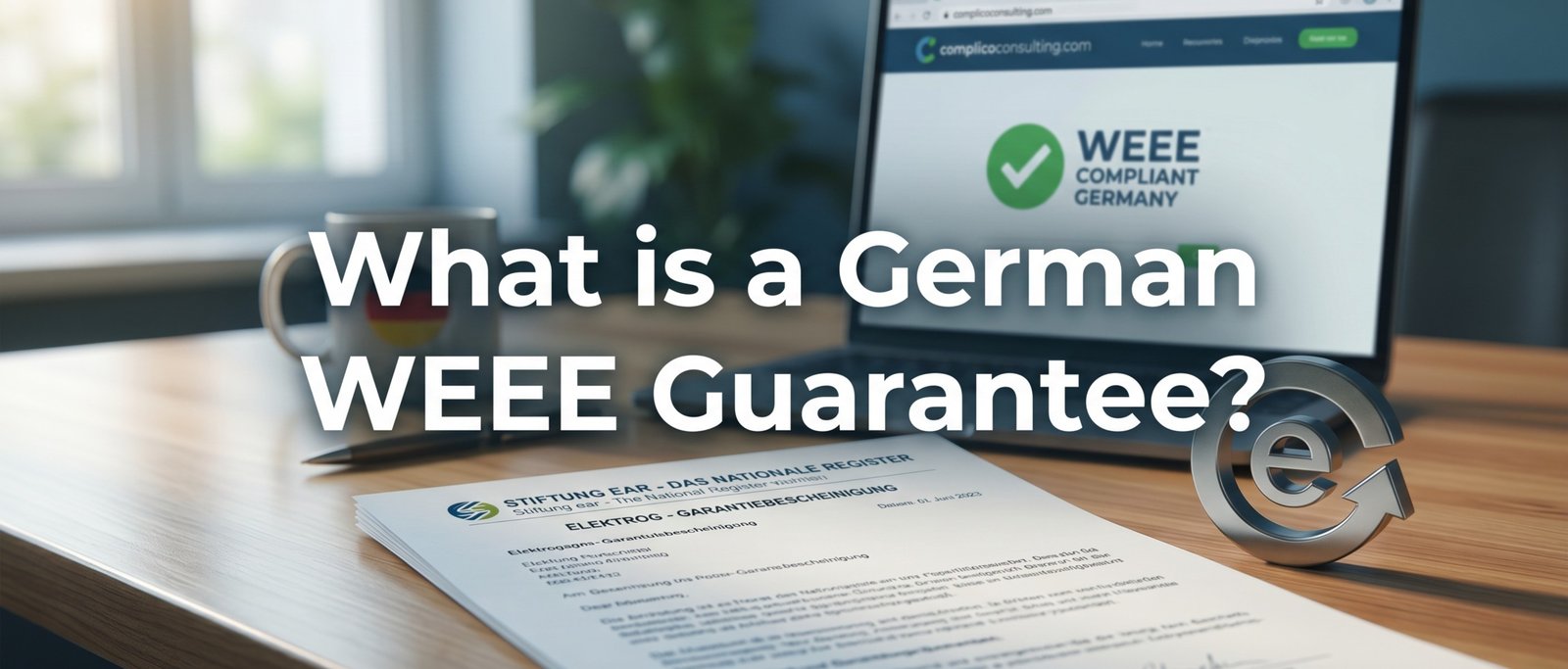
The german weee guarantee is a financial security deposit. It proves to Stiftung ear that, even in the event of your company's insolvency, funds are securely set aside to finance the collection, recycling, and disposal of the electronics you introduced to the market.
This guarantee is strictly mandatory for B2C (Business-to-Consumer) electrical and electronic equipment. Without an approved guarantee certificate, Stiftung ear will halt your registration process. Without a complete registration, you will not receive your WEEE Registration Number (WEEE-Reg.-Nr.), making it completely illegal to sell your products in Germany and triggering immediate blocks from online marketplaces. Our WEEE Germany registration guide for electronics sellers covers the basics in more depth.
Mistake #1: Confusing B2C, B2B, and Dual-Use Equipment
One of the most frequent and costly mistakes businesses make is misunderstanding how Stiftung ear classifies equipment.
Many B2B sellers operate under the assumption that because they only sell their products to other businesses, they are exempt from providing a german weee guarantee. While it is true that strictly B2B (Business-to-Business) equipment does not require an insolvency guarantee, the definition of what constitutes B2B is incredibly narrow in Germany.
Stiftung ear categorizes products based on their potential use, not your specific sales channel. If an electronic device can, in theory, be used in a private household—even if it is marketed and sold exclusively to commercial enterprises—it is classified as "dual-use." Under German law, dual-use equipment is automatically treated as B2C equipment.
The Pitfall:
A company registers a professional-grade router or a specialized lighting fixture as B2B to avoid the cost and administrative burden of a guarantee. During the Stiftung ear review process (which involves manual checks), the authority determines the product could feasibly be used in a home office or residential garage. The registration is rejected, the company is forced to re-apply as B2C, and they must immediately secure a german weee guarantee, delaying market entry by weeks or even months.
The Solution:
Always assume dual-use products are B2C. Before submitting your registration, rigorously evaluate your product catalog against Stiftung ear's guidelines. If there is any reasonable chance a private consumer could use the device, register it as B2C and arrange for your german weee guarantee from day one. If you genuinely believe your product is strictly B2B, you must provide compelling evidence to Stiftung ear to be granted an exemption, which is rarely an easy process.
Mistake #2: Using Individual Bank Guarantees Instead of Collective Systems
When foreign companies realize they need to secure an insolvency-proof guarantee, their first instinct is often to approach their corporate bank. The ElektroG does allow for "individual guarantees" in the form of a bank suretyship or a cash deposit at a local German district court. However, choosing this route is almost always a massive strategic error.
The Pitfall:
Setting up an individual bank guarantee is fraught with friction:
- Liquidity drain: A bank suretyship ties up your company's credit line, while a court deposit locks up vital cash flow that could be used for growth.
- Administrative nightmare: The language on a bank suretyship must match Stiftung ear's exact legal templates word-for-word. A single misplaced comma or translated term will result in rejection.
- Hidden auditing fees: Every time you submit an individual guarantee, Stiftung ear charges administrative fees to audit the document. If it is rejected and you must submit a corrected version, you pay the auditing fee again.
The Solution:
Savvy businesses utilize a Collective Guarantee System (kollektives Garantiesystem) provided by specialized compliance service providers in Germany.
By joining a collective system, you pay a small annual premium (often around 0.3% to 0.5% of the total calculated guarantee amount, plus a flat administrative fee). In return, the provider issues a certificate that is pre-approved by Stiftung ear. This route protects your liquidity, avoids bank credit checks, bypasses individual auditing fees, and guarantees that your certificate will be accepted by the authorities without delay. See our guide on choosing a WEEE guarantee provider in Germany.
Mistake #3: Underestimating or Miscalculating the Required Guarantee Amount
The financial value of your german weee guarantee is not a flat rate; it is a highly specific calculation based on the exact tonnage of equipment you plan to place on the German market.
The calculation uses a strict formula dictated by the EAR Rule Book:
Quantity of equipment in tonnes x Expected return rate (%) x Expected average disposal cost (€/tonne)
The Pitfall:
Companies often make two major errors here.
First, they drastically underestimate their sales volume to keep the guarantee premium low. If you exceed your planned tonnage halfway through the year, your current guarantee is exhausted. You must urgently purchase a supplementary guarantee. If Stiftung ear notices the shortfall before you do, they will issue a formal warning. If you fail to increase the guarantee amount in time, your WEEE registration will be revoked, and your marketplace listings will be taken down.
Second, companies fail to realize that the parameters (return rates and disposal costs) are set by Stiftung ear and vary wildly depending on the equipment type. Classifying a device in the wrong category can severely skew your calculation, leading to massive overpayments or dangerous under-coverage.
The Solution:
Work with an experienced compliance partner like Complico Consulting GmbH to accurately map your products to the correct Stiftung ear categories (there are currently 6 main categories and 17 equipment types). Always plan your expected tonnage with a realistic "buffer" of 10% to 20% to account for unexpected sales spikes. Monitoring your monthly placed-on-market data against your secured guarantee amount is a vital ongoing compliance task, as outlined in our step-by-step guide to obtaining a WEEE guarantee in Germany.
Mistake #4: Forgetting the Annual Renewal Obligation
EPR compliance is not a one-and-done checkbox exercise. It is a continuous operational requirement. A fundamental characteristic of the german weee guarantee is that it is only valid for a single calendar year.
The Pitfall:
A manufacturer successfully registers their business, uploads their guarantee certificate, receives their WEEE-Reg.-Nr., and successfully links it to their Amazon Seller Central account. Believing the process is finished, they move on.
When the new calendar year approaches, they fail to submit a new guarantee certificate. Stiftung ear sends warnings, which often get lost in spam folders or sent to former employees. Consequently, Stiftung ear revokes the WEEE registration. Amazon's automated systems detect the invalid number, and the seller wakes up to deactivated listings and plummeting revenue. Furthermore, even if you stop selling a product, you must maintain a guarantee for the expected lifespan of the devices you previously sold.
The Solution:
Implement a strict, centralized compliance calendar. Your german weee guarantee for the upcoming year must typically be verified by Stiftung ear before the current year ends. Partnering with a comprehensive compliance service means your renewals can be automated, ensuring there are no gaps in your registration and your marketplace presence remains uninterrupted.
Mistake #5: Data Mismatches Between EAR, Marketplaces, and the Guarantee Provider
In the era of marketplace liability, platforms like Amazon, eBay, and Kaufland are legally required to verify that their third-party sellers are EPR compliant. They do this by cross-referencing your provided WEEE-Reg.-Nr. with the official Stiftung ear public database, an issue central to our news update on Amazon EPR Europe compliance.
The Pitfall:
Even if you have secured a flawless german weee guarantee and completed your registration, a tiny clerical error can bring your sales to a halt.
If the company name on your Amazon account is "TechGadgets LLC", but the name on your guarantee and Stiftung ear registration is "Tech Gadgets L.L.C.", the automated marketplace verification bots will reject your number due to a data mismatch. The same applies to VAT IDs, primary addresses, and Brand Names. Marketplaces require 100% data parity. If the brand printed on your product doesn't perfectly match the brand listed on your Stiftung ear registration, your ASINs will be blocked.
The Solution:
Before initiating any registration process, standardize your company master data. The legal entity name, address, VAT ID (e.g., DE459923379), and exact brand typography must be identical across:
- Your business incorporation documents.
- Your marketplace Seller Central profiles.
- Your collective guarantee certificate.
- Your Stiftung ear registration portal.
Mistake #6: Non-EU Sellers Failing to Appoint an Authorized Representative
The German Electrical and Electronic Equipment Act has strict jurisdictional rules. If your company is based outside of Germany (and has no physical registered branch within the country), you cannot register with Stiftung ear directly, nor can you directly submit a german weee guarantee.
The Pitfall:
Foreign sellers often waste weeks trying to navigate the Stiftung ear portal, only to find they are legally blocked from submitting applications. Attempting to use a virtual office or a freight forwarder's address as a "German branch" is illegal and will result in the rejection of your application and potential fines.
The Solution:
Non-German companies must legally appoint a domestic Authorized Representative (Bevollmächtigter). This representative takes on the legal and financial obligations of your WEEE compliance in Germany. The Authorized Representative will secure the german weee guarantee in their name on your behalf, complete the registration, and handle the mandatory monthly tonnage reporting. Choosing a reliable, specialized representative is crucial, as their failure to comply directly impacts your ability to sell.
How Complico Consulting GmbH Secures Your Market Access
Navigating the complexities of the German WEEE directive is a daunting task that distracts you from your core business—developing great products and growing your sales. The bureaucratic hurdles, stringent definitions, and severe penalties for non-compliance mean that expert guidance is not just helpful; it is a business necessity.
At Complico Consulting GmbH, we specialize in shielding international e-commerce sellers, brands, and manufacturers from the regulatory pitfalls of the EU market. We don't just offer advice; we provide end-to-end execution.
Our WEEE Compliance Services Include:
- Authorized Representation (WEEE AR): For non-German businesses, we act as your legally appointed Authorized Representative, bearing the compliance burden so you can sell freely.
- Guarantee Procurement: We navigate the complex landscape of collective guarantee systems to secure the most cost-effective and fully compliant german weee guarantee for your specific B2C equipment.
- Stiftung ear Registration & Management: We handle the entire application process, correct equipment classification, and brand registrations to secure your vital WEEE-Reg.-Nr. without delay.
- Data Parity Verification: We audit your marketplace profiles (Amazon, eBay, etc.) against your compliance data to ensure your WEEE numbers are accepted instantly by platform algorithms.
- Ongoing Reporting: We manage your mandatory monthly placed-on-market reporting and annual guarantee renewals, ensuring you never face surprise deactivations or fines.
Don't let a misunderstood regulation or a missed guarantee deadline lock you out of Europe's most profitable market. Proactive compliance is the ultimate competitive advantage. Explore our full range of compliance services.
Ready to secure your German operations ?
Contact Complico Consulting GmbH today to streamline your WEEE compliance strategy.
Email: info@complicoconsulting.com
WhatsApp: +49 160 7959362
Address: Bahnhofstr 12, 63549, Ronneburg, Germany
VAT ID: DE459923379
Essential Resources for What is the German WEEE Guarantee ?