
Summarize this article with:
If you are an e-commerce seller looking to expand your footprint in Europe, Germany is likely at the top of your list. It boasts one of the largest and most lucrative consumer markets in the world. However, if your product catalog includes anything with a battery or a plug, you are about to run into one of the most stringent environmental regulations in the European Union: the WEEE Directive, specifically implemented in Germany through the ElektroG (Electrical and Electronic Equipment Act).
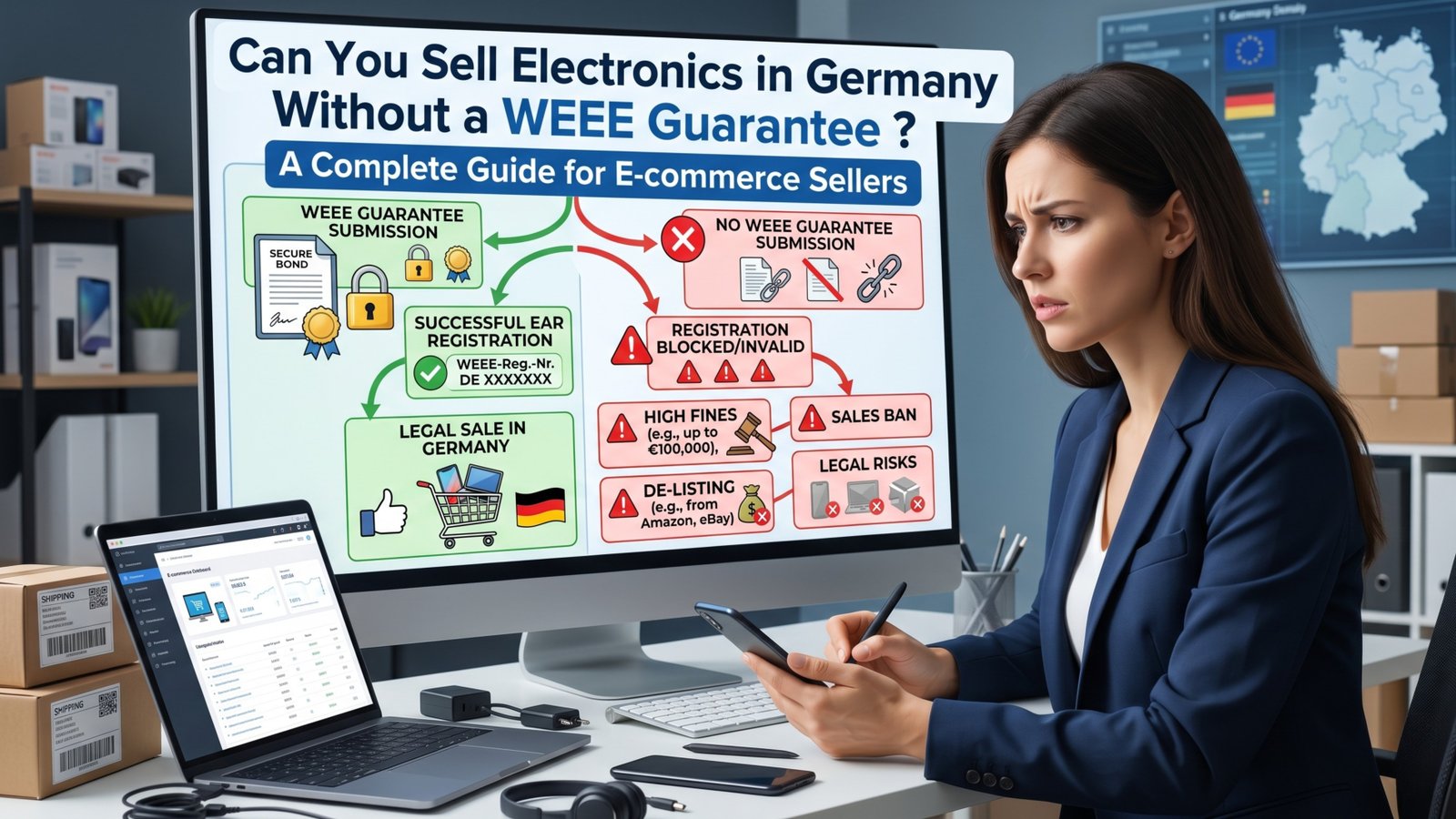
A common question that lands on our desks is: Can I simply bypass the red tape ? Can you sell electronics in Germany without a WEEE guarantee ?
The short, uncompromising answer is no. If you want to sell electronics germany weee compliance complete with an insolvency-proof financial guarantee is a strict legal requirement for business-to-consumer (B2C) sales. This builds on our related guide covering how to get a WEEE guarantee in Germany.
In this comprehensive guide, we are going to break down exactly what the WEEE guarantee is, why Germany demands it, how it impacts your sales on platforms like Amazon, eBay, and Etsy, and the exact steps you need to take to ensure your business remains compliant and profitable.
What is the WEEE Directive and the German ElektroG ?
Before diving into the guarantee itself, it helps to understand the landscape. WEEE stands for Waste Electrical and Electronic Equipment. The WEEE Directive is an overarching European Union law designed to tackle the rapidly growing problem of electronic waste. The core philosophy behind WEEE is Extended Producer Responsibility (EPR). This principle dictates that the manufacturer, importer, or seller who introduces a product into the market is also financially and legally responsible for its eventual disposal and recycling.
While WEEE is an EU directive, each member state implements it through its own national laws. In Germany, this law is the Elektro- und Elektronikgerätegesetz (ElektroG).
The ElektroG mandates that anyone placing electrical and electronic equipment (EEE) on the German market for the first time must register with the national register, known as the stiftung ear (Elektro-Altgeräte Register).
The Crux: What Exactly is the WEEE Guarantee ?
When sellers hear the word "guarantee," they often think of a product warranty. In the context of German WEEE compliance, a guarantee means something entirely different.
The WEEE guarantee is an insolvency-proof financial guarantee.
Imagine a scenario where a company sells millions of cheap electronic gadgets in Germany over five years, and then suddenly goes bankrupt and disappears. A decade later, all of those gadgets reach the end of their lifecycle and are thrown away by consumers. The local German municipalities are now stuck with the bill for collecting, sorting, and safely recycling mountains of toxic electronic waste, with no company left to foot the bill.
To prevent this, the German government requires you to provide a financial guarantee before you are allowed to sell a single electronic item to a private household. This guarantee acts as an insurance policy. It proves that even if your company goes bankrupt or ceases operations, there are locked funds available to cover the future costs of recycling the products you are putting on the market today.
Therefore, Can You Sell Electronics in Germany Without a WEEE Guarantee ?
Legally, absolutely not. If you are selling B2C (Business-to-Consumer), the stiftung ear will flat-out reject your registration application if you do not provide proof of an accepted financial guarantee. Without a registration, you cannot legally sell.
Does This Apply to Every Seller ? (B2B vs. B2C)
This is where the nuances of the law come into play. The requirement for an insolvency-proof guarantee depends on who you are selling to.
1. B2C (Business-to-Consumer) Sales: If your electronics can theoretically be used in private households, they are classified as B2C equipment. Even if you only intend to sell them to businesses, if a normal consumer could buy and use the item (e.g., a standard laptop, a coffee maker, or a desk lamp), it is classified as B2C.
Guarantee Required ? Yes. Mandatory.
2. B2B (Business-to-Business) Sales: If your equipment is exclusively designed for industrial, professional, or commercial use and would never be used in a private home (e.g., heavy industrial machinery, specialized medical scanning equipment), it is classified as B2B.
Guarantee Required ? No. You still must register with the stiftung ear, report your sales volumes, and provide a credible concept for how the equipment will be recovered and recycled at the end of its life, but the upfront insolvency-proof financial guarantee is waived.
For the vast majority of e-commerce operators selling on Amazon, eBay, or their own Shopify stores, your products will fall under B2C, meaning the guarantee is inescapable. Common classification errors are covered in our WEEE guarantee mistakes guide.
The 6 Categories of Electronic Waste in Germany
To get your guarantee and registration sorted, you first need to know how your products are classified. The German ElektroG categorizes electronics into six groups. The cost of your guarantee and your recycling obligations will depend on which category your products fall into:
- Temperature Exchange Equipment: Refrigerators, freezers, air conditioning units, heat pumps.
- Screens, Monitors, and Equipment containing screens having a surface greater than 100 cm²: Televisions, computer monitors, laptops, tablets.
- Lamps: Straight fluorescent lamps, compact fluorescent lamps, LED lamps.
- Large Equipment: (Any external dimension more than 50 cm) Washing machines, large printers, electric stoves, large photovoltaic panels.
- Small Equipment: (No external dimension more than 50 cm) Vacuum cleaners, microwaves, radios, video cameras, electric toys, smoke detectors.
- Small IT and Telecommunication Equipment: (No external dimension more than 50 cm) Mobile phones, GPS devices, routers, personal computers, printers.
The Real-World Consequences of Non-Compliance
Let's say a seller decides to take the risk. They want to sell electronics germany weee compliance seems too expensive or complicated, so they just list their products and hope for the best. What actually happens ?
The enforcement mechanisms in Germany are incredibly robust, and the consequences for trying to fly under the radar are severe and multi-faceted.
1. Marketplace Suspensions (Amazon, eBay, Etsy)
Since July 2023, the legal landscape shifted dramatically for online marketplaces. Under the Extended Producer Responsibility (EPR) regulations, marketplaces like Amazon, eBay, and Etsy are now legally obligated to check if their sellers are WEEE compliant.
If you try to list an electronic item on Amazon Germany without a valid WEEE-Reg.-Nr. (Registration Number), Amazon will block the listing immediately. If you fail to provide it for existing listings, they will suspend your account and freeze your funds. The marketplaces can be heavily fined if they allow non-compliant sellers on their platforms, so their automated systems are ruthless in enforcing this. You literally cannot access the German e-commerce market without this number. See our guide on Amazon Germany WEEE compliance.
2. Crushing Fines from the Federal Environment Agency (UBA)
If you are caught selling without registration, the German Federal Environment Agency can issue administrative fines of up to €100,000 per violation. Furthermore, they can confiscate all of your non-compliant inventory and ban you from the market.
3. Competitor Warning Letters (Abmahnungen)
Germany has a unique legal mechanism known as the Abmahnung (warning letter). Competing businesses or consumer protection agencies actively monitor the market for sellers who are cutting corners on compliance. If a competitor notices you are selling electronics without a WEEE registration, they can hire a lawyer to send you a cease-and-desist letter. You will be legally forced to stop selling, and you will have to pay the competitor's hefty legal fees out of your own pocket.
How to Secure a WEEE Guarantee in Germany
Now that we have established that you absolutely cannot sell electronics in Germany without a WEEE guarantee, how do you actually get one ?
You generally have two options for securing this financial safety net:
Option 1: The Individual Guarantee
You can theoretically set up a blocked bank account or secure a surety bond from a bank or credit insurer on your own. You calculate the estimated future recycling cost of all the products you plan to sell this year, lock that money away, and submit proof to the stiftung ear.
While this sounds straightforward, it ties up a massive amount of your working capital. The stiftung ear has complex formulas for calculating the required amount based on anticipated return rates and disposal costs per ton. For most small to medium e-commerce businesses, an individual guarantee is entirely impractical and financially suffocating.
Option 2: The Collective Guarantee Scheme (The Standard Method)
This is the route that 99% of e-commerce sellers take. Instead of tying up your own capital in a blocked account, you join an approved collective guarantee system (often operated by compliance schemes or recycling networks), a topic we explore further in our guide to choosing a WEEE guarantee provider.
Here is how it works:
- You pay a relatively small annual fee to a guarantee provider.
- In return, the provider adds your sales volumes to their massive, pre-funded collective guarantee pool.
- The provider gives you a guarantee certificate or electronic token.
- You submit this token to the stiftung ear during your registration process.
By using a collective scheme, you satisfy the legal requirement for an insolvency-proof guarantee without having to freeze thousands of euros of your own cash.
The Step-by-Step Guide to Selling Electronics in Germany Legally
If you are ready to enter the German market, here is the exact roadmap you need to follow to achieve WEEE compliance.
Step 1: Appoint an Authorized Representative (If you are based outside of Germany) If your company does not have a registered, physical branch office in Germany, you cannot register directly with the stiftung ear. The German government requires a domestic entity to hold legally accountable. Therefore, foreign sellers (including those in other EU countries, the UK, the US, or China) must appoint a German Authorized Representative (WEEE AR). This representative steps into your legal shoes and handles all compliance obligations on your behalf.
Step 2: Secure Your Guarantee Before applying for registration, purchase your participation in a collective guarantee scheme for the specific categories (1-6) of products you intend to sell.
Step 3: Register with the stiftung ear Submit your company details, product categories, brands, and your guarantee proof to the stiftung ear portal. Warning: The stiftung ear is notoriously slow. Processing times can take anywhere from 6 to 12 weeks. You cannot sell a single item until the registration is fully approved and you receive your WEEE-Reg.-Nr. Plan your product launches accordingly!
Step 4: Update Your Marketplace Accounts Once you receive your 8-digit WEEE-Reg.-Nr., upload it immediately to the EPR compliance portals on Amazon Seller Central, eBay, or Etsy. They will verify the number against the national database to ensure it belongs to your brand and company.
Step 5: Monthly Reporting Compliance doesn't stop at registration. Every single month, you (or your Authorized Representative) must log into the stiftung ear portal and report the exact weight (in kilograms) of the electronics you sold in Germany during the previous month.
Step 6: Annual Updates At the end of every calendar year, you must submit a final annual report, and you must renew your financial guarantee for the upcoming year based on your projected sales volumes.
The Hidden Trap: Packaging and Battery Compliance
It is vital to note that WEEE is usually only one piece of the puzzle. When you sell an electronic device, you are almost always triggering two other major EPR regulations in Germany:
The Packaging Act (VerpackG): The box your electronic device comes in, the plastic wrap, and the shipping carton all require registration with the LUCID database and a licensing agreement with a dual system.
The Battery Act (BattG): If your electronic device contains a battery (even a tiny built-in button cell on a motherboard), you must complete a separate Battery registration with the stiftung ear.
A suspension on Amazon can happen if you are missing any of these three registrations. A holistic approach to compliance is mandatory, which is why we recommend reviewing our LUCID registration guide for Germany alongside your WEEE and battery obligations. For end-to-end support, explore our full range of services or contact Complico Consulting GmbH directly.
More About sell electronics germany weee Resources
- Stiftung ear (German National Register for WEEE)
- Umweltbundesamt (UBA - German Environment Agency)
- BMUV (Federal Ministry for the Environment, Nature Conservation, Nuclear Safety and Consumer Protection)
- European Commission – WEEE Directive Official Page
- Amazon Seller Central – EPR Requirements for Germany