
Summarize this article with:
If you are a non-EU e-commerce brand, manufacturer, or remote seller shipping products to European consumers, the regulatory landscape is about to undergo a seismic shift. For years, cross-border e-commerce operated with a degree of leniency regarding environmental regulations. That era is officially ending.
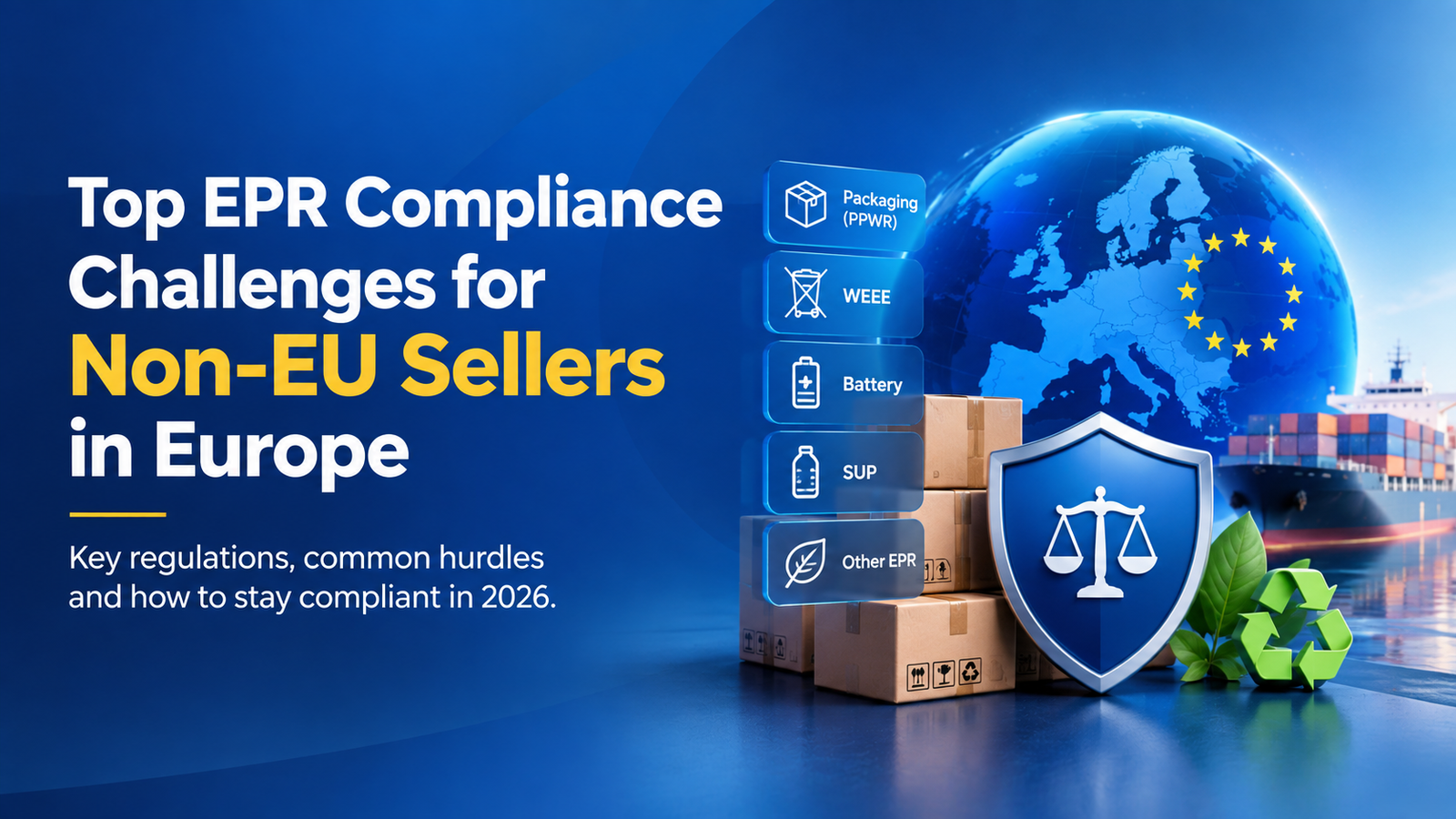
By 2026, the European Union is implementing aggressive, legally binding frameworks designed to close loopholes and enforce EPR Compliance (Extended Producer Responsibility) across the board. The EU Packaging and Packaging Waste Regulation (PPWR), alongside updated marketplace liabilities and stricter data reporting requirements, means that sustainability is no longer just a marketing talking point—it is a strict condition for market access.
At Complico Consulting GmbH, we specialize in helping international businesses decode complex European regulations. In this comprehensive guide, we will break down the top EPR Compliance challenges non-EU sellers will face in 2026, what these changes mean for your daily operations, and how you can proactively protect your profit margins and marketplace listings.
What is Extended Producer Responsibility (EPR) ?
Before diving into the 2026 challenges, it is essential to understand the core philosophy behind EPR. Extended Producer Responsibility is an environmental policy approach that makes the "producer" (which legally includes manufacturers, importers, and remote e-commerce sellers) physically and financially responsible for a product's entire lifecycle [1.2.3].
This responsibility extends past the point of sale, encompassing the take-back, recycling, and ultimate disposal of the product and its packaging [1.2.3]. The primary goal is to shift the financial burden of waste management away from local municipalities and taxpayers, placing it directly onto the businesses that introduce the waste into the market [1.1.3].
Historically, EPR applied heavily to domestic EU companies. However, the surge in direct-to-consumer (D2C) shipping has prompted regulators to expand these rules. Today, if you place a packaged product on the EU market, you are obligated to comply—regardless of where your company is headquartered [1.1.2].
Why 2026 is a Tipping Point for Non-EU Sellers
The year 2026 is not an arbitrary date; it is a critical legislative deadline. The EU Packaging and Packaging Waste Regulation (PPWR, Regulation 2025/40), which officially entered into force in February 2025, sees its most stringent provisions take effect on August 12, 2026 [1.1.2].
Simultaneously, the European Union is standardizing data reporting formats [1.1.4] and turning e-commerce marketplaces (like Amazon, eBay, and Zalando) into active regulatory enforcers [1.2.1].
For non-EU sellers, ignoring these updates will result in blocked marketplace listings, confiscated shipments at customs, and significant financial penalties [1.1.2, 1.1.4]. Below are the top five challenges you must prepare for.
Challenge 1: The "Authorized Representative" Mandate
Perhaps the most disruptive change for non-EU brands is the new legal requirement regarding domestic representation.
Under the PPWR, starting August 12, 2026, any non-EU company placing packaging on the EU market must appoint a formally recognized, EU-based Authorised Representative [1.1.2].
What This Means for Your Business
You can no longer manage your European EPR Compliance entirely from the United States, Asia, or the UK. You must designate a legal entity or individual located within the EU to accept legal responsibility for your registration, data reporting, and financial obligations [1.1.2].
The complexity: This is not a single, blanket appointment for the entire European Union. The mandate operates on a per-country basis [1.1.2]. If you ship to Germany, France, and Spain, you need a recognized representative in each of those specific member states [1.1.2].
Expert Insight: Finding and appointing authorized representatives takes time. These entities are accepting legal liability for your environmental footprint, meaning they will require thorough audits of your operations before signing a contract. Do not wait until the summer of 2026 to begin this process.
Challenge 2: Unforgiving Gatekeepers and Marketplace Liability
In the past, regulatory authorities had to hunt down non-compliant overseas sellers—a nearly impossible task. The EU has solved this enforcement problem by shifting the liability onto the platforms that facilitate the sales.
Driven by the EU Digital Services Act and updated national laws, online marketplaces and fulfillment service providers (like 3PL warehouses) are now legally designated as compliance gatekeepers [1.2.1, 1.2.3].
The Automated Verification Process
By 2026, marketplaces will utilize fully digitized, automated interfaces directly linked to national EPR registries (such as the LUCID register in Germany or SYDEREP in France) [1.2.1].
Zero Tolerance: If your EPR registration number is missing, invalid, or does not perfectly match your seller profile, your product listings will be automatically suspended [1.1.2, 1.2.1].
Fulfillment Freezes: Third-party logistics providers will be prohibited from warehousing, picking, packing, or shipping goods for unregistered retailers [1.2.1]. Doing so would make the 3PL liable for your non-compliance [1.2.1].
If a marketplace flags your account for non-compliance, retroactive registration can take weeks or even months [1.1.2]. During that time, your European revenue stream drops to zero.
Challenge 3: Hyper-Fragmented National Rules vs. Harmonized Data
One of the most frustrating aspects of EPR Compliance in Europe is the lack of a centralized, pan-European system. While the EU sets the overarching directives, the actual implementation, enforcement, and fee structures are handled by individual member states [1.2.5].
| Compliance Aspect | The Reality for Sellers |
|---|---|
| Registration | Must be completed separately in every single country where you sell [1.1.2]. |
| Eco-Organizations | You must contract with specific Producer Responsibility Organizations (PROs) locally (e.g., CITEO in France, Ecoembes in Spain) [1.1.2]. |
| Thresholds | Some countries offer exemptions for low volumes; others (like France) require registration from the very first package sold [1.2.2]. |
| Product Streams | Packaging is universal, but you may also need separate registrations for Electronics (WEEE), Batteries, or Textiles depending on the destination [1.2.3]. |
The 2026 Data Standardization Effort
To mitigate this chaos, the EU is introducing a standardized data set for all member states by February 2026 [1.1.4]. While this aims to unify reporting formats—requiring identical data fields regarding material types, weights, and recyclability across borders—it also means that sellers must drastically upgrade their internal data collection methods to meet this new, rigid standard [1.1.4].
Challenge 4: Granular Data Audits and Eco-Modulated Fees
EPR is no longer a flat tax. It has evolved into a highly variable financial obligation based on the exact environmental impact of your packaging. This system is known as eco-modulation.
Under eco-modulated fee structures, your financial contribution is calculated based on real-world recycling performance [1.1.3].
The Red, Amber, Green (RAG) System
Your packaging will be scientifically categorized based on its material composition:
- Green: Materials that are easily recyclable and widely processed (e.g., plain cardboard, clear PET). These incur the lowest compliance fees [1.1.3].
- Amber: Materials that can be recycled but pose challenges in the sorting or processing phases (e.g., glass jars with non-removable plastic labels). These face higher fees [1.1.3].
- Red: Hard-to-recycle materials that contaminate waste streams (e.g., multi-layer laminates, highly contaminated glass, unidentifiable composites). These face severe financial penalties and highest reporting burdens [1.1.3].
The Data Burden
To accurately report, you cannot simply guess your packaging weights. You are required to provide audit-proof data detailing exact material types, weight specifications per packaging unit, and verifiable supply chain documentation [1.1.4]. For multinational sellers with diverse SKUs, gathering Bill of Materials (BOMs) and conducting Life Cycle Assessments (LCAs) will shift from being a "best practice" to a mandatory operational requirement [1.1.1, 1.1.5].
Challenge 5: "Recyclability by Design" and Strict Packaging Rules
The ultimate goal of the 2026 regulations is to force manufacturers to redesign their products. Regulatory compliance is no longer an afterthought handled by the legal department; it must now dictate the earliest stages of product development and packaging engineering [1.1.1].
The PPWR introduces strict physical constraints on how you package goods for the EU market [1.1.2]:
Empty Space Restrictions: E-commerce parcels will be subject to a strict maximum limit of 40% empty space [1.1.2]. Shipping small items in oversized boxes filled with plastic padding will become a legal violation, not just a waste of shipping costs [1.2.2].
Mandatory Recyclability Grades: By 2030, all packaging placed on the EU market must meet a recyclability grade of 'C' or higher [1.1.2]. Grade 'D' or ungraded packaging will be entirely banned from sale [1.1.2]. Design decisions must be made now to ensure compliance by the end of the decade.
Recycled Content Quotas: The regulations mandate a minimum of 35% post-consumer recycled (PCR) content in flexible plastic packaging by 2030 [1.1.2]. You will need verifiable documentation from your suppliers proving this PCR content to pass marketplace and customs audits [1.1.2].
Chemical Restrictions: Alongside EPR, strict bans on PFAS (forever chemicals) in packaging (such as grease-resistant coatings on food boxes) will force a total requalification of suppliers [1.1.1].
The Strategic Advantage of Proactive Compliance
While these regulations appear daunting, they present a distinct competitive advantage for businesses that adapt early. Many of your competitors will ignore these warnings, facing sudden marketplace suspensions and supply chain bottlenecks in Q3 of 2026.
By taking action now, you can:
- Protect Revenue: Ensure uninterrupted sales on major EU marketplaces.
- Optimize Margins: Redesign packaging to achieve "Green" eco-modulation status, drastically reducing your annual EPR fee liabilities.
- Enhance Brand Trust: Leverage your verified sustainability metrics to appeal to the increasingly eco-conscious European consumer base.
Your Actionable 2026 Checklist
At Complico Consulting GmbH, we recommend that non-EU sellers immediately begin the following steps to safeguard their market access:
- Map Your Markets: Audit your sales data to identify every EU country you ship to [1.1.2]. Your obligations are triggered by the destination of the consumer, not where the goods entered Europe.
- Audit Your Packaging Data: Break down every SKU in your catalog. Document the exact weight, material composition (primary, secondary, and transport packaging), and recyclability of each component [1.2.2].
- Identify Authorized Representatives: Begin vetting and contracting with EU-based representatives for your highest-volume markets immediately. Remember, the PPWR mandate takes effect in August 2026 [1.1.2].
- Engage Your Supply Chain: Demand transparency from your packaging suppliers. You will need verifiable proof of Post-Consumer Recycled (PCR) content and chemical composition to pass upcoming data audits [1.1.1, 1.1.2].
- Re-engineer for Compliance: Analyze your shipping boxes. If your void fill regularly exceeds 40%, redesign your parcel formats now to avoid penalties and bans [1.1.2, 1.2.2].
- Register Proactively: Do not wait for Amazon or Zalando to flag your account. Register with the necessary national portals (like LUCID in Germany) and pay your initial eco-contributions to secure your registration numbers [1.1.2, 1.2.1].
How Complico Consulting GmbH Can Help
Navigating the fragmented maze of European environmental law is incredibly risky to attempt internally, especially for businesses lacking a dedicated EU compliance department.
At Complico Consulting GmbH, we provide end-to-end EPR Compliance management tailored specifically for non-EU sellers and e-commerce brands.
Multi-Country Registration: We handle the complex bureaucracy of registering your business across multiple European member states, ensuring all paperwork is flawless and submitted on time.
Data Management & Reporting: We help you structure your packaging data to meet the new harmonized EU standards, calculating your exact obligations and submitting your recurring volume reports to the relevant PROs.
Authorized Representation: We can connect you with trusted, fully vetted authorized representatives to satisfy the strict 2026 PPWR requirements.
Strategic Packaging Consulting: Our experts will analyze your current packaging portfolio and advise on design changes to minimize your eco-modulated fees and ensure compliance with empty-space and recyclability mandates.
Conclusion
The year 2026 represents a point of no return for international e-commerce in Europe. The days of shipping non-compliant packaging across borders without consequence are over. With automated marketplace enforcement, granular data audits, and the mandatory appointment of local representatives, EPR Compliance is now a foundational pillar of doing business in the EU.
Do not let regulatory blind spots disrupt your international growth. Contact Complico Consulting GmbH today to schedule a comprehensive audit of your European compliance strategy, and secure your place in the future of sustainable global retail.