
Summarize this article with:
nds based in the United States, the United Kingdom, Canada, or Asia, capturing a slice of this market is an exciting growth milestone. However, gaining physical entry past EU borders and successfully maintaining digital listings on modern online marketplaces has become dramatically more complex.
As we move through 2026, the European Union has systematically tightened its enforcement infrastructure. Cross-border e-commerce, strict environmental mandates, and localized food safety crackdowns mean that non-EU brands can no longer simply ship retail-ready packages across borders without a formalized legal anchor on European soil.
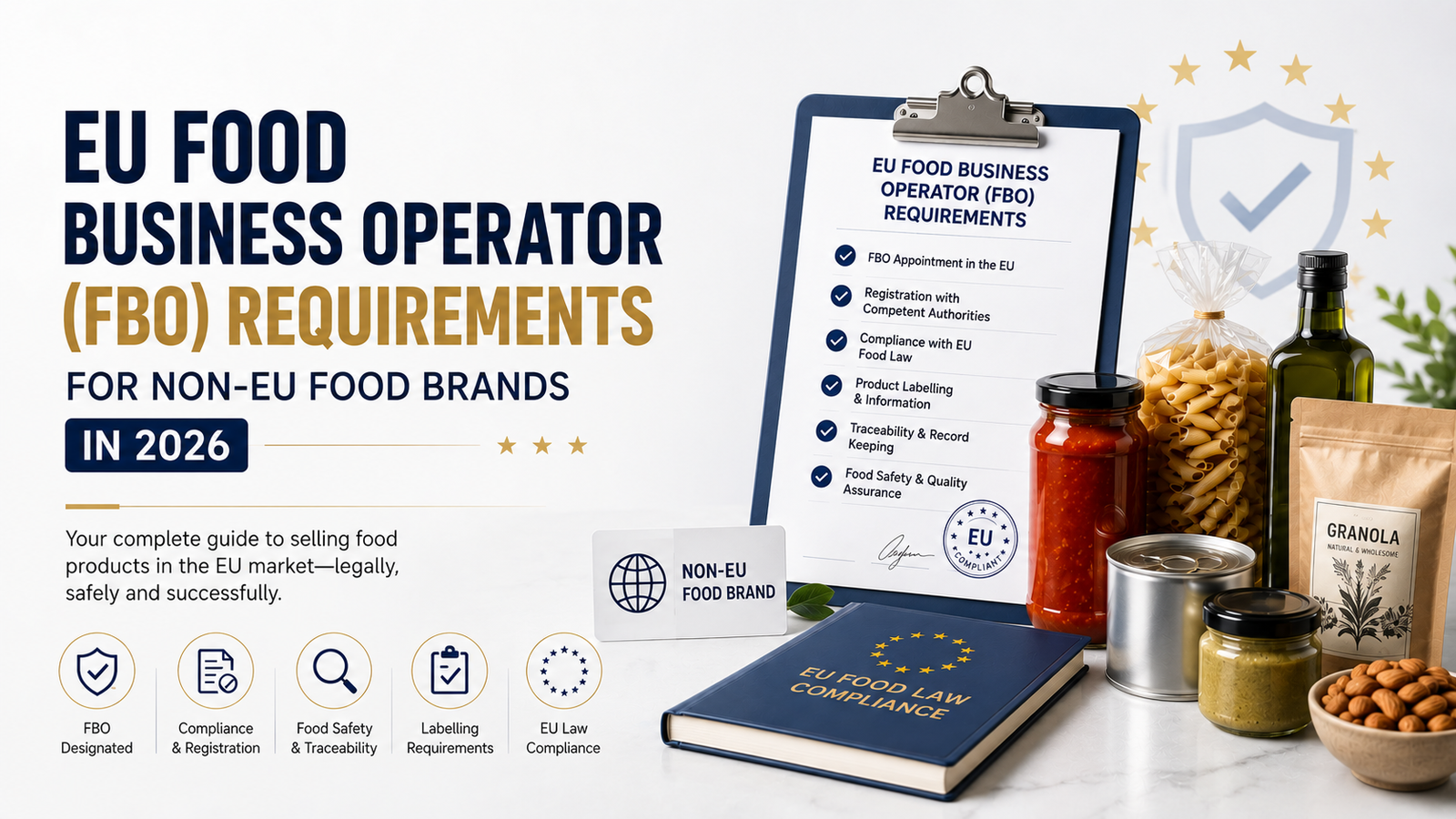
That anchor is the Food Business Operator (FBO).
Whether you sell specialty snacks, health supplements, artisanal ingredients, or shelf-stable beverages, understanding the deep legal mechanisms governing the Food Business Operator role is no longer an optional compliance checklist item, it is the baseline structural requirement for market viability. This comprehensive guide breaks down the updated 2026 requirements, label mandates, e-commerce distance selling compliance, and operational shifts that non-EU food brands must execute to safeguard their European distribution networks.
1. Defining the Legal Anchor: What is an EU Food Business Operator ?
To comprehend why the European Union enforces such strict frameworks, one must look at the foundational architecture of European food law. Under Regulation (EC) No 178/2002 (the General Food Law), the EU established an unbroken chain of traceability. The core principle is simple: every piece of food consumed within the EU must be traceable back to a responsible entity that can be held legally liable if a public health crisis occurs.
A Food Business Operator is legally defined as the natural or legal person responsible for ensuring that the requirements of food law are met within the food business under their control.
For brands operating physically inside the European Union, the FBO is typically the domestic manufacturer or the primary packer. However, for a brand operating outside the European borders, a major compliance vulnerability arises. The EU cannot easily exercise jurisdiction over a legal entity based in Chicago, London, or Tokyo. Therefore, under Regulation (EU) No 1169/2011 on the provision of Food Information to Consumers (FIC), specific rules dictate who carries the legal weight for imported foodstuffs.
The Hierarchy of Responsibility Under Article 8
Article 8 of Regulation (EU) No 1169/2011 explicitly states that the Food Business Operator responsible for food information is the operator under whose name or business name the food is marketed.
However, if that specific operator is not established within the European Union, the legal mantle automatically shifts. In these scenarios, the responsible party defaults to:
- The Importer into the EU Market: The physical entity that clears the goods through European customs. Learn more about this role in our Importer of Record guide.
- An Authorized EU Representative: A designated, legally established corporate entity within the EU that explicitly contracts to act as the FBO for the non-EU brand, similar to our EU Authorised Representative services.
If your food brand sells via a traditional distribution model, your commercial importer typically assumes the legal FBO responsibilities. But if you sell directly to consumers via your own localized WordPress/Shopify store, or leverage decentralized fulfillment models like Amazon FBA, eBay, or Etsy, the lack of a traditional, clear-cut importer creates a severe legal vacuum. Without a clearly designated Food Business Operator established in the EU, your products are legally non-compliant, subject to immediate customs seizure, marketplace listing deletion, and significant financial penalties.
2. The Core Labeling Mandate: FBO Physical Address Requirements
The most immediate and strictly audited touchpoint of this regulation is your physical packaging. A food label is treated by EU authorities as a binding legal document. Under Regulation (EU) No 1169/2011, the inclusion of the Food Business Operator name and address is not a cosmetic choice; it follows highly specific typographic and structural parameters.
No Digital Duplicity: The Physical Address Requirement
A common misconception among cross-border e-commerce operators is that providing a QR code, an email address, a social media handle, or a corporate website URL satisfies consumer contact requirements.
EU law strictly rejects this. The label must display a complete physical postal address located within the European Union.
This address must be detailed enough to allow a consumer or a regional food safety authority (such as Germany's BVL or France's DGCCRF) to send a physical, registered legal letter to the entity. It cannot be a temporary mailbox, a virtual dead-drop, or a standard PO Box without a physical corporate presence behind it. The name displayed alongside the address must be the registered legal entity name of the FBO (e.g., the corporate name of your importer or your contracted compliance representative).
Typographic Specifications: The X-Height Rule
The European Union regulates legibility with extreme mathematical precision to prevent brands from burying mandatory warnings or corporate responsibility data in microscopic text.
The 1.2mm Threshold: Mandatory food information including the name and address of the Food Business Operator—must be printed using a font size where the "x-height" (the height of a lower-case 'x') is at least 1.2 millimeters. Business Companion
Small Packaging Exception: If the largest surface area of your product packaging is less than 80 square centimeters, the minimum permitted x-height drops to 0.9 millimeters. J. Dauman Logistics
If your packaging fails this physical check during a spot audit at a port of entry (such as Rotterdam or Hamburg) or within a retail warehouse, the entire consignment can be turned away or ordered for destruction at your expense.
Language and Localization Challenges
EU food regulations stipulate that mandatory label information must be presented in a language easily understood by consumers in the Member State where the food is commercialized. While certain universal symbols are accepted, text-based elements like preparation instructions, allergen declarations, and specific legal titles must be localized.
If you are using a single centralized EU FBO address for multi-country distribution (for example, distributing across Germany, France, and Spain), the FBO address itself remains stable, but the accompanying legal definitions (e.g., "Imported by:", "Distributed by:", or "Verantwortlicher Lebensmittelunternehmer:") must properly align with the targeted national languages.
3. E-Commerce and Distance Selling Enforcement in 2026
The year 2026 represents a watershed moment for e-commerce compliance tracking. Historically, many non-EU food brands bypassed strict labeling oversight by shipping individual direct-to-consumer parcels through the mail or relying on the operational friction that slowed down marketplace monitoring. Those gaps have officially closed.
Article 8(2) and Pre-Purchase Data Mandates
For brands utilizing WordPress WooCommerce storefronts or external online marketplaces, Article 8(2) of Regulation 1169/2011 contains a revolutionary clause that is being heavily policed this year.
The law dictates that when prepacked foods are offered for sale via distance communication (online shopping, catalog orders, or digital applications), all mandatory food information except for the specific "use-by" or "best-before" date must be fully available to the consumer before the purchase is concluded.
This means your online product detail pages (PDPs) must clearly, legibly, and completely display:
- The full ingredient list and highlighted allergen declarations.
- The explicit metric net quantity.
- The standardized nutritional declaration table (per 100g or 100ml).
- Any specific storage conditions or instructions for use.
- The name and physical address of your designated EU Food Business Operator.
If a European consumer cannot read your FBO details and nutrient profiles on your WordPress site prior to clicking "Add to Cart," your digital operation is in direct violation of EU distance selling laws.
The Marketplace Compliance Clampdown: Amazon, eBay, and Etsy
Online marketplaces have transformed from neutral platforms into proactive gatekeepers. Under updated European cross-border compliance policies, marketplaces face secondary liability if they continually facilitate the sale of non-compliant, unvetted third-party goods.
As a result, platform protocols in 2026 require non-EU brands to formally upload and register their verified Food Business Operator information inside their seller portals (such as Amazon Seller Central).
- The Verification Process: Platforms are utilizing automated and manual verification systems to match the FBO data uploaded in your account with official EU corporate registries (like Germany's Handelsregister).
- The Consequence of Non-Compliance: If a brand fails to provide a verified EU FBO, or if a discrepancy is identified between the digital upload and the physical packaging image, marketplaces are executing swift, automated listing suspensions. In severe cases, entire merchant accounts are frozen, locking up vital capital and inventory.
4. Crucial 2026 Regulatory Shifts Impacting Importer FBOs
A professional Food Business Operator is not a passive address label; they are an active compliance manager. In 2026, the regulatory compliance ceiling has risen significantly. If your designated EU representative or importer is not deeply embedded in current legislative updates, your brand could face sudden compliance shocks.
The EU Deforestation Regulation (EUDR) Deadline
Perhaps the most monumental shift hitting the food supply chain is the full implementation of the EU Deforestation Regulation (EUDR). For medium and large-scale enterprises, the hard enforcement deadline lands on December 30, 2026.
If your food products contain any of the following core commodities, the EUDR completely changes your compliance reality:
- Cocoa (Chocolate, cocoa butter, cocoa powder, flavorings)
- Coffee (Whole bean, ground, extracts)
- Soy (Soy protein, lecithin, soybean oil)
- Palm Oil (Used extensively in processed foods, baked goods, and spreads) Passionfruit | Automate Customer Requests
Under the EUDR, any operator or trader who places these commodities on the EU market must prove that the raw materials do not originate from recently deforested land (post-December 31, 2020) and were produced in accordance with local legislation. This requires collecting precise geolocation coordinates (latitude and longitude) for every single plot of land where the ingredients were grown, executing strict risk assessments, and filing an official Due Diligence Statement in the EU information system. Your EU FBO or importer will be on the front lines of verifying this data before your shipment ever departs for European ports.
Elevated Food Safety and Micro-Biological Criteria
2026 has seen an aggressive modernization of chemical and microbiological thresholds across the EU. Regional enforcement bodies have increased sample testing frequencies at border inspection posts:
- New Listeria monocytogenes Controls: Ready-to-eat (RTE) food brands face highly stringent criteria regarding Listeria monocytogenes. Unless you have ironclad, validated shelf-life data proving that Listeria levels remain under 100 cfu/g under realistic consumer handling conditions, your FBO must ensure rigorous testing documentation is attached to each import batch. GOV.UK
- Revised Maximum Residue Limits (MRLs): The European Food Safety Authority (EFSA) has introduced updated MRLs for an array of pesticides and heavy metal elements (such as copper residues) across fruits, vegetables, spices, and cereals. Trace One
- Novel Food Naming Updates: Technical nomenclature updates are now active. For instance, the authorized name for rapeseed protein-fibre concentrate has been legally changed to "defatted rapeseed powder". FBOs must ensure that labels reflect this exact legal terminology immediately to avoid technical mislabeling charges. Trace One
Critical Operational Verification Points
| Compliance Domain | Operational Requirement | Non-Compliance Impact |
|---|---|---|
| FBO Address Presence | Must be a complete, physical EU-based postal address. Digital-only variants are entirely prohibited. | Custom seizures, immediate cargo rejection, total marketplace listing deletion. |
| Pre-Purchase Display | Display all mandatory food data (except expiry dates) directly on your website prior to customer check-out. | Fines from regional consumer protection agencies; breach of distance selling laws. |
| Typography & Sizing | Lower-case font 'x-height' must maintain a minimum of 1.2mm on standard consumer packaging. | Relabeling mandates at regional entry ports; severe logistical delays. |
| EUDR Supply Tracking | Provision of geolocation data and Due Diligence Statement for sensitive ingredient streams. | Fines reaching up to 4% of total annual Union-wide turnover; wholesale product recalls. |
6. How Complico Consulting GmbH Safeguards Your European Market Access
Regulatory compliance should never be an afterthought, nor should it be a barrier that paralyzes your international expansion. In the hyper-regulated trade environment of 2026, trying to piece together fragmented compliance requirements via generic search engines puts your brand, your capital, and your corporate reputation at severe risk.
At Complico Consulting GmbH, we specialize in transforming intricate European and UK regulatory frameworks into seamless, scalable business strategies. Operating directly out of our professional headquarters in Ronneburg, Germany, our team provides tailored compliance management designed specifically for international food brands, e-commerce sellers, and marketplace operators.
We provide a comprehensive suite of targeted compliance solutions:
- FBO Advisory & Framework Setup: Helping you properly structure your importer relationships or establish a bulletproof Authorized Representative pathway to fulfill your Food Business Operator obligations with total legal certainty.
- Comprehensive Label & Formulation Reviews: Auditing your ingredient profiles against updated 2026 EU additive bans, validating your nutritional panels, checking the exact 1.2mm typographic parameters, and ensuring complete compliance with localized language mandates.
- E-Commerce Data Audits: Reviewing your WordPress, WooCommerce, or marketplace storefront structures to guarantee absolute conformity with Article 8 distance selling regulations, protecting your platform from abrupt account suspensions.
- Supply Chain EUDR Readiness Strategy: Evaluating your ingredient supply lines for cocoa, coffee, soy, and palm derivatives to construct robust due diligence pipelines before the high-stakes December 2026 deadline.
Don't leave your European market entry to chance, and don't wait for an automated marketplace suspension to reveal a hidden vulnerability in your packaging. Work with an expert team that understands the micro-details of German and broader European food safety administration.
Connect With Our Compliance Specialists Today
Ensure your brand is structurally sound, legally anchored, and completely optimized for European growth. Contact us to schedule a dedicated compliance review for your product line.
Complico Consulting GmbH
📍 Bahnhofstr 12, 63549, Ronneburg, Germany
📧 info@complicoconsulting.com
🌐 www.complicoconsulting.com
Frequently Asked Questions (FAQ)
1. What is a Food Business Operator (FBO) ?
A Food Business Operator (FBO) is the individual or legal entity responsible for ensuring that food products comply with applicable food safety and labeling regulations. For products sold in the European Union, the FBO is legally accountable for meeting EU food law requirements.
2. Who needs an EU Food Business Operator ?
Any non-EU business that manufactures, imports, or sells food products within the European Union may need an EU-based Food Business Operator or importer responsible for regulatory compliance. This is particularly important for businesses selling directly to EU consumers through e-commerce platforms or online marketplaces.
3. Is an FBO required for online food sales ?
Yes. Businesses selling prepacked food through websites, online stores, or marketplaces must comply with EU food information requirements. Mandatory food information must generally be available to consumers before they complete their purchase.
4. What information must appear on food labels ?
EU food labels typically must include:
- Product name
- Ingredient list
- Allergen information
- Net quantity
- Nutritional declaration
- Storage instructions (where applicable)
- Country of origin (when required)
- Best-before or use-by date
- Name and physical address of the responsible Food Business Operator
5. Does the FBO address have to be located in the EU ?
Yes. The responsible Food Business Operator's address must be a valid physical postal address within the European Union. Email addresses, websites, QR codes, or social media accounts cannot replace this legal requirement.
6. Can a PO Box be used as the FBO address ?
In general, the address should identify a real, legally established business location where the responsible operator can be contacted by authorities. Businesses should ensure the address satisfies applicable regulatory requirements.
7. What font size is required for mandatory food information ?
Under EU food labeling rules, mandatory information should generally use a minimum x-height of 1.2 mm. Smaller packages with a limited surface area may qualify for reduced minimum font size requirements.
8. Do food labels need to be translated ?
Yes. Mandatory food information must be provided in a language that consumers in the destination Member State can easily understand. Businesses selling across multiple EU countries often need localized labels.
9. What information must be displayed on e-commerce product pages ?
Before purchase, consumers should be able to view mandatory food information, including:
- Product name
- Ingredients
- Allergens
- Nutrition information
- Net quantity
- Storage conditions
- Instructions for use (where applicable)
- Name and address of the responsible Food Business Operator
10. Does Amazon require Food Business Operator information ?
Many online marketplaces require sellers to provide regulatory information for food products sold in the EU. Missing or incorrect Food Business Operator details may result in listing restrictions or compliance requests.
More About Food Business Operator Resources
- European Commission: General Food Law (Regulation EC No 178/2002)
- European Commission: Food Hygiene (Regulation EC No 852/2004)
- UK Food Standards Agency (FSA): Register a Food Business
- UK Food Standards Agency (FSA): HACCP Guidelines
- European Food Safety Authority (EFSA): Applications and Compliance
Need help establishing your EU Food Business Operator pathway and staying ahead of the 2026 regulatory shifts ? Take a look at our services overview, compare our compliance service pricing, or get in touch with our team for tailored guidance. You may also find our guides on GPSR compliance and cosmetics compliance useful, or browse more insights on our blog.