
Summarize this article with:
Responsibility (EPR). Over the past few years, the German government has drastically tightened its environmental regulations, shifting the burden of electronic waste recycling onto the sellers themselves.
Today, online marketplaces like Amazon, eBay, and Etsy are legally required to verify your compliance. Without a valid WEEE Registration number, your listings will be suppressed, your inventory stranded, and your revenue stream in Europe's largest e-commerce market immediately severed.
At Complico Consulting GmbH, we see hundreds of sellers hit a wall when trying to navigate the German Electrical and Electronic Equipment Act (ElektroG). The bureaucratic hurdles, the language barrier, and the strict technical requirements of Stiftung EAR (the German WEEE registration authority) can turn a straightforward compliance task into a logistical nightmare.
This comprehensive guide is designed to demystify the process. We will walk you through exactly what WEEE Registration entails in Germany, whether you actually need it, and provide a clear, step-by-step roadmap to getting your registration number so you can keep your Amazon listings active and profitable.
What is WEEE Registration and the German ElektroG ?
WEEE stands for Waste from Electrical and Electronic Equipment. It is an overarching European Union directive aimed at reducing electronic waste by making the producers of these goods financially responsible for their end-of-life collection, recycling, and environmentally safe disposal.
However, because it is an EU directive rather than a regulation, every member state implements it differently. In Germany, the directive is implemented through the ElektroG (Elektro- und Elektronikgerätegesetz).
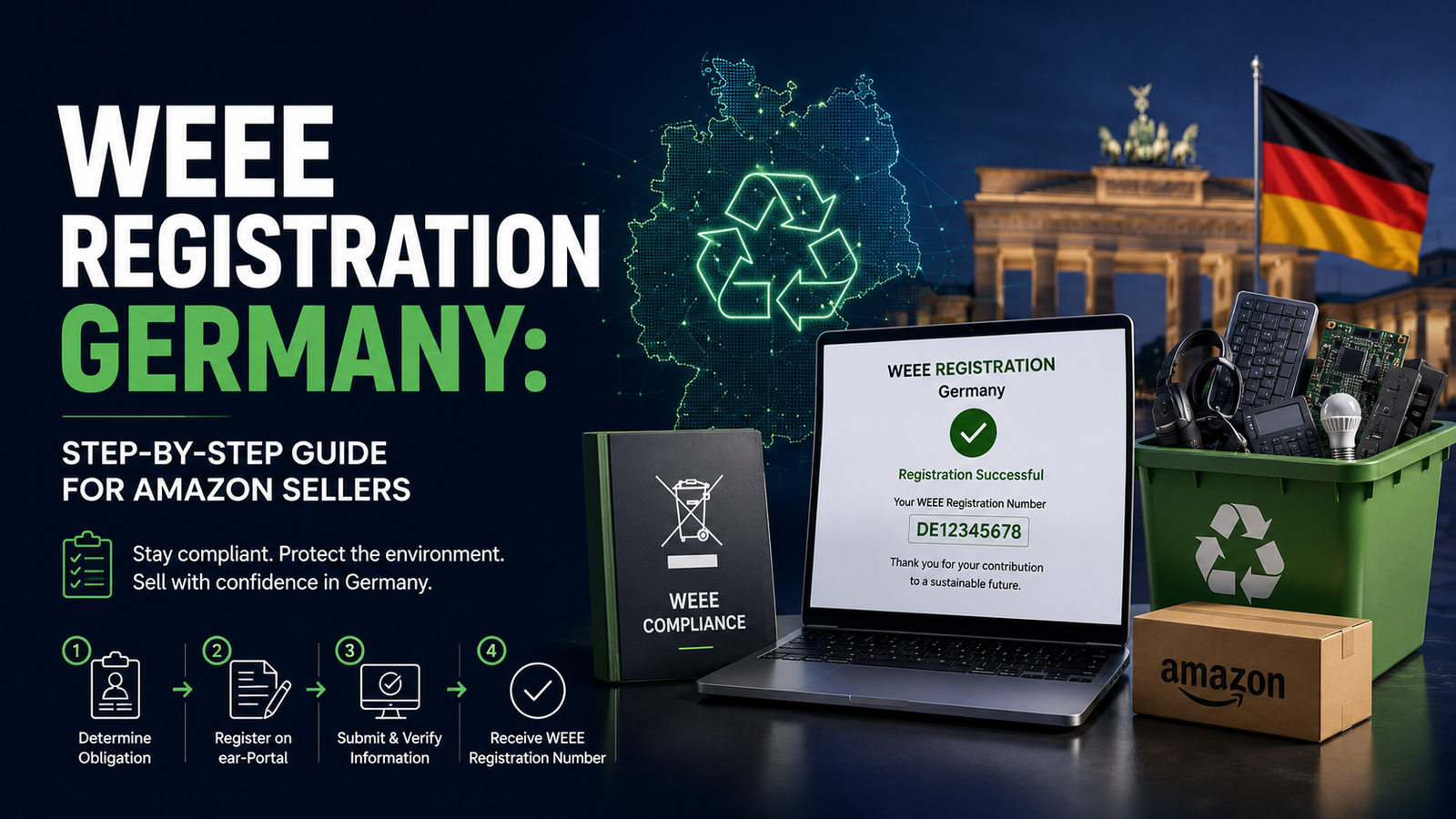
Under the ElektroG, a central clearing house was established: Stiftung EAR (Elektro-Altgeräte Register). Stiftung EAR is the official authority where all manufacturers, importers, and distributors must register their electrical equipment before placing it on the German market. Upon successful processing, Stiftung EAR issues an eight-digit WEEE Registration number (e.g., WEEE-Reg.-Nr. DE 12345678). This is the exact number Amazon requires you to input into your compliance portal.
Why Amazon Sellers Cannot Ignore WEEE Registration
Historically, many international sellers flew under the radar when it came to German environmental laws. That loophole is permanently closed.
As of January 2023, an amendment to the ElektroG made online marketplaces legally liable for the non-compliance of their third-party sellers. This means Amazon can face massive fines if they allow unregistered electronics to be sold on their platform. Consequently, Amazon's automated systems now proactively block the sale of any electrical or electronic product that does not have a verified WEEE Registration number attached to its brand.
The penalties for ignoring this are severe:
- Immediate Listing Suppression: Amazon will deactivate your ASINs until a valid number is provided and validated.
- Confiscation of Profits: German authorities have the right to seize profits made from illegally sold electronics.
- Massive Fines: Fines for non-compliance can reach up to €100,000 per violation.
- Account Suspension: Repeated EPR violations can lead to permanent marketplace bans.
Are You a "Producer" Under German Law ?
One of the most common misconceptions we address at Complico Consulting is the definition of a "producer." Many Amazon sellers believe that because they buy their products from a factory in China or wholesale from a distributor, they are merely "resellers" and exempt from the rules.
Under the ElektroG, the definition of a producer is incredibly broad. You are legally considered a producer (and therefore must undergo WEEE Registration) if you meet any of the following criteria:
- You manufacture EEE: You make electrical equipment under your own name or brand.
- You are an OEM / White-label seller: You have equipment designed or manufactured by someone else, but you sell it in Germany under your own brand name (the most common scenario for Amazon Private Label sellers).
- You import into Germany: You import EEE from outside of Germany (e.g., from China, the US, or the UK) and place it on the German market for the first time, a role closely related to that of an Importer of Record.
- You are a dropshipper: You sell products directly to German end-users from a location outside of Germany.
If you are a Private Label Amazon seller importing goods from Asia into German FBA fulfillment centers, you are a producer.
The 6 Categories of Electrical and Electronic Equipment
Before you begin your WEEE Registration, you must correctly classify your products. Stiftung EAR divides all electrical equipment into six distinct categories. Choosing the wrong category will lead to immediate rejection of your application, wasting weeks of processing time.
- Heat exchangers: Refrigerators, freezers, air conditioners, and heat pumps.
- Screens and monitors: Televisions, computer monitors, laptops, and any equipment with a screen larger than 100 square centimeters.
- Lamps: LED bulbs, fluorescent tubes, and energy-saving lamps (note: the light fixture itself may fall into a different category).
- Large equipment: Washing machines, large medical devices, and large solar panels (any external dimension greater than 50 cm).
- Small equipment: Toasters, vacuum cleaners, electronic toys, smart home devices, and small drones (no external dimension greater than 50 cm).
- Small IT and telecommunication equipment: Smartphones, GPS devices, routers, keyboards, and USB cables.
Note on passive devices: In Germany, even "passive" equipment like cables, adapters, and basic antennas require WEEE Registration if they are designed to conduct electricity.
The WEEE Registration Process: A Step-by-Step Guide
Securing your registration is a multi-step administrative process. Because Stiftung EAR processes applications on a first-come, first-served basis, any error in this sequence can send you back to the end of the queue.
Step 1: Determine B2B vs. B2C Classification
You must define whether your product is for private households (B2C - Business to Consumer) or exclusively for commercial use (B2B - Business to Business). Most Amazon sellers deal in B2C products. This distinction is critical because B2C equipment requires an insolvency-proof guarantee (explained in Step 3), whereas B2B equipment does not.
Step 2: Appoint an Authorized Representative (For Non-German Sellers)
If your company does not have a physical, registered branch in Germany, you cannot register directly with Stiftung EAR.
German law dictates that foreign companies must appoint a domestic Authorized Representative (Bevollmächtigter). This representative must be a legally capable entity based in Germany that takes on the legal responsibility for your compliance. They will hold your EAR account, manage your tonnages, and serve as the point of contact for German authorities. Finding a reliable compliance partner to act as your representative is the first mandatory hurdle for international e-commerce operators.
Step 3: Secure an Insolvency-Proof Guarantee (B2C Only)
If you sell to private consumers, the German government wants assurance that your products will be recycled even if your business goes bankrupt twenty years from now. Therefore, you must submit an insolvency-proof guarantee alongside your WEEE Registration application.
You do not have to put up massive amounts of cash for this. Instead, you purchase a guarantee certificate from an approved collective system or surety provider. The cost is calculated based on the tonnage of equipment you expect to sell, the category of the equipment, and the estimated future recycling costs.
Step 4: Submit Your Application to Stiftung EAR
Once you have your representative and your guarantee, the actual application is submitted via the Stiftung EAR online portal. You will need to provide:
- Your company details (or your representative's details).
- The specific brand name under which you sell on Amazon (this must match your Amazon brand exactly).
- The product category and equipment type.
- Your guarantee certificate.
- Photographs of the product and the brand logo permanently affixed to the item.
Stiftung EAR strictly enforces the branding rule. "No Name," "Unbranded," or generic equipment descriptions will be rejected.
Step 5: Wait for Approval and Receive Your WEEE Number
After submission, patience is required. Processing times at Stiftung EAR typically range from 4 to 12 weeks, depending on their current backlog. During this time, you are legally prohibited from selling the unregistered equipment in Germany.
Once approved, you will receive an official registration certificate via email containing your highly anticipated eight-digit WEEE Registration number.
Step 6: Validate Your Number in Amazon Seller Central
Getting the number is only half the battle; the final step is proving it to Amazon so they unlock your listings.
- Log into Amazon Seller Central and navigate to the Regulatory Compliance page.
- Filter the list for items mentioning "EPR" and "German WEEE".
- Click "Submit" next to the affected brand or ASIN.
- Enter your WEEE-Reg.-Nr. exactly as it appears on your certificate.
Amazon will then ping the Stiftung EAR database to validate your number. This validation process usually takes up to 5 working days. Once confirmed, your listings will automatically reactivate.
Common Pitfalls and How to Avoid Them
Over our years of assisting e-commerce businesses, we have noticed recurring errors that sellers make when attempting WEEE Registration on their own:
- Brand Mismatches: The brand name registered with Stiftung EAR must perfectly align with the brand name on your Amazon listing and the physical branding on the product. If Amazon has you listed as "SuperTech" but your EAR registration says "Super Tech Limited," Amazon's automated systems may fail to validate the number.
- Digitally Altered Photos: Stiftung EAR requires photos of your product showing the brand name. If they suspect the logo has been digitally superimposed (Photoshopped) onto a generic product image, they will instantly reject the application.
- Forgetting Batteries (BattG): If your electronic device contains a battery (even a small coin cell), your WEEE number is not enough. You must also register under the German Battery Act (BattG) and obtain a separate Batt-Reg.-Nr. DE number.
- Ignoring Ongoing Reporting: Getting your WEEE Registration number is not a one-and-done event. You are required to submit regular monthly reports declaring the exact weight (tonnage) of the electronics you sold in Germany, as well as an annual review. Failing to report will lead to the revocation of your registration.
What Are the Costs and Timelines Involved ?
Budgeting for compliance is an essential part of doing business in Europe today. While costs fluctuate based on your specific product volume and the partners you choose, here is a general breakdown of what to expect for German WEEE Registration:
Timelines
- Preparation and Authorized Representative setup: 1–2 weeks.
- Stiftung EAR processing time: 4–12 weeks.
- Amazon validation: 1 week.
- Total expected timeline: 6 to 15 weeks.
Expected Costs
- Stiftung EAR Fees: The government charges administrative fees for processing the registration (typically around €30 to €50 per brand/category), plus quarterly account maintenance fees.
- Insolvency Guarantee: Varies heavily by volume, but expect a few hundred euros annually for a standard Amazon seller.
- Authorized Representative Fees: If you are a non-German company, you will pay an annual retainer to your local representative.
- Recycling / Disposal Costs: Paid to an approved waste management company based on the actual weight of products you sell.
Maintaining Your Compliance
The compliance journey continues long after your listings are reinstated. The German market operates on an Extended Producer Responsibility model, meaning your obligations stretch throughout the lifecycle of the product.
You must integrate WEEE reporting into your monthly operational workflow. Every month, you must extract your sales data from Amazon, calculate the net weight of the electrical equipment sold to German postcodes, and report this data through the Stiftung EAR portal (or provide it to your Authorized Representative to report on your behalf). Furthermore, if you introduce a new product category or launch a new sub-brand, you must complete a supplementary registration process before those new items go live on Amazon.
Conclusion
The barriers to entry in the European e-commerce market are rising, and WEEE Registration is at the forefront of this shift. While the ElektroG regulations may seem daunting, they are ultimately a standardized, logical process. By taking the time to properly categorize your products, securing a reliable Authorized Representative, and carefully managing your Stiftung EAR submissions, you can safeguard your seller account from devastating suspensions.
Navigating these regulations shouldn't require you to become an expert in German environmental law. Your time is best spent sourcing products, optimizing listings, and scaling your brand. If you are struggling with the Stiftung EAR portal, dealing with suppressed Amazon ASINs, or simply want to ensure your business is fully compliant across the EU, we are here to help.
The compliance landscape is shifting rapidly, but with the right preparation and guidance, you can secure your market access and build a resilient, compliant, and highly profitable brand in Germany.
Frequently Asked Questions (FAQ)
1. What is WEEE Registration ?
WEEE Registration is the mandatory registration process for producers of electrical and electronic equipment (EEE) under Germany's Electrical and Electronic Equipment Act (ElektroG). Once approved by Stiftung EAR, businesses receive a unique WEEE registration number that allows them to legally sell applicable products in Germany.
2. Who needs WEEE Registration in Germany ?
You generally need WEEE Registration if you:
- Manufacture electrical or electronic products under your own brand.
- Import electronic products into Germany.
- Sell private-label or white-label electronics.
- Dropship electrical products to German customers.
- Place electronic products on the German market for the first time.
3. What products require WEEE Registration ?
Most electrical and electronic equipment requires registration, including:
- Smartphones and tablets
- Laptops and computers
- Kitchen appliances
- Smart home devices
- Electronic toys
- Power tools
- Chargers and adapters
- USB cables
- LED lighting
- Devices with integrated batteries
Even certain passive electrical products, such as cables and connectors, may require registration.
4. What is Stiftung EAR ?
Stiftung EAR (Elektro-Altgeräte Register) is Germany's official authority responsible for administering WEEE Registration under the ElektroG. It reviews applications, issues WEEE registration numbers, and oversees producer compliance.
5. What is a WEEE registration number ?
A WEEE registration number (WEEE-Reg.-Nr. DE) is the official identification issued by Stiftung EAR after successful registration. Online marketplaces such as Amazon require this number before allowing many electronic products to be sold in Germany.
6. Is WEEE Registration mandatory for Amazon Germany sellers ?
Yes. Amazon Germany requires sellers of applicable electrical and electronic products to provide a valid WEEE registration number. Without it, listings may be suppressed or removed from sale.
7. Do foreign companies need an Authorized Representative ?
Yes. Businesses without a registered legal entity in Germany generally must appoint a German Authorized Representative (Bevollmächtigter) to complete and manage the WEEE registration process.
8. What is an insolvency-proof guarantee ?
An insolvency-proof guarantee is required for many B2C registrations. It ensures that products can still be collected and recycled even if the producer ceases business operations.
9. How long does WEEE Registration take ?
Typical timelines include:
- Preparation and documentation: 1–2 weeks
- Stiftung EAR review: 4–12 weeks
- Amazon verification (if applicable): Up to 5 working days
Processing times may vary depending on application accuracy and workload.
10. How much does WEEE Registration cost ?
Costs generally include:
- Stiftung EAR administrative fees
- Authorized Representative fees (for non-German businesses)
- Insolvency guarantee costs (where applicable)
- Recycling system participation fees
- Ongoing compliance and reporting costs
The total cost depends on product category, sales volume, and business structure.
More About WEEE Registration Resources
- Stiftung EAR (Elektro-Altgeräte Register) – Official Authority Website
- Umweltbundesamt (German Environment Agency) – ElektroG Overview
- European Commission – WEEE Directive Policy Page
- Stiftung EAR – Authorized Representative (Bevollmächtigter) Guide
Ready to get your electronics WEEE-registered and reactivate your Amazon listings ? Take a look at our services overview, compare our compliance service pricing, or get in touch with our team for tailored guidance. You may also find our guides on EPR compliance for Amazon FBA and GPSR compliance useful, or browse more insights on our blog.