
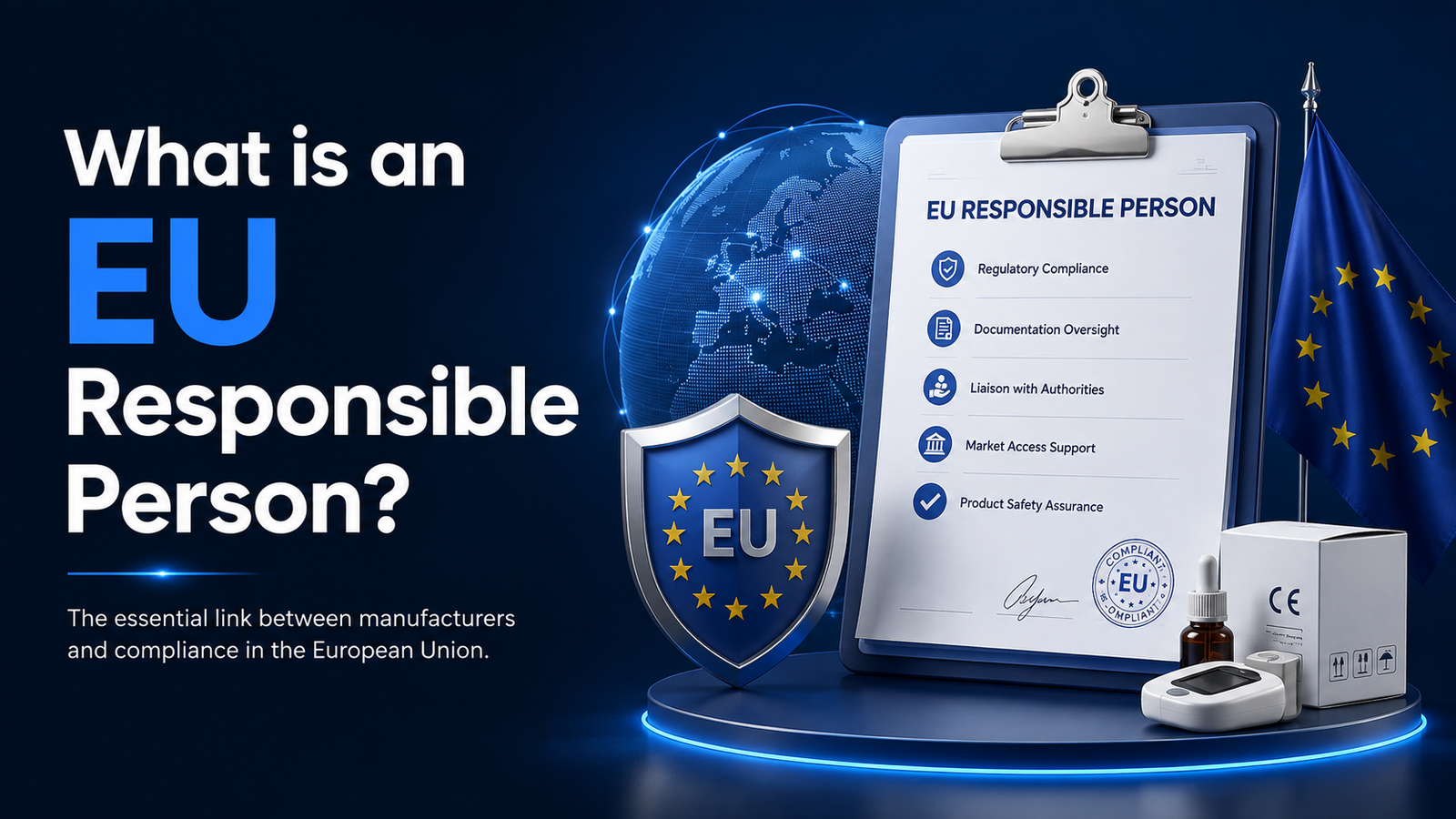
European Union who ensures that every cosmetic product placed on the market complies fully with Regulation (EC) No 1223/2009.
They are the ultimate guarantor of product safety. If a consumer has an adverse reaction, or if a national health authority wants to audit your product's safety data, the EU Responsible Person is the one who answers the call. Their name and registered EU address must be printed on every single unit of your product.
Without an EU Responsible Person, your cosmetic products simply cannot be legally sold in the EU or the European Economic Area (EEA), which includes countries like Norway, Iceland, and Liechtenstein.
Who Can Act as an EU Responsible Person ?
A common misconception is that any business partner in Europe can just sign a form and act as your representative. The reality is that taking on this role means accepting immense legal liability. According to the regulations, the EU Responsible Person can be filled through four specific avenues:
1. The Manufacturer
If your cosmetics are manufactured physically within the European Union and are not exported and re-imported, the EU-based manufacturer is the Responsible Person by default.
2. The Importer
If you manufacture your products outside the EU (for example, in the US, UK, or Asia), your importer automatically becomes the Responsible Person by default when they bring the goods across the border.
The catch: Most importers absolutely do not want this responsibility. They are logistics and sales experts, not toxicologists or regulatory compliance specialists. If an importer takes on the role, they will often demand exclusivity over your brand in Europe, limiting your ability to work with other distributors.
3. The Distributor
A distributor only becomes the EU Responsible Person if they place the cosmetic product on the market under their own name or trademark, or if they modify a product already on the market in a way that might impact its compliance (like changing the formulation or significantly altering the packaging).
4. A Designated Third Party (The Best Option for Non-EU Brands)
Manufacturers and importers can designate a specialized third-party firm based in the EU to act as their EU Responsible Person via a written mandate.
This is where specialized firms like Complico Consulting GmbH step in. By appointing an independent regulatory expert, you retain full ownership of your product formulation, you can work with as many importers and distributors as you like, and you have peace of mind knowing your compliance is being managed by professionals who understand the nuances of the law.
The Core Responsibilities: What Does the EU Responsible Person Actually Do ?
The title is not just administrative; it is a highly active, ongoing role. Article 5 of the EU Cosmetics Regulation outlines a massive list of obligations. Let's break down the most critical tasks your EU Responsible Person must execute and maintain.
1. Guaranteeing Product Safety and the CPSR
Before a product can be sold, the EU Responsible Person must ensure it is safe for human health under normal and reasonably foreseeable conditions of use. This is proven through the Cosmetic Product Safety Report (CPSR).
The CPSR is a dense, highly technical document split into two parts:
- Part A (Safety Information): This includes the product's formula, physical and chemical characteristics, stability data, microbiological quality, packaging material purity, and the toxicological profile of every single ingredient.
- Part B (Safety Assessment): This is the actual sign-off. It must be conducted by a qualified Safety Assessor—a professional with a recognized European university degree in pharmacy, toxicology, medicine, or a similar discipline.
Your EU Responsible Person coordinates this entire process, ensuring the assessor has the data they need and that the final report proves the product is safe.
2. Building and Holding the Product Information File (PIF)
The CPSR is just one part of a larger dossier called the Product Information File (PIF). The EU Responsible Person must compile, hold, and continuously update the PIF for every single product variation you sell.
The PIF contains:
- A clear description of the cosmetic product.
- The completed CPSR.
- A description of the manufacturing method and a statement of compliance with Good Manufacturing Practices (GMP) under ISO 22716.
- Proof of the effects claimed for the cosmetic product (if you claim a serum "reduces wrinkles by 20%," the PIF must contain the clinical studies proving it).
- Data on any animal testing performed by the manufacturer, its agents, or suppliers (note: animal testing for cosmetics is strictly banned in the EU, so this usually verifies that none took place).
The 10-Year Rule: The EU Responsible Person must keep the PIF readily accessible in electronic or paper format at the address listed on the product label for a full 10 years after the last batch of that product was placed on the market.
3. CPNP Notification
Before your product hits the shelves or your e-commerce store, the EU Responsible Person must notify the Cosmetic Products Notification Portal (CPNP). This is a centralized European database accessible by competent authorities and poison control centers across all 27 member states.
They must upload the product formulation, packaging imagery, and labeling details. Crucially, a CPNP registration is not an "approval" or a certificate, it is simply a notification. The burden of proof regarding safety still rests entirely on the Responsible Person's shoulders.
4. Labeling and Claims Compliance
Your packaging must meet strict rules. The EU Responsible Person verifies that your labels include:
- The name and address of the EU Responsible Person.
- The country of origin (e.g., "Made in USA").
- Nominal content (weight or volume).
- Date of minimum durability or the "Period After Opening" (PAO) jar symbol.
- Precautions for use and warnings.
- The batch number.
- The function of the product.
- A fully compliant INCI (International Nomenclature of Cosmetic Ingredients) list. For example, the EU currently recognizes specific perfume allergens that must be explicitly listed if they exceed certain thresholds.
They also review your marketing claims to ensure you aren't making medical claims (which would classify the product as a drug) or unsubstantiated promises.
5. Cosmetovigilance (Handling Adverse Reactions)
If a consumer has a severe allergic reaction to your product, the EU Responsible Person is legally obligated to manage the situation. They must report any Serious Undesirable Effects (SUE) to the competent health authorities immediately, detailing the exact nature of the reaction and any corrective measures taken—which could range from a warning label update to a full-scale product recall.
Costs of Appointing an EU Responsible Person
A common question we hear at Complico Consulting GmbH is, "How much is this going to cost me ?"
It is important to view compliance not as a tax, but as a crucial investment in your brand's international viability. The costs of an EU Responsible Person structure generally break down into fixed initial costs and variable ongoing costs.
Initial Compliance and Testing Costs
Before an EU Responsible Person can represent you, your products must pass the required tests. If you haven't done these yet, you will need to budget for:
- Microbiological and Challenge Testing: To ensure the product resists bacteria and mold (especially if it contains water).
- Stability and Compatibility Testing: To prove the product holds up over time and doesn't react negatively with its packaging.
- Safety Assessor Fees: Paying a toxicologist to review your formula and write the CPSR.
Depending on the complexity of your formula, these laboratory and assessment fees can range anywhere from €500 to €2,000+ per product formulation.
The EU Responsible Person Retainer
Because the EU Responsible Person takes on legal liability for your product for a decade, third-party representation is rarely a one-time fee. It is usually structured as an annual retainer.
The cost depends heavily on:
- The number of SKUs: A brand with 3 face creams will pay significantly less than a makeup brand with 50 different lipstick shades.
- Formulation complexity: Products for children under three, intimate hygiene products, or products using nanomaterials carry higher risks and require more intensive oversight.
- Market activity: Frequent formulation changes, packaging updates, or introducing new sizes require the Responsible Person to continually update the PIF and CPNP, which increases costs.
Generally, you can expect an annual representation fee ranging from a few hundred to a few thousand euros per year, depending on the breadth of your catalog.
The Hidden Cost of Non-Compliance
When evaluating costs, you must weigh them against the risks of getting it wrong. If you attempt to sell without an EU Responsible Person, or if you appoint an unqualified importer who fails to maintain the PIF, the financial consequences are severe.
Customs authorities actively check for RP addresses on imported cosmetics. If your goods are seized at the border, you lose your inventory and shipping costs. If a non-compliant product makes it to market and is audited, authorities can force a mandatory recall across all 27 countries. Furthermore, platforms like Amazon enforce strict compliance; if you cannot provide valid EU Responsible Person documentation, your listings will be instantly suspended, halting your revenue overnight.
Why Choose Complico Consulting GmbH as Your EU Responsible Person ?
At Complico Consulting GmbH, we understand that for non-EU brands, the European regulatory framework can feel like an impenetrable wall. We are here to dismantle that barrier.
When you partner with us, you aren't just buying a signature on a document; you are gaining an extension of your team based right here in Europe.
Here is how we bring value to your brand:
- Independence and Control: Because we are an independent consultancy and not a distributor, you retain 100% control over your formulations, PIFs, and distribution strategy. You can switch importers at will without having to restart your compliance process.
- End-to-End Management: We don't just hold the final file. We actively review your ingredient lists against the latest EU banned and restricted substances, coordinate with certified Safety Assessors for your CPSR, and handle the CPNP notification from start to finish.
- Marketing Peace of Mind: We review your labels, packaging, and marketing claims before you go to print, ensuring you don't face costly redesigns or regulatory fines for making non-compliant claims.
- Crisis Management: In the rare event of an inspection or a consumer adverse reaction, we act as the direct liaison between your brand and European health authorities, managing the communication professionally and swiftly.
Selling cosmetics in Europe doesn't have to be a headache. With the right EU Responsible Person, compliance becomes a seamless part of your operations, allowing you to focus on what you do best: creating incredible products and building your brand.
If you are planning to launch your cosmetic line in the European Union, or if you need to transition away from your current importer to an independent representative, we can help. Reach out to the team at Complico Consulting GmbH today to discuss your product catalog and get a clear, transparent roadmap to EU compliance.
Frequently Asked Questions (FAQs)
1. What is an EU Responsible Person for cosmetics ?
An EU Responsible Person for cosmetics is a natural or legal person established within the European Union who ensures that cosmetic products comply with Regulation (EC) No. 1223/2009. Their name and EU address must appear on every cosmetic product sold in the EU.
2. Who needs to appoint an EU Responsible Person ?
Any manufacturer, brand owner, or private-label business located outside the European Union that sells cosmetic products in the EU must appoint an EU Responsible Person before placing products on the European market.
3. What are the responsibilities of an EU Responsible Person ?
An EU Responsible Person is responsible for maintaining the Product Information File (PIF), ensuring a Cosmetic Product Safety Report (CPSR) is completed, submitting product details through the Cosmetic Products Notification Portal (CPNP), verifying product labeling, monitoring product safety, and communicating with EU authorities when required.
4. Is an EU Responsible Person mandatory for selling cosmetics in Europe ?
Yes. Under Regulation (EC) No. 1223/2009, every cosmetic product sold within the European Union must have an appointed EU Responsible Person. Without one, the product cannot be legally placed on the EU market.
5. What is the Product Information File (PIF) ?
The Product Information File (PIF) is a mandatory compliance document that contains the Cosmetic Product Safety Report (CPSR), manufacturing information, product description, safety data, supporting evidence for product claims, and other regulatory documentation. The EU Responsible Person must maintain the PIF for at least 10 years after the last product batch is placed on the market.
6. What is the Cosmetic Products Notification Portal (CPNP) ?
The Cosmetic Products Notification Portal (CPNP) is the European Union's online notification system for cosmetic products. Before a cosmetic product is sold in the EU, the EU Responsible Person must submit the required product information through the CPNP.
7. Can my importer act as my EU Responsible Person ?
Yes, an importer can become the EU Responsible Person. However, many importers prefer not to accept the legal responsibilities associated with the role. For this reason, many non-EU brands appoint an independent compliance company to act as their EU Responsible Person.
8. What happens if I sell cosmetics without an EU Responsible Person ?
Selling cosmetics without a valid EU Responsible Person can result in customs delays or product seizures, marketplace listing removals, product recalls, regulatory enforcement actions, financial penalties, and restrictions on selling products within the European Union.
9. How much does an EU Responsible Person service cost ?
The cost of EU Responsible Person services depends on factors such as the number of products, formulation complexity, required documentation, and ongoing compliance support. Businesses should also consider additional costs for product testing, CPSR preparation, and CPNP notification.
10. How can Complico Consulting GmbH help as your EU Responsible Person ?
Complico Consulting GmbH provides comprehensive EU Responsible Person services for cosmetic brands, including CPSR coordination, Product Information File (PIF) management, CPNP notification, labeling compliance reviews, regulatory consulting, and ongoing support to help businesses sell cosmetics legally across the European Union.
More About EU Responsible Person Resources
- European Commission: General Product Safety Regulation (GPSR)
- EUR-Lex: Regulation (EU) 2019/1020 (Market Surveillance and Compliance of Products)
- European Commission: The 'Blue Guide' on the Implementation of EU Product Rules 2022
- EU Safety Gate (formerly RAPEX)
- European Commission: CE Marking Overview
Ready to appoint a qualified EU Responsible Person for your cosmetics brand ? Take a look at our services overview, compare our compliance service pricing, or get in touch with our team for tailored guidance. You may also find our guides on GPSR compliance and EU Authorised Representative services useful, or browse more insights on our blog.