
Summarize this article with:
For years, the European Union has been quietly tightening the net around environmental accountability. If you are an electronics seller, you've likely heard the term "WEEE" thrown around in board meetings or compliance checklists. But as of 2026, the regulatory landscape has shifted from a "best practice" approach to a rigorous, high-stakes enforcement reality.
If your business places electrical and electronic equipment (EEE) on the European market, the era of ignoring WEEE registration is officially over. From massive fines to the sudden removal of products from major marketplaces like Amazon and eBay, the risks of non-compliance have never been higher.
In this guide, we'll break down what this enforcement wave means for your operations and how you can stay ahead of the curve.
What is WEEE, and Why the Sudden Enforcement ?
WEEE stands for Waste Electrical and Electronic Equipment. The EU WEEE Directive is designed to combat the growing mountain of e-waste by ensuring that producers take responsibility for the entire lifecycle of their products from the moment they are sold until they are discarded.
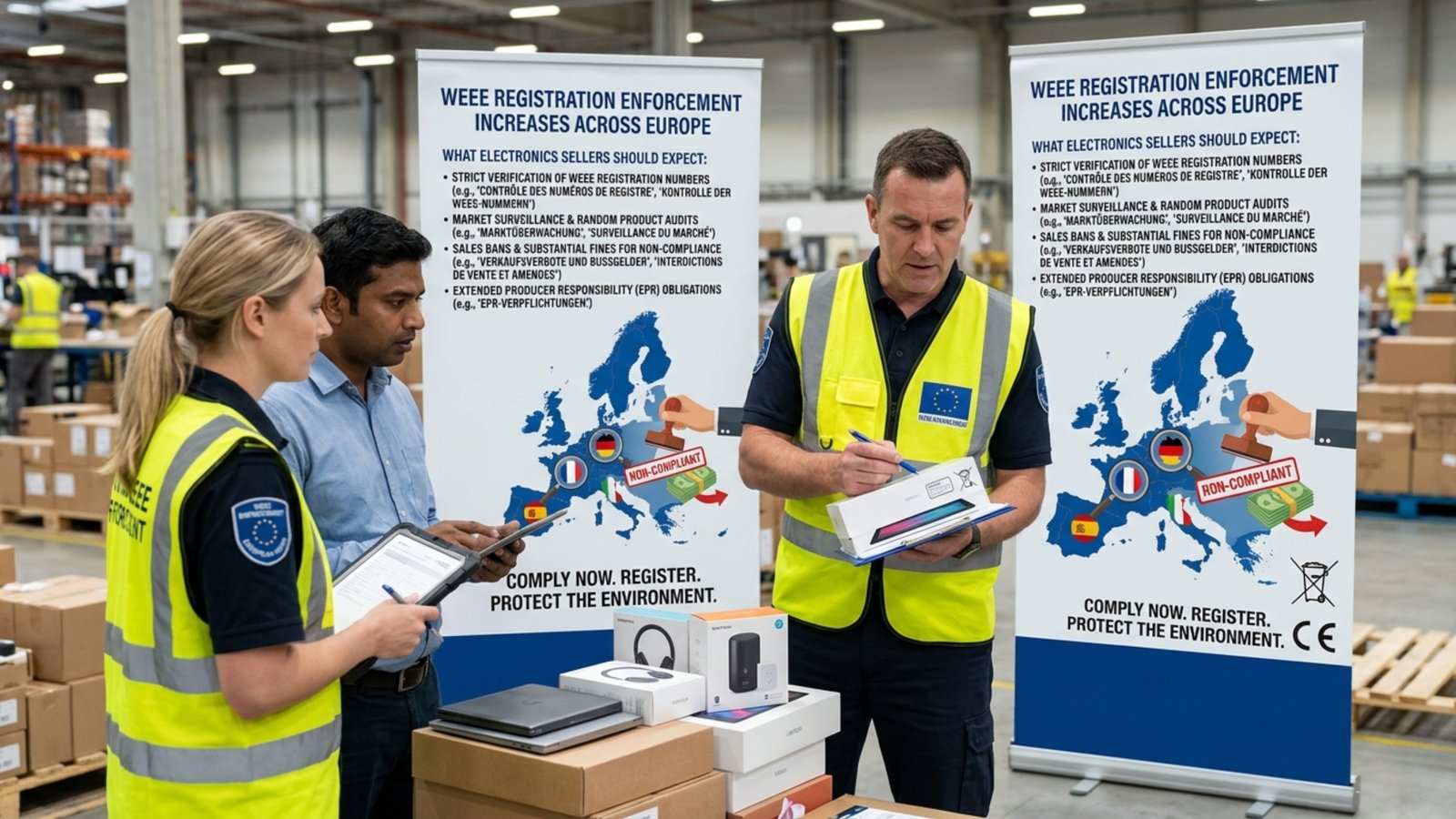
While these rules have been in place for years, national environmental agencies across Europe have significantly increased their data-sharing and inspection capabilities. They are now using AI-driven tools to cross-reference customs data with marketplace sales, identifying "ghost sellers" who have bypassed their registration duties.
The Core Objective
The goal is simple: Extended Producer Responsibility (EPR). The EU wants to ensure that the hazardous materials found in electronics are safely recycled and that valuable raw materials are recovered. If you sell the product, you are responsible for its "end-of-life" management.
Does Your Business Need WEEE Registration ?
Many sellers wrongly assume that if they don't manufacture the electronics themselves, they are exempt. This is a dangerous misconception.
Under EU law, a "producer" is defined as any entity that puts EEE on the market for the first time in a specific country. This includes:
- Manufacturers based in the EU.
- Importers bringing goods into the EU.
- Online retailers selling directly to end-users in an EU country, even if the seller is based outside the EU.
- Rebranders selling white-label products under their own trademark.
If your product requires an electric current or an electromagnetic field to function, it is almost certainly in scope.
The Consequences of Ignoring Compliance
Regulatory authorities are no longer issuing polite warnings. Enforcement actions have become swift and severe:
- Product Bans: Marketplaces are legally obligated to block listings that lack valid WEEE registration numbers. A single compliance gap can shut down your entire sales channel overnight.
- Stiff Financial Penalties: Fines for non-compliance are calculated based on the volume of goods sold. For many businesses, these fines can be retroactive, leading to massive, unexpected hits to your bottom line.
- Reputational Damage: Many European countries publish the names of non-compliant entities. In a market that prioritizes sustainability, losing the trust of your customers is a permanent blow to your brand.
- Legal Liability: In some jurisdictions, individual company directors can be held personally responsible for environmental regulatory breaches.
How to Navigate the Complexity
The challenge for most sellers is that the WEEE Directive is an EU-wide framework, but enforcement is handled at the national level. This means that if you sell in Germany, France, and Italy, you aren't just dealing with one set of rules—you are dealing with three distinct registers, three different reporting formats, and three sets of local fees.
Your Action Plan for 2026:
- Audit Your Product Portfolio: Identify exactly which of your SKUs fall under the directive.
- Centralize Your Data: Maintain a clear record of units sold by weight, product category, and country.
- Appoint an Authorized Representative (AR): If you are a non-EU business, you are legally required to appoint a local representative to act on your behalf.
- Automate Reporting: Don't rely on manual spreadsheets. Compliance deadlines are strict, and errors in reporting can trigger an audit.
Partnering for Peace of Mind with Complico Consulting GmbH
Navigating the bureaucratic maze of European environmental compliance is a full-time job and one that can easily distract you from scaling your business. At Complico Consulting GmbH, we specialize in turning the complexity of WEEE registration into a seamless, automated, and worry-free process.
Whether you are a startup launching your first product in Germany or an established e-commerce brand expanding across the continent, our experts provide:
- End-to-End Registration Support: We handle the paperwork with national authorities so you get your registration numbers without the headache.
- Marketplace Compliance: We ensure your compliance data is correctly formatted for Amazon, eBay, and other platforms to prevent account suspensions.
- Strategic Advisory: We help you navigate "eco-modulation" fees, where better product design can lead to lower recycling costs.
- Ongoing Monitoring: As regulations evolve, we ensure your business remains compliant, giving you the freedom to focus on what you do best: selling.
Don't wait for a compliance notice to arrive in your inbox. Contact Complico Consulting GmbH today for a consultation and secure your market access for the future.
Are you currently unsure if your product range meets the latest EU requirements ? Reach out to our team at Complico Consulting GmbH to schedule your compliance health check today.
More About WEEE registration Resources: