
Summarize this article with:
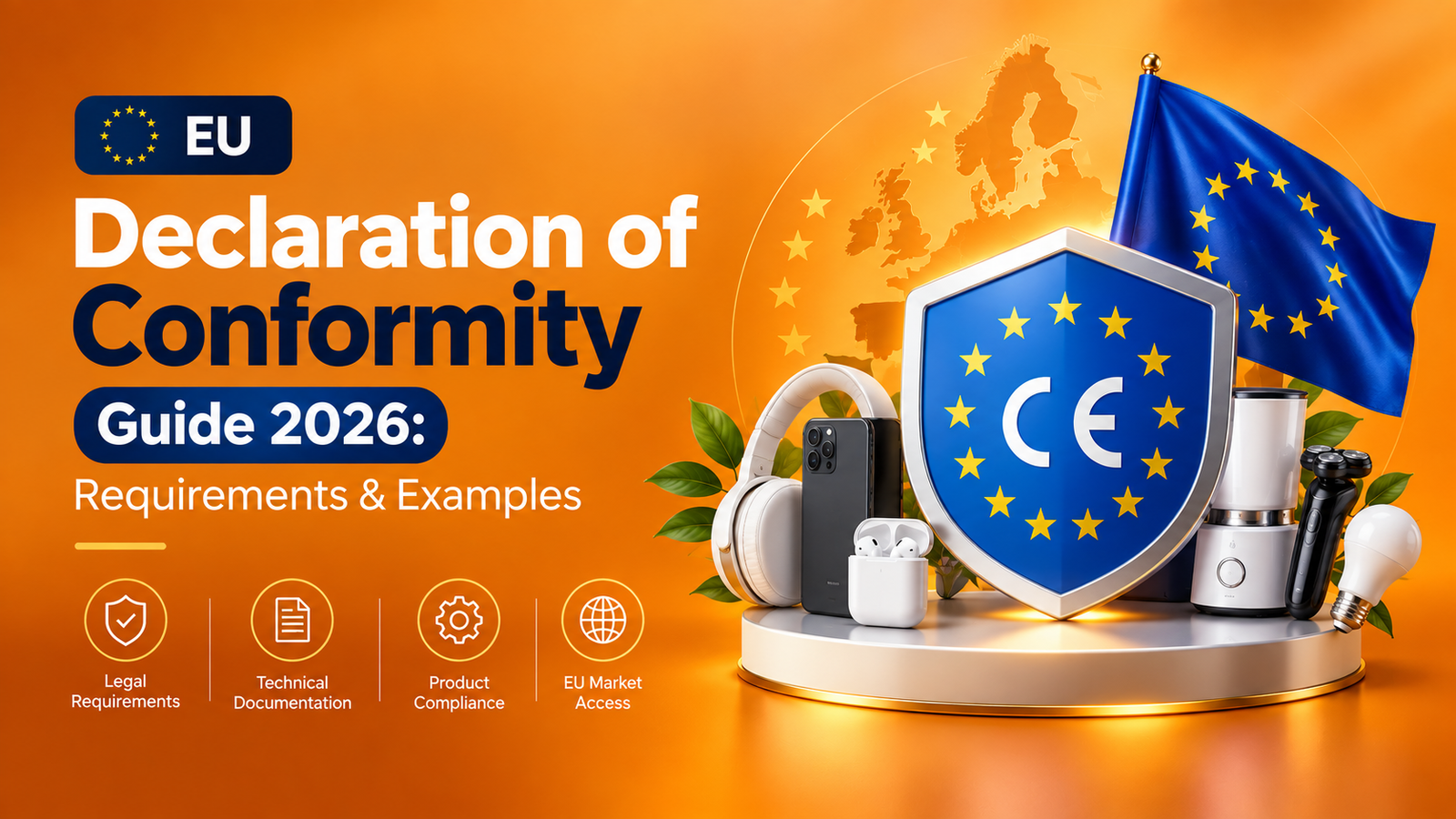
Navigating the European Union’s regulatory landscape can feel like trying to hit a moving target. If you are manufacturing, importing, or selling products within the European Economic Area (EEA), you already know that compliance is not optional it is the barrier to entry. At the center of this regulatory framework is one crucial document: the EU declaration of conformity (DoC).
Whether you are launching a new line of electronics on Amazon, expanding your toy brand into Germany via TikTok Shop, or shipping industrial machinery to France, the EU declaration of conformity is your legal ticket to the market. But as we move into 2025, the rules are tightening. With the enforcement of the General Product Safety Regulation (GPSR) and the upcoming Packaging and Packaging Waste Regulation (PPWR), regulatory authorities and online marketplaces are scrutinizing compliance documentation closer than ever before.
In this comprehensive guide, we will break down exactly what an EU declaration of conformity is, who is legally responsible for it, the mandatory requirements you must include, and real-world examples to help you draft your own.
What is an EU Declaration of Conformity ?
An EU declaration of conformity is a formal, legally binding document in which a manufacturer (or their Authorized Representative) explicitly states that a specific product complies with all applicable essential health, safety, and environmental requirements of relevant European Union directives and regulations.
Think of it as a sworn statement. By signing this document, you are taking full legal responsibility for the product's compliance. It is the final step in the conformity assessment process and is an absolute prerequisite before you can affix the CE marking to your product and place it on the market.
It is important to understand that the DoC is not a passive piece of paper. It is an active legal declaration backed by a comprehensive "Technical File." If a market surveillance authority in any EU Member State questions the safety of your product, the DoC is the very first document they will request. If you cannot produce it—or if it is drafted incorrectly your product can be detained at customs, removed from digital storefronts, or subjected to an expensive, mandatory pan-European recall.
Why 2025 is a Turning Point for EU Compliance
The year 2025 represents a massive shift in how the European Union enforces product safety, particularly for e-commerce and international sellers. If you rely on templates from 2020, you are likely already out of compliance.
1. The General Product Safety Regulation (GPSR)
Replacing the outdated General Product Safety Directive, the GPSR establishes a strict safety net for all consumer products even those that do not require a CE mark. The GPSR mandates rigorous risk assessments, technical documentation, and clear traceability. It also places a heavy burden on online marketplaces like Amazon, eBay, and Etsy to ensure that sellers have valid compliance documentation, including the EU declaration of conformity, on file before a listing goes live.
2. E-Commerce Marketplace Gatekeeping
Gone are the days when a non-EU seller could ship a container of unverified goods into a European fulfillment center. Today, platforms like Amazon and TikTok Shop act as secondary regulators. They utilize automated compliance algorithms to verify your DoC. If your document lacks a required standard, references an outdated directive, or is missing the signature of an EU-based entity, your listing will be suspended instantly.
3. The Push for Circular Economy and Sustainability
New frameworks, such as updates to the Waste Electrical and Electronic Equipment (WEEE) directive, Extended Producer Responsibility (EPR) mandates, and the incoming Packaging and Packaging Waste Regulation (PPWR), mean that your compliance obligations extend beyond the product itself to its packaging and lifecycle. Your DoC and supporting documentation must increasingly reflect these environmental standards.
Who is Responsible for the EU Declaration of Conformity ?
One of the most common points of confusion is determining exactly whose name and signature belongs on the document. The EU defines roles very specifically.
The Manufacturer
The primary responsibility always lies with the legal manufacturer. In the eyes of the EU, the "manufacturer" is the entity that designs or manufactures a product and markets it under their own name or trademark. Even if you outsource production to a factory in China, if your brand name is on the box, you are the manufacturer. You must draw up and sign the EU declaration of conformity.
The EU Authorized Representative
If the manufacturer is located outside of the European Union (e.g., in the US, UK, or Asia), they are legally required under the Market Surveillance Regulation to appoint an economic operator established within the EU.
This is where an EU Authorized Representative (or EU Responsible Person) steps in. The Authorized Representative acts as the official liaison between the non-EU manufacturer and European authorities. They hold the DoC and the technical documentation, ensuring it is available to market surveillance authorities upon request. In many cases, their name, address, and contact details must be explicitly stated on the EU declaration of conformity and the product packaging.
The Importer and Distributor
While the importer does not typically draft the DoC (unless they rebrand the product, thereby becoming the legal manufacturer), they have a strict legal duty to verify that the manufacturer has drawn up the DoC and affixed the CE mark. Importers must keep a copy of the EU declaration of conformity for 10 years after the product has been placed on the market.
Step-by-Step Requirements: What Must Your DoC Include ?
An EU declaration of conformity must follow a specific structure. Missing even one of these elements can render the document invalid. Here are the mandatory requirements for 2025:
1. Unique Identification of the Product
You must clearly identify the product so that the DoC can be unequivocally linked to the item in the physical world. This includes:
- Product name and generic description.
- Model number, type, or batch/serial number.
- A high-quality color photograph of the product (highly recommended, and mandatory for certain categories like toys).
2. Name and Address of the Manufacturer
State the full legal business name and registered postal address of the manufacturer. A simple P.O. Box is not acceptable.
3. Name and Address of the Authorized Representative
If you are a non-EU manufacturer, you must include the full name and address of your appointed EU Authorized Representative. This proves to customs and marketplaces that you have a legal footprint within the Union.
4. The Statement of Sole Responsibility
The document must contain the exact phrase: "This declaration of conformity is issued under the sole responsibility of the manufacturer." Do not alter this wording.
5. Object of the Declaration
Provide a concise statement describing what the product is, ensuring that it allows for traceability. For example: "Object of the declaration: 200W LED Floodlight, intended for outdoor industrial use."
6. Applicable Union Harmonization Legislation
You must list every single EU directive or regulation that applies to the product. A common mistake is declaring conformity to only one directive when several apply. For example, a simple electronic toy must comply with:
- The Toy Safety Directive (2009/48/EC)
- The Electromagnetic Compatibility (EMC) Directive (2014/30/EU)
- The Restriction of Hazardous Substances (RoHS) Directive (2011/65/EU)
7. References to Harmonized Standards
This is the most technical part of the document. You must list the specific European Harmonized Standards (EN standards) used to prove compliance, including the version year.
Correct: EN 71-1:2014+A1:2018 (Safety of toys - Part 1: Mechanical and physical properties)
Incorrect: EN 71 (Too vague, lacks version and specific part).
8. Notified Body Details (If Applicable)
For high-risk products (like medical devices, certain machinery, or personal protective equipment), a third-party laboratory known as a Notified Body must be involved in the assessment. If this is the case, you must state the Notified Body's name, identification number, the procedure they performed, and the certificate number they issued.
9. Signature and Date
The DoC must be signed by an individual with the legal authority to bind the manufacturing company. It must include:
- Place and date of issue.
- Name and functional title of the signatory (e.g., "Jane Doe, Chief Compliance Officer").
- A physical or legally binding digital signature.
EU Declaration of Conformity Example / Template
Below is a standardized template that aligns with the requirements of the New Legislative Framework (NLF). You can adapt this for your own products, ensuring you fill in the specific details accurately.
EU DECLARATION OF CONFORMITY 1. Product Model / Type: [Insert Model Number, Batch, or Serial Number e.g., Model XJ-9000 Bluetooth Speaker] 2. Manufacturer: [Insert Full Legal Company Name] [Insert Full Postal Address] 3. EU Authorized Representative (if applicable): [Insert Name of Authorized Representative] [Insert EU Address] 4. This declaration of conformity is issued under the sole responsibility of the manufacturer. 5. Object of the Declaration: [Insert descriptive text allowing traceability, e.g., Portable wireless Bluetooth speaker, black, 15W output. Include a color image if applicable]. 6. The object of the declaration described above is in conformity with the relevant Union harmonization legislation: Radio Equipment Directive (RED) 2014/53/EU Restriction of Hazardous Substances (RoHS) Directive 2011/65/EU 7. References to the relevant harmonized standards used or references to the other technical specifications in relation to which conformity is declared: Health & Safety: EN 62368-1:2014/A11:2017 EMC: EN 301 489-1 V2.2.3, EN 301 489-17 V3.2.4 Radio Spectrum: EN 300 328 V2.2.2 RoHS: EN IEC 63000:2018 8. Notified Body (if applicable): [The notified body (Name, Number) performed (description of intervention) and issued the EU-type examination certificate: (Certificate Number)] OR state "Not Applicable" if a notified body was not required. 9. Additional Information: [Any other relevant information] Signed for and on behalf of: [Manufacturer Name] Place and Date of Issue: [e.g., Shenzhen, China. 15th March 2025] Name, Function: [e.g., John Smith, Director of Quality Assurance] Signature: ___________________________
Common Mistakes That Lead to Rejections
Drawing up a DoC might seem like a simple administrative task, but a single typo can halt your entire supply chain. Market surveillance authorities and platform compliance teams frequently reject documents for the following reasons:
- "Orphan" Directives: Listing a directive that does not apply to the product, showing a lack of understanding of the regulations.
- Outdated Standards: Citing an EN standard that has been withdrawn or superseded. You must constantly monitor the Official Journal of the European Union (OJEU) to ensure your listed standards are current.
- Missing the Technical File: The DoC is just the cover page. You must possess the full Technical Documentation (test reports, risk assessments, circuit diagrams, bills of materials) to back up the claims made on the DoC.
- Language Barriers: The EU declaration of conformity must be translated into the language or languages required by the EU Member State where the product is placed on the market.
- No EU Contact: For non-EU sellers, failing to list an EU Responsible Person on the document and the packaging guarantees a block at customs and rejection from Amazon.
Navigating E-Commerce Compliance in 2025
If your primary sales channels are Amazon, eBay, Etsy, or TikTok Shop, the EU declaration of conformity is the cornerstone of your account health.
Under the Market Surveillance Regulation and GPSR, these platforms are legally obligated to ensure that no unsafe or non-compliant product reaches European consumers. When you create a listing for an electronics item, toy, or cosmetic product, the platform's portal will demand an upload of your DoC, your CE certificates, and the contact details of your EU Responsible Person.
If the details on your DoC do not perfectly match your seller profile, your product labeling, and your test reports, the automated systems will flag the discrepancy. Resolving these listing hijackings and suspensions can take weeks of lost sales and frustrating back-and-forth with seller support. Having your documentation audited by a professional compliance partner before you ship your inventory is the only way to guarantee uninterrupted sales.
Secure Your Market Access with Complico Consulting GmbH
Drafting an accurate EU declaration of conformity requires a deep understanding of European legislation, harmonized standards, and precise legal phrasing. A simple template downloaded from the internet is rarely enough to protect your business from the strict enforcement of 2025.
At Complico Consulting GmbH, we specialize in simplifying EU regulatory compliance for international e-commerce sellers and global manufacturers. We understand the specific hurdles you face when selling across borders and dealing with the strict gating processes of Amazon and other major marketplaces.
Whether you need a comprehensive review of your existing documentation, assistance determining which directives apply to your new product line, or you require a reliable EU Authorized Representative / Responsible Person to act as your legal foothold in Europe, we provide end-to-end solutions tailored to your business.
Don't let a paperwork error disrupt your European growth strategy. Let us handle the regulatory complexities so you can focus on scaling your brand.
Ready to safeguard your European market entry?
Email: info@complicoconsulting.com
WhatsApp: +49 160 7959362
Headquarters: Bahnhofstr 12, 63549, Ronneburg, Germany
VAT: DE459923379
FAQ – EU Declaration of Conformity (DoC)
1. What is an EU Declaration of Conformity (DoC) ?
An EU Declaration of Conformity (DoC) is a legally binding document in which a manufacturer declares that a product complies with all applicable European Union legislation, including relevant health, safety, and environmental requirements.
2. Who is responsible for issuing the EU Declaration of Conformity ?
The manufacturer is primarily responsible for preparing and signing the DoC. For non-EU manufacturers, an EU Authorized Representative may hold the document and assist with regulatory obligations where required.
3. Which products require an EU Declaration of Conformity ?
Products subject to CE marking legislation typically require a DoC. These include electronics, machinery, toys, radio equipment, personal protective equipment (PPE), medical devices, and many other regulated products.
4. What information must be included in a DoC ?
A valid EU Declaration of Conformity generally includes:
- Product identification
- Manufacturer details
- EU Authorized Representative details (if applicable)
- Applicable EU legislation
- Harmonized standards used
- Declaration of responsibility
- Place and date of issue
- Name, position, and signature of the authorized person
5. Is an EU Declaration of Conformity mandatory for CE marking ?
Yes. For products covered by CE marking legislation, a DoC is a mandatory document and must be completed before the CE mark is affixed and the product is placed on the EU market.
6. What is the difference between a CE Certificate and a Declaration of Conformity ?
A Declaration of Conformity is a legal declaration issued by the manufacturer. A CE certificate, where applicable, may be issued by a Notified Body for products requiring third-party conformity assessment. Not all CE-marked products require a CE certificate.
7. How long must the Declaration of Conformity be retained ?
Manufacturers and, where applicable, importers should generally retain the Declaration of Conformity and supporting technical documentation for at least 10 years after the product is placed on the EU market.
8. Can non-EU manufacturers issue a Declaration of Conformity ?
Yes. Non-EU manufacturers remain responsible for issuing the DoC. However, they may also need to appoint an EU Authorized Representative or Responsible Person depending on the applicable legislation.
9. What happens if a product does not have a valid Declaration of Conformity ?
Products without a valid DoC may face customs delays, market surveillance actions, product recalls, marketplace listing removals, financial penalties, and restrictions on sale within the EU.
10. What documents support an EU Declaration of Conformity ?
The DoC should be supported by technical documentation, including product risk assessments, test reports, design information, compliance calculations, and other evidence demonstrating conformity with applicable EU legislation.
More About EU Resources: