
Summarize this article with:
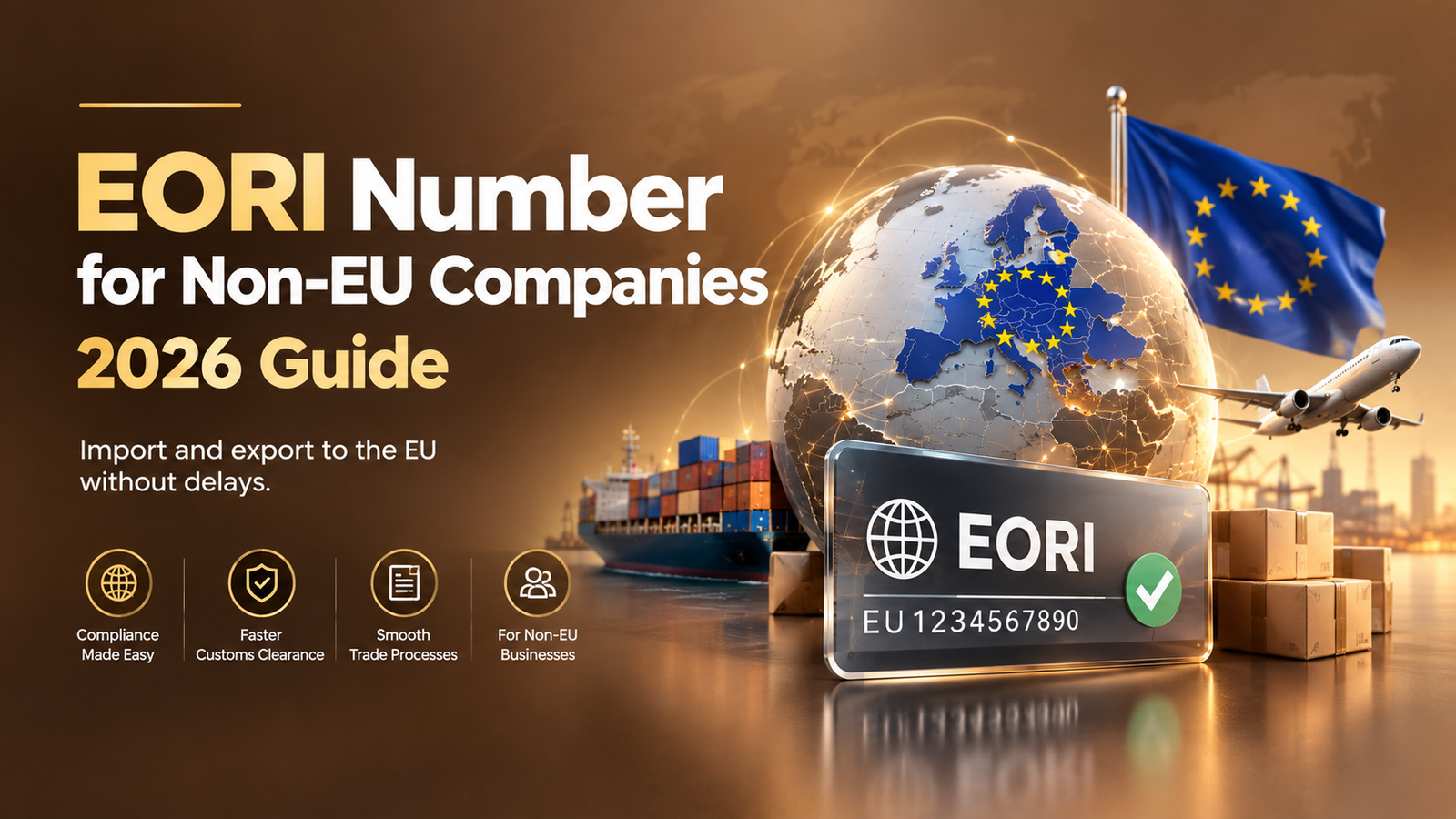
EORI Number for Non-EU Companies: The Complete 2026 Guide to European Customs Access
If there is one administrative hurdle that consistently catches international businesses off guard, it is customs compliance. Picture this scenario: your shipping container has just arrived at the Port of Rotterdam, or a cargo plane filled with your products has landed in Frankfurt. Your European buyers are waiting. But instead of smoothly clearing customs, your shipment is flagged, delayed, and racking up exorbitant daily storage fees. The reason ? A missing alphanumeric code.
For Non-EU Companies, understanding and securing an Economic Operators Registration and Identification (EORI) number is no longer just a bureaucratic formality—it is the essential passport that allows your commercial goods to legally cross European borders.
At Complico Consulting GmbH, we regularly help global businesses streamline their European market entry and regulatory operations. In this comprehensive, SEO-driven guide, we will dissect exactly what Non-EU Companies need to know about EORI numbers in 2026, from the latest regulatory shifts to a step-by-step application blueprint.
1. What is an EORI Number ?
Introduced by the European Union to enhance continental security and streamline customs processing, the EORI number is a unique identification code assigned to economic operators interacting with EU customs authorities.
Think of it as your company's digital fingerprint for international trade. Whether you are importing heavy industrial machinery into Germany, exporting luxury goods out of Italy, or moving goods in transit across the continent, customs administrations across all 27 Member States use this single identifier to track and process your transactions.
The core philosophy of the EORI system is centralization. For Non-EU Companies, this identifier is critical because European customs software is entirely automated. Without a valid EORI number, any customs declaration your business attempts to file will be instantly rejected by the system, bringing your supply chain to a halt.
2. Do Non-EU Companies Actually Need an EORI Number ?
A pervasive misconception among foreign exporters is that only businesses physically established within the European Union need to worry about European customs registrations. This is demonstrably false. The requirement is not based on where your corporate headquarters is located, but rather on the specific customs activities your business performs.
Non-EU Companies are legally required to hold a valid EORI number if they engage in any of the following activities within the EU customs territory:
Lodging a Customs Declaration: If your company acts as the "declarant" (the legal importer or exporter of record), you must have your own EORI.
Filing Summary Declarations: This includes Entry Summary Declarations (ENS) and Exit Summary Declarations (EXS).
Acting as a Transport Carrier: If you operate as a transport company moving goods by sea, air, or inland waterway into the European Union.
Filing Temporary Storage Declarations: Required if your goods are held temporarily at a port or airport before being assigned a formal customs procedure.
Applying for Customs Decisions: Including Binding Tariff Information (BTI), Binding Origin Information (BOI), or applying for Authorized Economic Operator (AEO) status.
The Incoterms Factor: Why "DDP" Changes Everything
Your shipping terms dictate your customs responsibilities. If you sell goods to European buyers under terms like DAP (Delivered at Place) or FOB (Free on Board), the European buyer usually assumes the role of the importer of record. In these cases, the buyer utilizes their own EU EORI number, and your foreign entity may not need one.
However, if you sell goods under the DDP (Delivered Duty Paid) Incoterm, the dynamic completely flips. Under DDP, your company assumes all responsibility, risks, and costs associated with transporting the goods, paying duties, and clearing customs. As the legal importer of record, Non-EU Companies selling under DDP must possess their own EORI number, and typically require an Importer/Exporter of Record (IOR/EOR) service.
3. The 2026 ICS2 Update and EORI Requirements
Compliance is a moving target, and 2026 has brought significant changes to how European customs operate. The most critical update for global supply chains is the final rollout phases of the Import Control System 2 (ICS2).
ICS2 is the EU's new advance cargo information and risk management system. It requires detailed data about goods to be submitted to EU customs before the goods even arrive at the external borders. For maritime, road, and rail transport, the Entry Summary Declaration (ENS) data requirements are stricter than ever.
Because ICS2 relies on exact operator identification to assess security risks, a valid EORI number is mandatory for all parties mentioned in the ENS filing. If Non-EU Companies are listed as the consignee or the declarant in the advance cargo data, lacking an EORI number will result in the shipment being denied permission to load at the foreign port of departure.
4. The "Single Number" Rule and Jurisdictional Nuances
The European customs framework operates on a strict single-number rule. This mandate dictates that a legal entity can only hold one valid EORI number at any given time, and this single number is recognized interchangeably across all 27 EU Member States.
For companies incorporated inside the EU, the application rule is simple: you apply in the Member State where you are established. But how does this work for foreign entities?
Where Do Non-EU Companies Apply ?
For Non-EU Companies, the application must be submitted to the customs authority of the Member State where you first lodge a declaration or apply for a customs decision.
Scenario A: A US-based manufacturing corporation plans to import its first batch of goods through the Port of Hamburg. They must apply for their EORI number through the German customs portal (Zoll-Portal).
Scenario B: An Australian eCommerce brand is utilizing a third-party logistics (3PL) warehouse in Amsterdam and will file their first import declaration in the Netherlands. They must apply through the Dutch Customs Administration.
Once the US or Australian business receives their German or Dutch EORI number, they can legally use it to clear goods in France, Spain, Poland, or any other EU nation. Attempting to register for a second EORI number in another Member State is not only unnecessary but will result in the application being actively blocked by the central EU database.
5. EU vs. UK EORI Numbers: The Brexit Divide
The logistical landscape of Europe was permanently altered by Brexit, and the administrative echo continues to impact global supply chains today. One of the most frequent points of confusion for Non-EU Companies is the stark difference between European and British EORI numbers.
Because the United Kingdom is no longer part of the EU customs union, an EU EORI number is entirely invalid for British customs clearance. Conversely, a UK EORI number is completely invalid for European customs clearance.
The "Double EORI" Requirement
If your international expansion strategy involves importing goods into both the UK and the EU markets, you will be legally required to hold two distinct identifiers:
A GB EORI Number: Issued by His Majesty's Revenue and Customs (HMRC) in the UK, starting with the prefix "GB".
An EU EORI Number: Issued by an EU Member State, starting with the two-letter country code of that state (e.g., "DE" for Germany, "FR" for France).
The Northern Ireland Protocol
If your supply chain routes goods into or out of Northern Ireland, compliance becomes even more granular. You will require a specific EORI number starting with the prefix "XI". This protocol ensures compliance with the unique customs border arrangements established for Northern Ireland post-Brexit. Non-EU Companies must audit their logistics routes meticulously; deploying a GB EORI in Northern Ireland or an EU EORI in London will result in immediate cargo seizures at the border.
6. Step-by-Step Application Guide for Non-EU Companies
Securing your EORI number does not have to be a severe bottleneck if you approach it strategically. Here is the exact roadmap Complico Consulting GmbH recommends for Non-EU Companies preparing to enter the European market, as covered in our EORI number and customs registration guide.
Step 1: Map Your Supply Chain
Before interacting with any customs authority, determine exactly where your goods will first enter the EU and require a formal declaration. This decision dictates which country's customs portal you must use. Do not leave this step to your freight forwarder to decide at the last minute; it is a fundamental business strategy decision.
Step 2: Gather Corporate Documentation
European customs authorities are legally bound to verify the existence of your entity. While specific formatting requirements vary slightly between Member States, Non-EU Companies must prepare the following foundational documents:
An official extract from your local commercial trade register (e.g., Certificate of Incorporation or Articles of Organization), typically dated within the last 6 months.
Documentary proof of the company's registered headquarters address.
Valid identification documents (such as passports) of the company's legal representatives or managing directors.
Note: Depending on the Member State of application, these documents may require certified translation into the local language or English, and potentially a Hague Apostille or formal notarization.
Step 3: Assess Your European VAT Position
While the EORI number is exclusively for customs identification, it is inherently linked to taxation. Does your company have a European Value Added Tax (VAT) number? If your foreign entity is already VAT-registered in the target Member State, you must link this VAT number to your EORI application.
Crucial distinction: Having an EORI number does not automatically register you for VAT, and having an EU VAT number does not replace the legal requirement for an EORI. They are entirely separate compliance regimes.
Step 4: Submit via the National Customs Portal
Paper applications are essentially a relic of the past. You must submit your application through the secure electronic portal of the chosen Member State.
Germany: Processed via the Zoll-Portal. As of 2026, third-country operators must ensure their digital data matches their physical documents perfectly.
France: Processed via the SOPRANO portal. Note that France recently transitioned to a SIREN-based format, streamlining identification for multi-site operations.
Ireland: Processed via the Revenue Online Services (ROS) portal, which now mandates the inclusion of an Eircode for accurate geographic tracking.
Step 5: Validation and Activation
Processing timelines are not uniform. Some customs authorities issue the number within 48 hours, while others may take 5 to 10 working days—especially when manual verification of foreign corporate documents is required. Furthermore, once the national authority issues the number, it can take an additional 24 to 48 hours for the code to replicate across the European Commission's central database (EOS).
Expert Tip: Never attempt to ship your commercial goods until you can actively verify your new EORI number on the official European Commission public validation website. Shipping on the assumption of approval is a costly gamble.
7. Common Pitfalls and Expensive Assumptions
Even seasoned logistics professionals and supply chain managers make critical errors when navigating European customs law. Non-EU Companies should be acutely aware of the following operational traps.
Trap 1: The Freight Forwarder Assumption
"My logistics partner (DHL, FedEx, UPS) will handle all customs clearances, so my company does not need its own EORI."
This is the most common—and most expensive—assumption a foreign business can make. If your freight forwarder is acting as an indirect representative, they assume joint legal and financial liability for your customs debt. Because of this massive financial risk, most forwarders absolutely refuse to act in this capacity.
Instead, forwarders operate as direct representatives. Under direct representation, they submit the paperwork in your name and entirely on your behalf. This legally makes you the declarant. Therefore, you must provide a valid EORI number. Without it, the forwarder is paralyzed and cannot legally clear your goods.
Trap 2: Mismatched Corporate Data
Customs clearance in 2026 is an algorithm-driven process. If the company name, suffix (e.g., LLC vs. Inc.), or registered address on your EORI registration does not perfectly match the data printed on your Commercial Invoice, Bill of Lading, and the customs declaration itself, the automated software will flag a mismatch and halt clearance. Total data consistency across all transport and legal documents is non-negotiable.
Trap 3: Ignoring Temporary Imports
Some Non-EU Companies assume they only need an EORI for permanent sales. However, if you are importing goods temporarily—such as bringing specialized equipment into Europe for a trade show, a filming production, or temporary infrastructure testing—you still require an EORI number to lodge the temporary admission customs declaration, unless you are utilizing an ATA Carnet in specific allowable scenarios.
8. Frequently Asked Questions for Global Operators
Can Non-EU Companies hold more than one EU EORI number ?
No. The European Commission strictly enforces the single-number rule to prevent customs fraud and systemic confusion. If you are a Canadian corporation holding a Spanish EORI number, you must use that exact same identifier to clear goods in Germany, Italy, or Poland.
How long is an EORI number valid ?
Once issued, an EORI number does not expire. It remains valid indefinitely unless the business formally ceases to exist, undergoes a fundamental legal restructuring (such as transitioning into an entirely new legal corporate entity), or formally requests a cancellation from the issuing authority.
Is there a governmental fee to apply for an EORI number ?
No, European customs authorities do not charge an application or processing fee to issue an EORI number. The government process is entirely free. However, Non-EU Companies will routinely incur necessary professional costs for legal counsel, certified document translation, notarization, and strategic consulting to ensure the application is structured correctly on the very first attempt.
Can I use my local tax ID or VAT number instead of an EORI ?
Absolutely not. Your domestic corporate tax ID (such as a US Employer Identification Number) or even a European VAT number cannot be used as a substitute for an EORI number on customs declarations. They serve entirely distinct legal and regulatory purposes.
Will my company details be made public ?
When applying, you will be asked if you consent to having your company's name and address published on the European Commission's public EORI validation website. If you decline, the public database will only confirm that your EORI number is "Valid," without revealing your corporate identity to competitors.
Secure Your European Market Entry with Complico Consulting GmbH
Attempting to penetrate the lucrative European market without airtight customs compliance is a guaranteed recipe for delayed shipments, frustrated buyers, and severely damaged profit margins. The EORI number is simply the first foundational layer of a much larger, highly complex regulatory framework.
For Non-EU Companies, navigating the intersection of customs law, VAT obligations, and sustainability mandates requires specialized, localized expertise. It is no longer enough to simply obtain a registration number; modern global businesses must structure their entire supply chain to align seamlessly with strict, constantly evolving EU directives.
At Complico Consulting GmbH, we specialize in transforming opaque European regulations into clear, actionable business strategies. We partner with Non-EU Companies to seamlessly manage the full spectrum of European compliance—from initial EORI and VAT registrations to comprehensive Extended Producer Responsibility (EPR) consulting for packaging, WEEE, and single-use plastics across highly regulated markets like Sweden, Germany, and beyond.
Do not let a missing identifier keep your products off European shelves or stuck in a port terminal. By securing your compliance architecture today, you ensure resilient, scalable, and uninterrupted commercial trade for 2026 and long into the future.
Ready to streamline your European expansion and secure your supply chain? Contact Complico Consulting GmbH today to ensure your international customs operations are fully compliant, highly efficient, and perfectly built for cross-border growth. View our pricing or explore our full range of compliance services.
More About EORI Resources: