
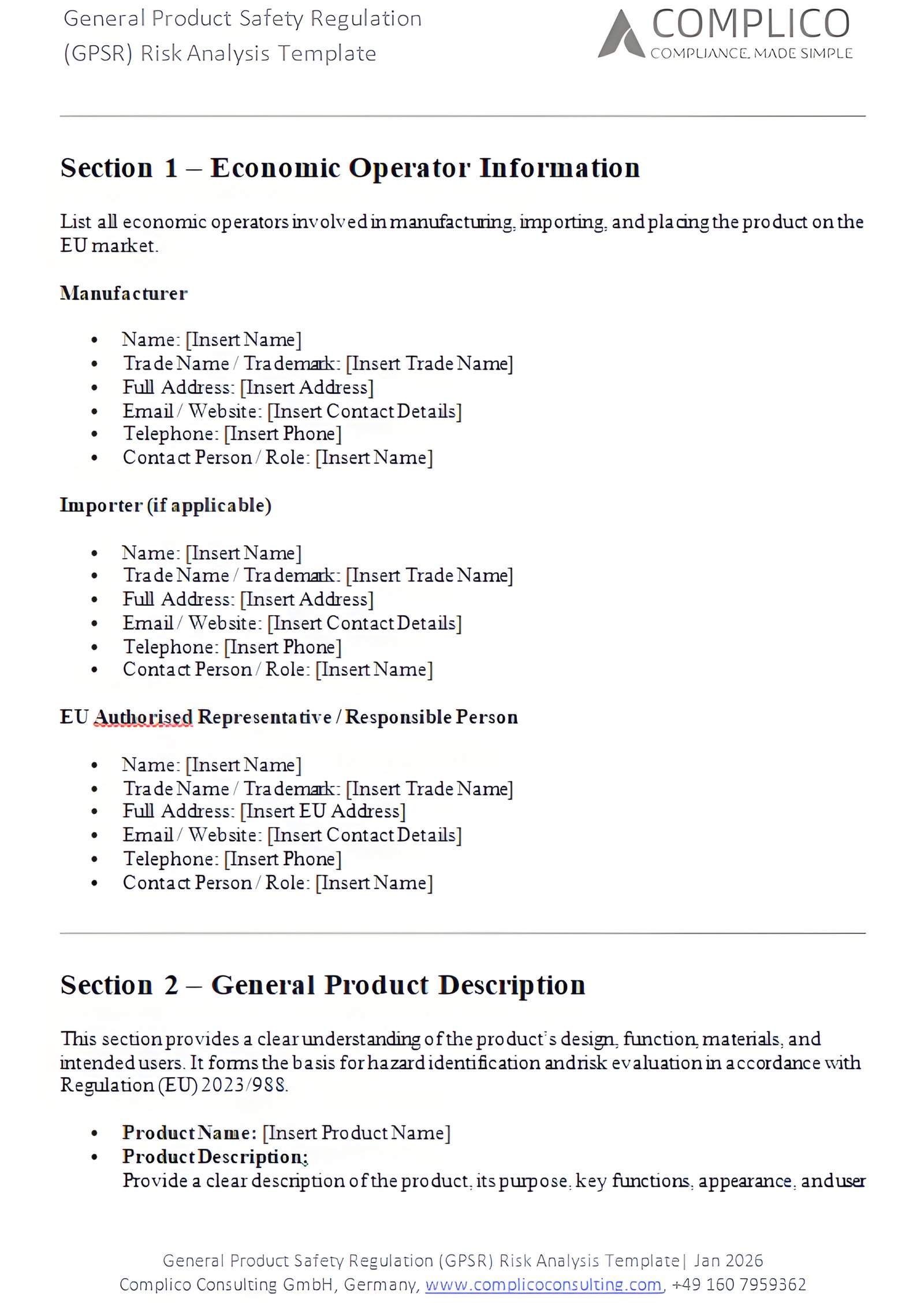
General Product Safety Regulation (GPSR) Risk Analysis Template
Navigating the EU GPSR: Your Essential Risk Analysis Template Selling consumer products in the European Union has always required a sharp focus on safety. However, since the General Product Safety Regulation...
About this resource
Navigating the EU GPSR: Your Essential Risk Analysis Template
Selling consumer products in the European Union has always required a sharp focus on safety. However, since the General Product Safety Regulation (GPSR)—Regulation (EU) 2023/988—took effect in December 2024, the stakes have been considerably higher. One of the most critical obligations for manufacturers, importers, and EU Responsible Persons under the GPSR is the mandate to conduct and document a comprehensive Internal Risk Analysis for all non-food consumer products.
If you are looking to structure this documentation effectively, you are in the right place. A robust risk analysis does more than just keep you compliant; it protects your customers and shields your brand from product recalls and hefty fines. Let's break down exactly what a GPSR-compliant Risk Analysis Template should look like.
Why Use a Standardized Template ?
Under the GPSR, market surveillance authorities can request your technical documentation at any time. A standardized template ensures consistency across your product lines, helps you systematically identify potential hazards, and provides concrete evidence of your due diligence. It takes the guesswork out of compliance.
The Anatomy of a GPSR Risk Analysis Template
Here is a step-by-step breakdown of the essential sections you must include in your risk assessment framework.
1. Economic Operator Information
Before diving into the product details, you must establish accountability. This section identifies all relevant parties in the supply chain.
Manufacturer: Full legal name, registered trade name, physical postal address, and electronic address (email/website).
EU Importer (if applicable): Contact details to ensure traceability if the manufacturer is outside the EU.
EU Responsible Person: Name and contact information for the entity established in the EU that is legally responsible for compliance tasks.
2. Comprehensive Product Description
You need to clearly define what is being assessed. Vague descriptions can lead to compliance gaps.
Product Name and Function: What is the item, and what is its intended use ?
Identifiers: SKUs, batch codes, serial numbers, or EAN/UPC barcodes.
Materials and Composition: A Bill of Materials (BOM) or a clear list of primary raw materials.
Intended Users: Specifically note if the product is intended for, or likely to be used by, vulnerable groups (e.g., children, the elderly). Age grading is crucial here.
3. Applicable Legal Requirements & Standards
List the regulatory frameworks that govern the product. The GPSR acts as a safety net, but specific, harmonized standards still apply.
EU Directives/Regulations: e.g., REACH (Chemicals), RoHS (Electronics), or the Toy Safety Directive.
Harmonized Standards: e.g., EN 71 for toys, EN 62368 for electrical equipment.
4. Hazard Identification
This is the core of the risk analysis. You must anticipate how the product could cause harm during normal use and reasonably foreseeable misuse. Categorize hazards logically:
Physical & Mechanical: Sharp edges, small parts (choking hazards), instability, or entrapment risks.
Chemical: Presence of restricted substances, allergens, or toxic materials.
Flammability & Thermal: Overheating components, contact with hot surfaces, or fire risks.
Electrical: Short circuits, battery issues, or electric shock risks.
Hygiene & Microbiological: Potential for bacterial growth or contamination (especially relevant for cosmetics or items used in wet environments).
5. Risk Evaluation (Severity vs. Likelihood)
Once a hazard is identified, you must score it. The most standard method is using a risk matrix that compares the severity of a potential injury against the probability of it occurring.
Severity: Minor (requires first aid), Moderate (requires medical attention), Serious (hospitalization), Critical (life-threatening).
Probability: Rare, Unlikely, Possible, Likely, Almost Certain.
Risk Level: Based on the matrix, classify the overall risk as Low, Medium, High, or Critical.
6. Mitigation and Control Measures
How are you addressing the identified risks ? This section proves your active commitment to safety.
Design Changes: Modifying the product engineering to eliminate the hazard (e.g., rounding sharp corners, enlarging small parts).
Manufacturing Controls: Quality assurance checks, visual inspections, or specific testing protocols during production.
Warnings and Instructions: Safety labels, age warnings, clear user manuals, and proper packaging markings.
7. Final Declaration of Safety
Conclude the document with a formal sign-off.
Conclusion: A clear statement declaring that, following the implementation of all control measures, the product is deemed safe under the GPSR requirements.
Signatures: Date and signature of the compliance officer, quality assurance lead, or responsible executive.
Best Practices for Maintaining Compliance
Treat It as a Living Document: A risk analysis is not a "one-and-done" task. If you change a supplier, alter a material, release a new version, or become aware of a safety issue (such as a customer incident reported via the Safety Gate), you must update the assessment.
Leverage Empirical Testing Data: Base your hazard evaluation on hard data whenever possible. Lab test reports from accredited testing facilities are invaluable for proving that a risk has been effectively mitigated.
Document Foreseeable Misuse: The GPSR explicitly requires you to consider how consumers might misuse the product, a topic covered in more depth in our guide on product categories covered by GPSR. If you sell a sturdy decorative box, for instance, you must consider the risk of a child standing on it, even if it wasn't designed as a step stool.
Need help preparing your risk analysis and technical file ? Our team offers dedicated GPSR consulting for online sellers and importers — get in touch to discuss your product portfolio.