
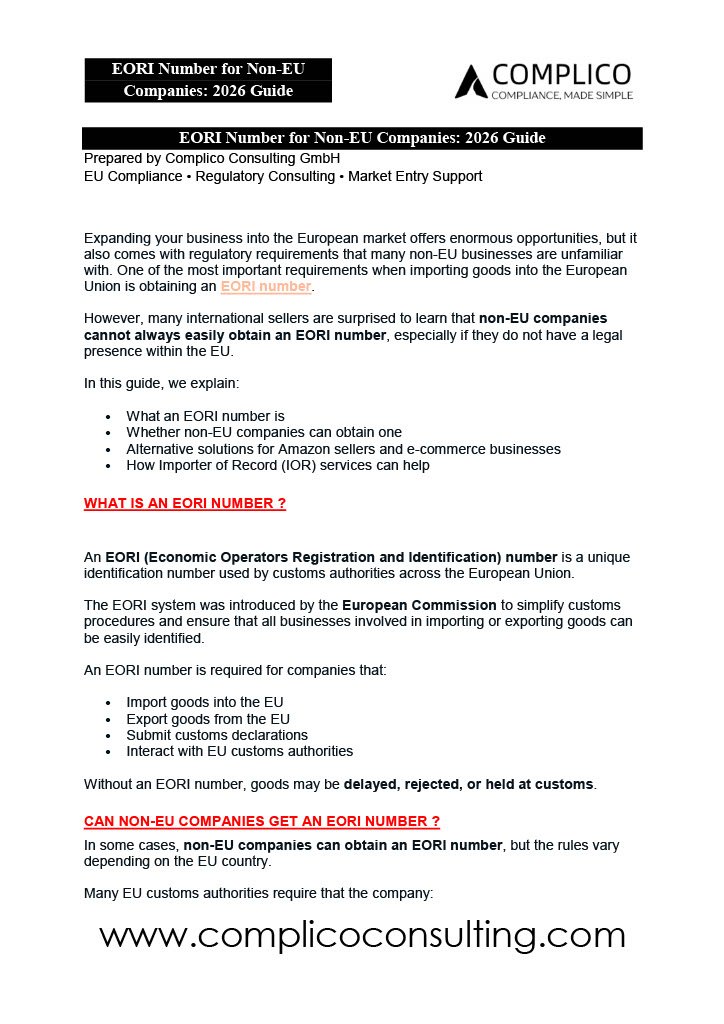
In the fast-paced world of global e-commerce and international trade, getting your goods across borders smoothly is everything. If you are a non-EU company whether based in the US, China, or elsewhere—shipping to the European Union or the United Kingdom in 2026, you cannot afford to ignore your EORI number.Without it, your inventory stops moving, and your storage fees start piling up. Here is everything you need to know to keep your supply chain running smoothly this year.
What is an EORI Number ?
The Economic Operators Registration and Identification (EORI) number is essentially the "passport" for your cargo. It is a unique alphanumeric ID used by customs authorities across the EU (and separately in the UK) to track and secure international shipments.Typically, the format consists of a two-letter country code (like FR for France or DE for Germany) followed by up to 15 alphanumeric characters.
Why Non-EU Companies Need It
You might think, "I'm not based in the EU, so this doesn't apply to me." If you are selling B2C on a marketplace where the platform handles customs, that might be true. However, if your non-EU business acts as the Importer of Record (IOR), lodges customs declarations, or manages temporary storage within the EU, you are legally required to have an EORI number.The "No EORI, No Ship" Rule: Customs authorities will categorically block any commercial shipment lacking a valid EORI number. It must be included on your commercial invoices and customs declarations.
The 2026 Landscape: What's Changing ?
Customs regulations are tightening in 2026 to enhance security and digital tracking:
- Format Overhauls (e.g., France): As of January 1, 2026, France is overhauling its EORI system, shifting from the 14-digit SIRET format to a 9-digit SIREN format. Legacy numbers are being systematically invalidated, meaning operators must ensure their registrations are up to date.
- The Uniqueness Principle: The EU strictly enforces a "one operator, one EORI" rule. If you hold a valid EORI issued in the Netherlands, you cannot apply for another one in France. Attempting to create duplicates will trigger errors and paralyze your flows in the central customs database.
- ICS2 Mandates: With the rollout of the EU's new digital customs system (ICS2), Entry Summary Declarations (ENS) are strictly mandatory, and a valid EORI is the prerequisite for filing them.
UK vs. EU: The "Double EORI" Reality
Post-Brexit, the UK and EU operate entirely separate customs systems. If you plan to sell to both regions, a single number won't cut it.
- EU EORI: Valid across all 27 EU member states. You only need one to clear customs anywhere in the Union.
- GB EORI: Required for importing goods into England, Scotland, and Wales. It starts with GB.
- XI EORI: A specialized identifier required specifically for trading with Northern Ireland under the Northern Ireland Protocol.
How Non-EU Businesses Can Apply
Getting an EORI number is completely free, but for non-EU entities, the process requires a specific approach:
- Determine Your Point of Entry: Non-EU businesses should apply for an EORI number in the first EU country where they intend to lodge a customs declaration.
- Appoint a Representative: Because your business has no physical presence in the EU, you generally cannot apply directly. You will need to appoint an EU-based Fiscal Representative or Indirect Customs Representative to apply on your behalf, as they will share liability for the customs debt.
- Submit the Paperwork: Your representative will submit your business details to the relevant national customs portal. Processing usually takes a few days to a few weeks, so initiate this well before your goods are loaded onto a ship.
EORI vs. VAT: Clearing the Confusion
It is incredibly common to confuse your EORI number with your Value Added Tax (VAT) number, as they are sometimes linked, but they serve completely different legal purposes.
| Feature | EORI Number | VAT Number |
|---|---|---|
| Primary Role | Customs identifier for tracking and security. | Fiscal identifier for tax collection. |
| The Core Question | "Who is physically moving the goods ?" | "Who is paying the tax ?" |
| Can one replace the otherv? | No. An EORI does not prove VAT registration. | No. A VAT number cannot clear customs. |
The Bottom Line: Treat your EORI number as a critical piece of your 2026 supply chain infrastructure. Audit your customs setup, ensure your forwarders have your correct numbers on file, and you'll avoid the dreaded "held at customs" notifications.