The European Union's Packaging and Packaging Waste Regulation (EU 2025/40, or PPWR) represents the most dramatic shift in packaging governance in three decades. By replacing the old 1994 Packaging Directive (PPWD), the EU has eliminated national variations and established a unified set of rules across all 27 member states. For manufacturing leaders, industrial supply chain managers, and brand owners, the cost of misclassification under PPWR is high. Failing to accurately identify your regulatory role or misinterpreting what counts as packaging can lead to market access blocks, supply chain delays, and severe financial penalties. Here is your clear, actionable guide to navigating the manufacturing definitions and guidelines under the PPWR.
Under Article 3(1) No. 13 of the PPWR, a manufacturer is defined as any natural or legal person who:
This definition carries a fundamental principle: For every single unit of packaging placed on the EU market, there is exactly one legal manufacturer across the entire EU.
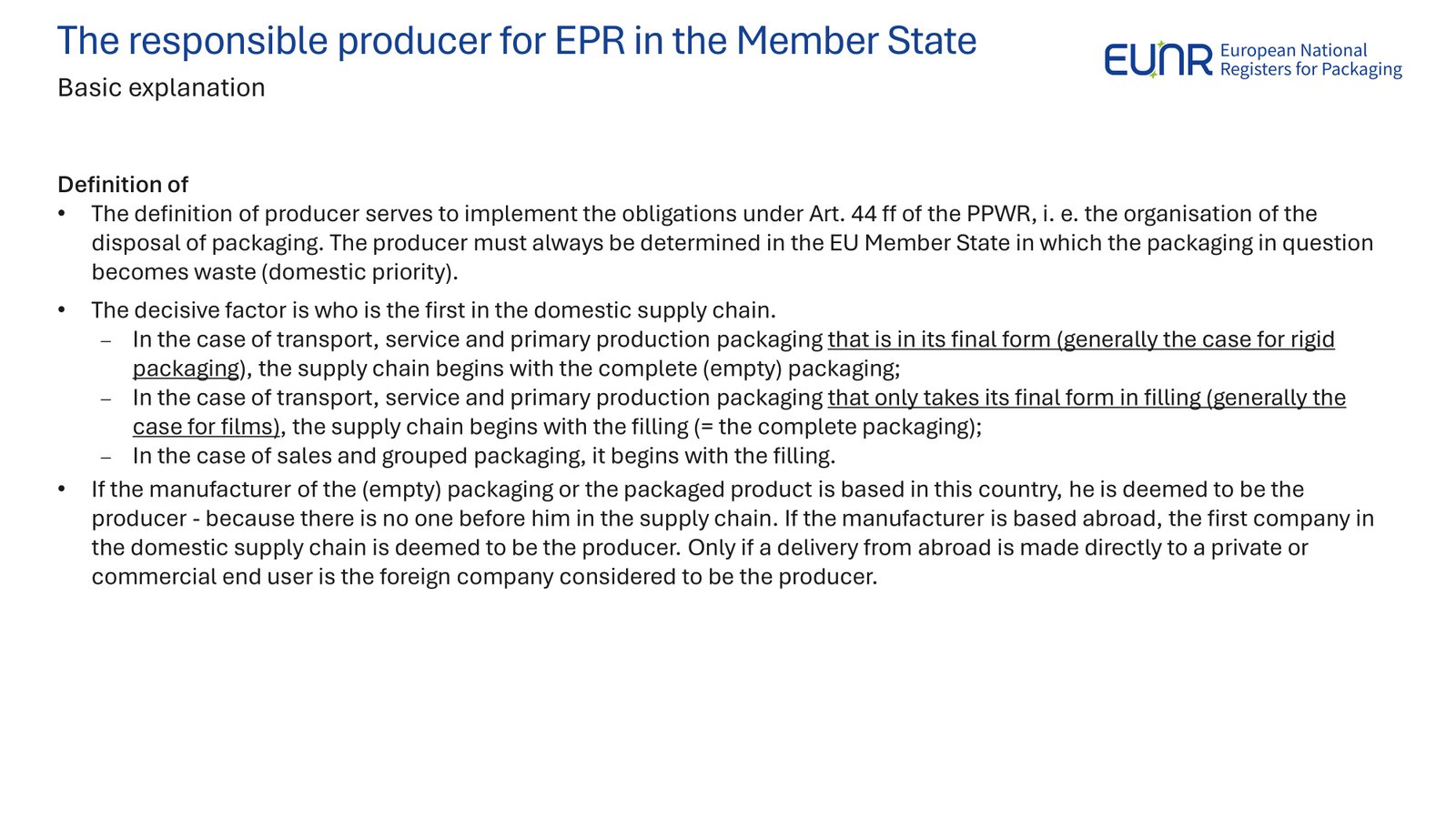
One of the most common legal pitfalls under PPWR is confusing the Manufacturer with the Producer. While one company can hold both roles, their regulatory functions are completely distinct:
| Regulatory Role | Primary Responsibility under PPWR | Core Focus |
|---|---|---|
| Manufacturer | Product & Packaging Design Conformity. Creating the technical documentation, completing conformity assessments, ensuring recyclability, and issuing the official EU Declaration of Conformity (DoC). | How the packaging is made. |
| Producer | Extended Producer Responsibility (EPR). Registering with national EPR schemes and financing the end-of-life recovery and recycling of packaging waste in the specific member state where it is placed on the market. | Who pays for the waste recovery. |
If you operate an OEM or contract manufacturing facility, who holds the legal status of the "Manufacturer" ?
Private Label / Contract Manufacturing: If Brand A hires Factory B to produce goods wrapped in packaging bearing Brand A's name or logo, Brand A is legally the Manufacturer. Factory B acts as a supplier.
Unbranded / White-Label Packaging: If a factory produces standard, unbranded packaging units sold to third-party fillers, the entity that places the final packaged product on the market under its brand assumes the legal manufacturer responsibilities.
The PPWR applies to all packaging formats placed on the EU market, whether used in B2B industrial supply chains or B2C retail channels.
Under Article 3, packaging is defined as any item intended to be used for the containment, protection, handling, delivery, or presentation of products. To determine your compliance footprint, audit all three packaging levels:
1. Primary Packaging (Sales Packaging)
The immediate container or wrapper surrounding the individual product intended for the end consumer or end user (e.g., a cosmetic bottle, a blister pack, or a beverage can), as covered under national schemes such as German packaging law.
2. Secondary Packaging (Grouped Packaging)
Packaging designed to group a specific number of sales units together at the point of purchase or display (e.g., shrink-wrap around a 6-pack, corrugated display boxes), similarly regulated under regimes like Dutch packaging law.
3. Tertiary Packaging (Transport & Industrial Packaging)
Packaging designed to facilitate the handling and transport of multiple sales units or grouped packages to prevent physical damage during transit, as also addressed under Austrian packaging law.
Important for industrial manufacturers: Stretch film, wooden pallets, plastic dunnage, strapping bands, corrugated trays, and bulk totes are fully covered under PPWR transport packaging guidelines.
Qualifies as Packaging (In-Scope): Fruit labels attached directly to produce, coat hangers sold together with garments, collation films, plastic sleeves for dry cleaning, and aluminum foil sold with food.
Exempt / Product-in-Itself (Out-of-Scope): Items sold empty as products (e.g., toolboxes, empty storage bins, refillable pepper mills), plant pots used exclusively during production, and components integral to consuming the product (e.g., wax layers on cheese or sausage skins).
If your company qualifies as a manufacturer under PPWR guidelines, you are legally responsible for satisfying several mandatory performance pillars:
Starting August 12, 2026, non-compliant packaging cannot be placed on the EU market. Manufacturers must assemble technical documentation proving compliance for each packaging format and issue an official EU Declaration of Conformity (DoC). Market surveillance authorities can request full technical proof on 10 days' notice.
All packaging must be designed for circularity. By 2030, packaging must achieve a Recyclability Performance Grade of A, B, or C (requiring at least 70% recyclability by weight). Grade C packaging will be phased out entirely by 2038, leaving only Grades A and B on the market, a shift already underway under Swedish packaging law.
Manufacturers must minimize material weight and volume to what is strictly necessary for functional protection. Starting in 2030, grouped, transport, and e-commerce packaging will be subject to a maximum empty space ratio of 50%. Unnecessary double walls, false bottoms, and oversized padding will be banned, mirroring principles already found in Italian packaging law.
Plastic packaging formats must incorporate minimum percentages of post-consumer recycled (PCR) plastic materials, with targets escalating progressively through 2030 and 2040, similar to obligations under Irish packaging law.
To ensure your operations align with PPWR definitions and milestones, follow this structured roadmap:
Map Your Packaging Scope: Catalog every primary, secondary, and tertiary packaging component used across your manufacturing and transport footprint, referencing frameworks such as Spanish packaging law.
Clarify Legal Roles Across Supply Chains: Review customer and contract manufacturer agreements to establish exactly who holds the "Manufacturer" title and DoC liability for each product line, and consider appointing an EU Authorised Representative where needed.
Audit Material Specifications: Request detailed BOM (Bill of Materials) data from packaging suppliers, including material purity, chemical safety, and verified PCR percentages, in line with requirements under Czech packaging law.
Redesign High-Risk Formats: Identify non-recyclable multi-material laminates or high-void transport designs and initiate engineering redesigns to meet the 50% empty space ratio and 2030 recyclability grades, as also required under Belgian packaging law.
Establish Digital Data Management: Implement centralized traceability software to store Declaration of Conformity files and support future QR code labeling / Digital Product Passport requirements, an area closely linked to EPREL registration services.
Getting your manufacturing definitions right is not merely a legal exercise—it is the prerequisite for keeping your products moving across European borders without costly supply chain disruptions. Our compliance services can help you assess your obligations — contact us for a free consultation. You can also review the European Commission's official PPWR overview and PPWR FAQ for further guidance.