
Navigating European Safety Data Sheets (SDS): A Guide to Chemical Compliance
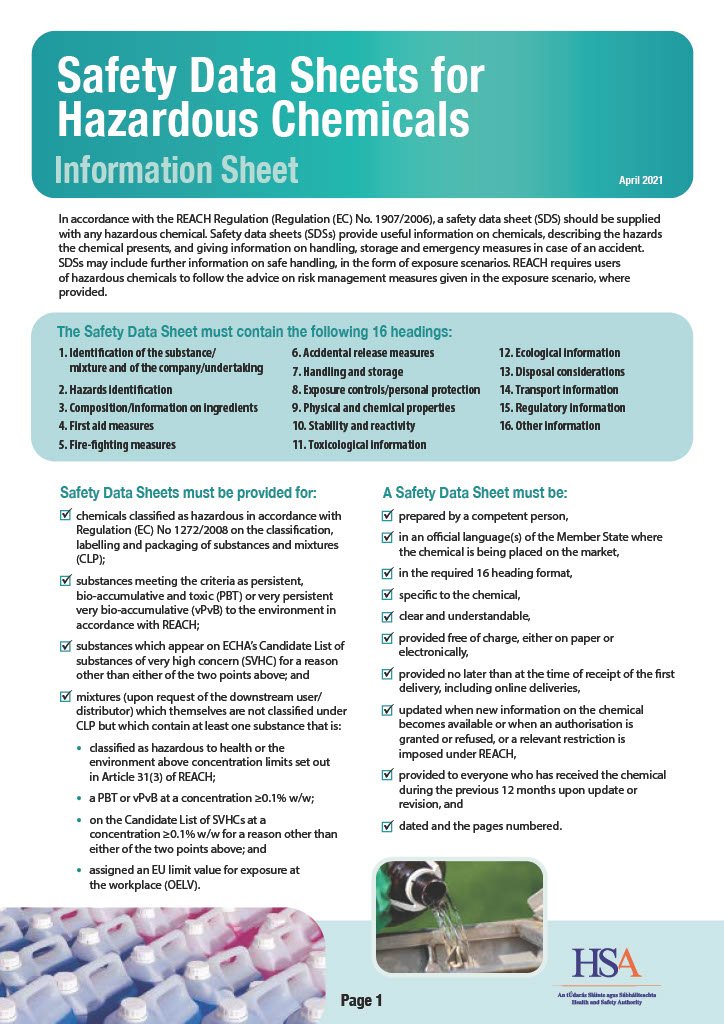
Managing chemical compliance in the European Union requires navigating one of the most stringent regulatory landscapes in the world. At the heart of this safety system sits the Safety Data Sheet (SDS)—a document that translates complex hazard data into actionable safety guidelines for workers, emergency responders, and industrial users.
Whether you manufacture chemicals inside the EU or import hazardous substances into the European Economic Area (EEA), maintaining up-to-date SDSs is a mandatory requirement for market access.
The Regulatory Framework: REACH and CLP
In the EU, Safety Data Sheets are governed primarily by two interconnected frameworks:
- REACH Regulation (EC No 1907/2006): Specifically, Annex II of REACH outlines the detailed rules for compiling an SDS. It defines when an SDS is required, how information should be structured, and who is responsible for providing it. View the REACH Regulation.
- CLP Regulation (EC No 1272/2008): The Classification, Labelling, and Packaging regulation aligns EU chemical rules with the United Nations’ Globally Harmonized System (GHS). The CLP regulation determines how health, physical, and environmental hazards are classified and communicated. View the CLP Regulation.
An SDS must be provided free of charge (on paper or electronically) on or before the first delivery of a hazardous chemical.
The 16 Mandatory Sections
European SDSs follow a standardized 16-section structure. While this matches the global GHS format, the EU enforces specific, highly granular requirements within each section:
- Identification of the substance/mixture and of the company/undertaking (includes the Unique Formula Identifier [UFI] where applicable)
- Hazards identification (CLP classification, signal words, hazard/precautionary statements)
- Composition/information on ingredients (details on hazardous constituents, concentration limits, and ATEs)
- First-aid measures
- Fire-fighting measures
- Accidental release measures
- Handling and storage
- Exposure controls/personal protection (includes DNELs and PNECs)
- Physical and chemical properties
- Stability and reactivity
- Toxicological information
- Ecological information
- Disposal considerations
- Transport information (ADR, RID, IMDG, ICAO/IATA)
- Regulatory information (EU-specific restrictions, REACH authorizations, national legislation)
- Other information (revised fields, full text of hazard statements)
Key Compliance Requirements Under Regulation (EU) 2020/878
The rules governing EU Safety Data Sheets were updated under Commission Regulation (EU) 2020/878, which became fully mandatory for all SDSs placed on the EU market.
If your company has not audited its SDS portfolio recently, ensure these specific provisions are implemented:
1. Endocrine Disruptors
SDSs must explicitly disclose whether a substance or component in a mixture is identified as having endocrine-disrupting properties for human health or the environment. This information must appear in Section 2.3, Section 11, and Section 12.
2. Nanoforms
If a substance encompasses nanoforms (materials engineered at the nanoscale), specific physical and chemical characteristics—such as particle size, surface area, and morphology—must be detailed in Section 9 and Section 3.
3. Integration of the UFI Code
For hazardous mixtures supplied for consumer or industrial use, the Unique Formula Identifier (UFI)—a 16-character alphanumeric code generated for Poison Centre Notifications (PCN)—must be clearly stated in Section 1.1 if it is not already printed on the product packaging label.
4. Added Details for Toxicological & Ecotoxicological Hazards
Specific Concentration Limits (SCLs), multiplying factors (M-factors), and Acute Toxicity Estimates (ATEs) must be disclosed alongside ingredients listed in Section 3.
Essential Rules for Companies Operating in the EU
Language Requirement: An EU SDS must be provided in the official language(s) of the EU Member State where the chemical is placed on the market, unless the Member State concerned provides otherwise. A single English-language SDS is not sufficient across Europe.
To maintain compliance, keep these three operational principles in mind:
- Qualified Preparation: Annex II stipulates that an SDS must be compiled by a "competent person" who has received appropriate training in chemical hazard classification and regulatory requirements.
- Proactive Revision: An SDS must be updated "without delay" whenever new hazard information becomes available, an authorization is granted or refused under REACH, or a new restriction is imposed. Updated versions marked "Revision: [Date]" must be provided to all recipients who received the substance in the preceding 12 months.
- Exposure Scenarios (Extended SDS): For substances registered under REACH at volumes over 10 tonnes per year, Exposure Scenarios (ES) detailing safe handling conditions for specific uses must be attached as an annex to the SDS (forming an "eSDS"). Downstream users must verify that their operational conditions align with these scenarios.
Keeping Your Chemical Portfolio Compliant
Navigating EU chemical regulations requires continuous vigilance. A robust compliance routine includes regularly auditing SDS databases against updated ECHA (European Chemicals Agency) guidance, working closely with upstream suppliers to capture updated hazard profiles, and ensuring seamless translation into all target country languages.
Maintaining accurate Safety Data Sheets protects downstream workers and safeguards your organization against regulatory penalties and market access delays.
Related Compliance Resources
If you sell hazardous chemicals or mixtures on European marketplaces, explore our related guidance on Safety Data Sheets for Amazon sellers, our broader EU chemical compliance guide, and our detailed overview of SDS EU compliance requirements. Companies handling cosmetic products should also review our cosmetics compliance services, including guidance on the Cosmetic Product Notification Portal (CPNP) and the EU Responsible Person requirement for cosmetics.
Non-EU manufacturers importing chemicals should also consider whether they need an Importer/Exporter of Record (IOR/EOR) service or an EU Authorised Representative to support market access.
Need Help With SDS Compliance ?
Managing REACH and CLP obligations, drafting compliant 16-section Safety Data Sheets, and keeping pace with regulatory updates like Regulation (EU) 2020/878 can be complex. At Complico Consulting GmbH, our specialists help you prepare, translate, and maintain compliant SDS documentation across all EU Member States. Explore our full range of compliance services, check our pricing, or contact us today for an expert consultation.
For more answers, visit our FAQ page or browse our compliance blog for the latest regulatory updates.