
Summarize this article with:
In the evolving landscape of European e-commerce, product safety is no longer just a "best practice" it is a legal mandate. The General Product Safety Regulation (GPSR), which came into full effect in December 2024, has fundamentally changed how businesses must operate when selling to EU consumers.
Whether you run a boutique store or a high-volume marketplace account, maintaining a GPSR-compliant website is essential to avoid penalties, product removals, and loss of consumer trust.
What is the GPSR ?
The General Product Safety Regulation (EU) 2023/988 is designed to ensure a high level of safety for all non-food consumer goods sold within the European Union. It replaces the older General Product Safety Directive (GPSD) and fills critical gaps in the digital era, ensuring that online and offline sales channels are held to the same rigorous standards.
Who Needs to Comply ?
If you sell to consumers in the EU, the GPSR likely applies to you. This includes:
- Manufacturers: Based in the EU or selling into the EU.
- Importers: Bringing goods from outside the EU into the market.
- Distributors & Online Marketplaces: Any business facilitating the sale of consumer goods.
- Brand Owners: Private label sellers are considered "manufacturers" under this regulation.
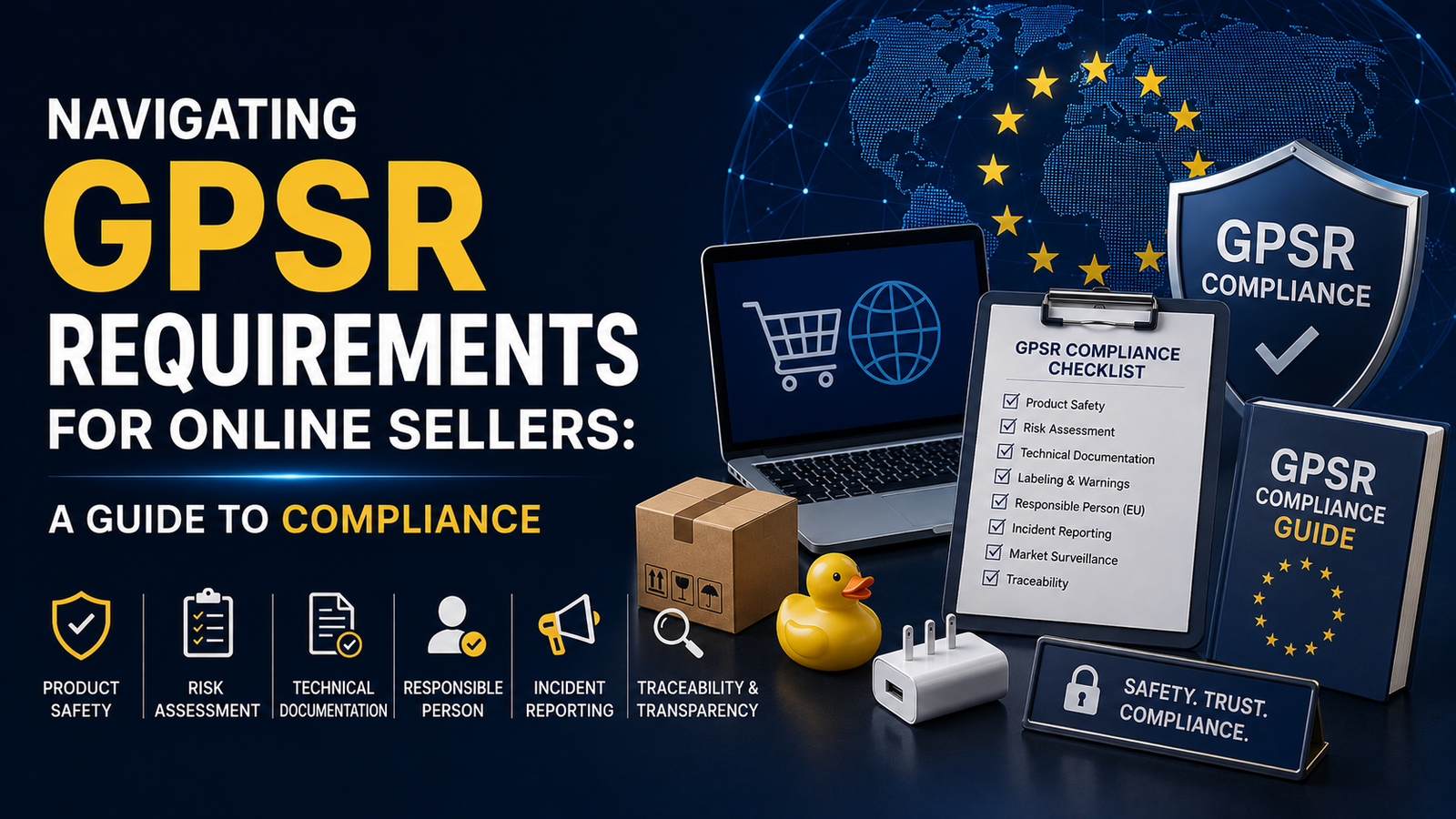
Checklist: Key GPSR Requirements for Your Website
To ensure your GPSR compliance website meets the latest standards, your product pages must provide clear, accessible, and accurate information.
1. Mandatory Contact Information
Every product listing must clearly display:
- Manufacturer details: Name, registered trade name/trademark, and postal/electronic address.
- Responsible Person (RP): If the manufacturer is based outside the EU, you must appoint an EU-based economic operator who acts as the primary point of contact for safety authorities. Their details must also be visible.
2. Product Identification & Traceability
Vague descriptions are no longer sufficient. You must ensure:
- Type, batch, or serial numbers: Every unit must be traceable to a specific production run.
- Product imagery: Clear photos that show the product type and, where possible, labels containing safety information.
3. Safety Warnings and Instructions
Transparency is the core of GPSR. You must provide:
- Instructions for use: Assembly or operating manuals in the language of the country of sale.
- Safety notifications: Any warnings (e.g., "Keep away from children," "Choking hazard") must be in a language easily understood by the consumer in the target market. Age-related warnings should also align with age restriction requirements.
Best Practices for a Compliant Website
Updating your store to align with the GPSR is an ongoing process. Here are three steps to maintain a robust GPSR compliance website:
- Audit Your Product Data: Go beyond the basics. Ensure every product SKU has a corresponding "Technical File" that includes risk assessments and declarations of conformity.
- Leverage Digital Tools: Many e-commerce platforms offer custom fields or plugins to help you display manufacturer and safety data directly on the product card.
- Centralize Your Documentation: If you are ever audited by market surveillance authorities, you must be able to provide safety documentation, risk assessments, and contact information quickly. Keep these records organized for at least 10 years.
The Cost of Non-Compliance
Ignoring these requirements isn't just a regulatory oversight; it's a business risk. Failure to meet GPSR standards can lead to:
- Heavy fines and legal penalties.
- Mandatory product recalls.
- Immediate removal from online marketplaces like Amazon, Etsy, or eBay.
- Customs seizures for non-compliant imported goods.
Final Thoughts
The transition to full GPSR compliance requires effort, but it is a vital investment in your brand's reputation. By prioritizing safety and transparency, you not only protect your business from legal risks but also build long-term trust with your customers.
Is your store ready for the latest safety audits ?
If you are just starting your compliance journey, it is recommended to conduct a full audit of your supply chain and product labels today.
Disclaimer: This blog post provides general information about the GPSR and does not constitute legal advice. Please consult with a legal professional or regulatory expert to address the specific needs of your business.
Frequently Asked Questions (FAQs)
1. What is a GPSR Compliance Website ?
A GPSR Compliance Website is an e-commerce website or online marketplace that meets the requirements of the General Product Safety Regulation (EU) 2023/988. It provides mandatory product information, manufacturer details, safety warnings, traceability information, and Responsible Person details where required.
2. Who needs a GPSR Compliance Website ?
Any business selling non-food consumer products to customers in the European Union should ensure its website complies with GPSR requirements. This includes manufacturers, importers, distributors, private-label brands, and online sellers using platforms such as Amazon, Shopify, Etsy, and eBay.
3. What information must be displayed on a GPSR Compliance Website ?
A GPSR Compliance Website should display the manufacturer's name and contact details, the EU Responsible Person's information (where applicable), product identification details, safety warnings, usage instructions, and accurate product images to help consumers make informed purchasing decisions.
4. Is an EU Responsible Person required for GPSR compliance ?
Yes. If the manufacturer is located outside the European Union, an EU-based Responsible Person is generally required. Their contact information must be available on the product, packaging, or product listing in accordance with GPSR requirements.
5. Does GPSR apply to online marketplaces like Amazon and Etsy ?
Yes. GPSR applies to products sold through online marketplaces, including Amazon, Etsy, eBay, and Shopify stores targeting EU consumers. Sellers are responsible for ensuring their product listings contain all required safety and compliance information.
6. What happens if my website does not comply with GPSR ?
Failure to maintain a GPSR Compliance Website may result in product listing removals, customs delays or seizures, product recalls, financial penalties, and enforcement actions by EU market surveillance authorities.
7. What products are covered under the GPSR ?
The GPSR applies to most non-food consumer products sold in the European Union, including household goods, furniture, electronics, toys, lifestyle products, and many other consumer items unless covered by specific sector-specific legislation.
8. How long should businesses keep GPSR compliance documentation ?
Businesses should retain technical documentation, risk assessments, product safety records, and related compliance documents for at least 10 years, allowing them to respond efficiently to inspections or market surveillance requests.
9. How can I make my website GPSR compliant ?
To create a GPSR Compliance Website, ensure every product listing includes complete manufacturer details, Responsible Person information where applicable, safety warnings, traceability information, multilingual instructions, and accurate product documentation.
10. How can Complico Consulting GmbH help with GPSR compliance ?
Complico Consulting GmbH helps businesses build and maintain a GPSR Compliance Website by providing GPSR compliance audits, EU Responsible Person services, product documentation reviews, technical file support, labeling guidance, and regulatory consulting for businesses selling across the European Union.
SEO Keywords Covered
- GPSR Compliance Website
- GPSR website requirements
- GPSR compliance
- General Product Safety Regulation
- EU Responsible Person
- GPSR for Amazon sellers
- GPSR for Shopify stores
- Product safety compliance EU
- GPSR product listing requirements
- EU product safety regulations
More About GPSR Compliance Resources:
- The Official GPSR Regulation Text (EUR-Lex)
- European Commission – Product Safety Overview
- Your Europe – Product Safety Requirements
- European Journal of Risk Regulation (Academic Context)
- International Cybersecurity Law Review (Industry Analysis)
Ready to make sure your store meets every GPSR requirement ? Explore our services overview, check our compliance pricing, or contact our team for a tailored GPSR audit. You may also find our guides on GPSR compliance and GPSR risk assessments useful, or browse more insights on our blog.