
Summarize this article with:
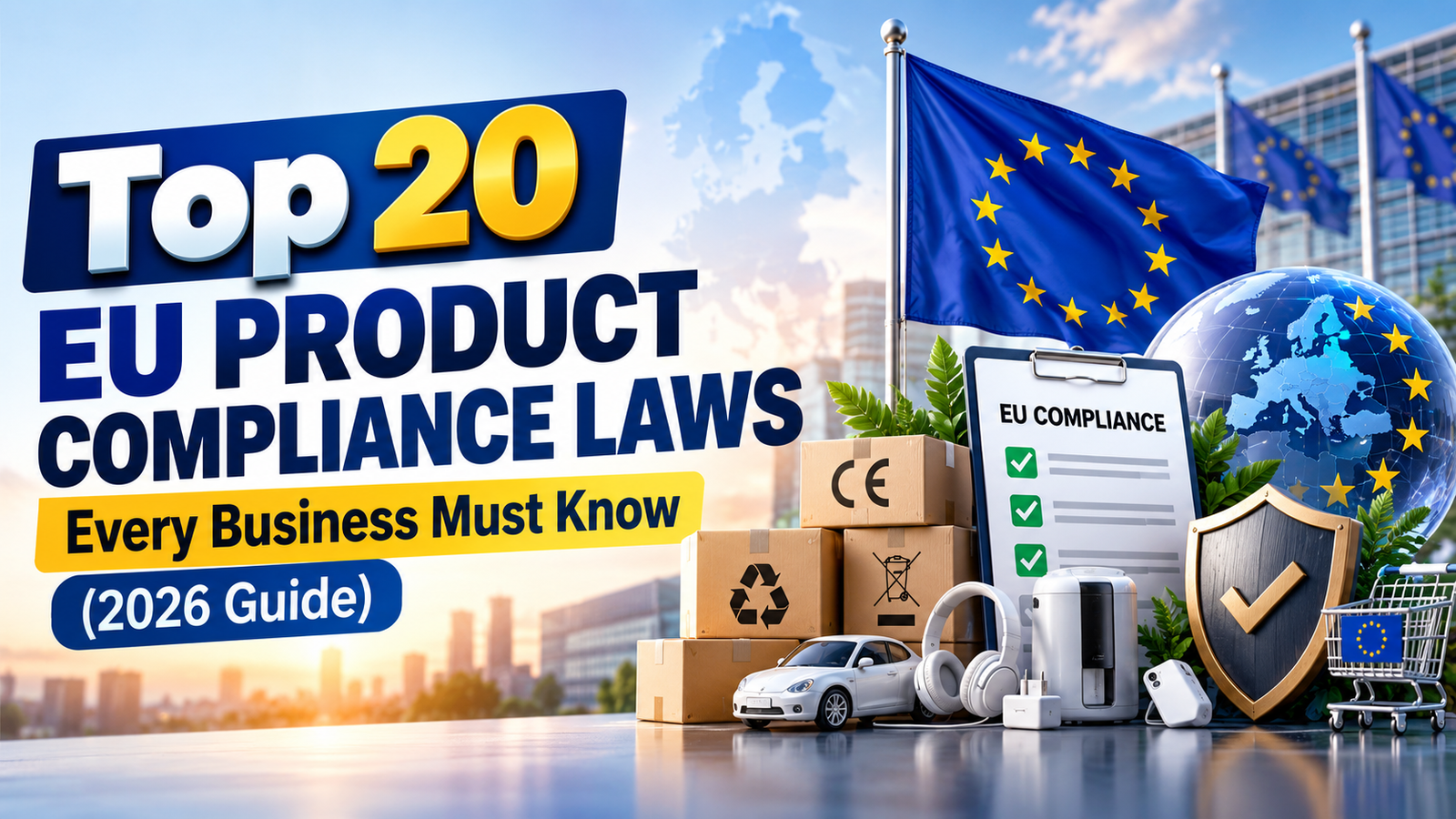
Top 20 EU Product Compliance Laws Every Business Must Know (2026 Guide)
Welcome to the ultimate guide on Product Compliance in the European Union for 2026. If you are manufacturing, importing, distributing, or selling goods within the EU market, you already know that navigating the regulatory landscape can feel like trying to hit a moving target.
At Complico Consulting GmbH, we specialize in helping businesses demystify these complex frameworks. The year 2026 represents a massive watershed moment for EU regulation. From the rollout of Digital Product Passports and stringent AI regulations to the sweeping changes in packaging and liability laws, maintaining Product Compliance is no longer just a legal checkbox—it is a core strategic advantage.
To help you stay ahead of the curve, we have compiled the definitive list of the top 20 EU Product Compliance laws and directives that every business must understand and act upon in 2026.
The Shifting Landscape of EU Product Compliance in 2026
Before we dive into the specific laws, it is important to understand why 2026 is such a pivotal year. The European Union has aggressively pursued a dual agenda: the European Green Deal (focusing on sustainability, circular economy, and chemical safety) and Europe's Digital Decade (focusing on AI, cybersecurity, and data rights).
As a result, modern Product Compliance now bridges the gap between the physical and the digital. A smart refrigerator, for example, must now comply with chemical restrictions for its plastics, energy efficiency standards for its compressor, cybersecurity rules for its Wi-Fi connection, and data accessibility laws for the user information it collects.
Failure to meet these Product Compliance requirements can result in blocked customs shipments, severe financial penalties, mandatory market recalls, and profound reputational damage. Let's explore the 20 laws you need to prioritize.
1. General Product Safety Regulation (GPSR)
While the GPSR officially entered into force in late 2024, 2026 is the year market surveillance authorities are expected to significantly intensify enforcement. The GPSR replaces the outdated General Product Safety Directive and modernizes the framework to account for the digital age.
What you need to know: The definition of a "product" now explicitly covers digital and hybrid products. It mandates that all non-EU manufacturers have an established economic operator (Responsible Person) within the EU.
Product Compliance Action: Ensure your technical documentation, risk assessments, and traceability protocols account for software updates and online sales channels.
2. Ecodesign for Sustainable Products Regulation (ESPR)
The ESPR is a cornerstone of the EU's circular economy strategy. Applying broadly across physical goods, it introduces strict ecodesign requirements focusing on durability, reparability, energy efficiency, and recyclability.
Key 2026 Milestone: Starting July 19, 2026, the ESPR introduces a landmark ban on the destruction of specific unsold consumer products, starting with apparel, clothing accessories, and footwear.
Product Compliance Action: Supply chains must pivot to track unsold inventory and prove compliance with end-of-life handling protocols.
3. The Digital Product Passport (DPP)
Technically born out of the ESPR, the Digital Product Passport deserves its own spot on this list due to its massive operational impact. The DPP requires businesses to attach a scannable digital identity (like a QR code) to products, granting consumers, regulators, and recyclers access to a product's lifecycle data.
Key 2026 Milestone: Delegated acts will begin phasing in the DPP in mid-2026 for highly regulated sectors such as textiles, iron, steel, and electronics, complementing existing EPREL registration obligations.
Product Compliance Action: Begin investing in data infrastructure and supply chain traceability software to securely host and share your product data.
4. Artificial Intelligence (AI) Act
The world's first comprehensive AI law will become fully applicable on August 2, 2026. If your product utilizes AI (even as an embedded feature in a consumer electronic or machine), you are bound by this risk-based framework.
What you need to know: The Act outright bans "unacceptable risk" AI (such as manipulative systems). "High-risk" AI systems face rigorous conformity assessments, human oversight requirements, and transparency obligations.
Product Compliance Action: Audit your product portfolio to classify any embedded AI systems and prepare technical documentation to prove your algorithms are unbiased, secure, and transparent.
5. Revised Product Liability Directive (PLD)
Applying to products placed on the market starting December 9, 2026, the modernized PLD radically alters the risk landscape.
What you need to know: The definition of a "defective product" is expanded to include software, digital production files, and AI systems. Furthermore, manufacturers remain liable for products under their control even after they have been placed on the market (e.g., via software updates). It also expands compensable damage to include data loss.
Product Compliance Action: Update your liability insurance and ensure your cybersecurity and software update mechanisms are flawless.
6. Packaging and Packaging Waste Regulation (PPWR)
Set to apply from August 12, 2026, the PPWR turns packaging design on its head. This regulation introduces aggressive targets for reducing packaging waste and mandates the use of recycled content.
What you need to know: One of the most critical aspects for consumer safety is the strict limitation on PFAS ("forever chemicals") in food-contact packaging.
Product Compliance Action: Redesign your packaging to eliminate banned substances, minimize empty space, and ensure it meets recyclability standards.
7. Cyber Resilience Act (CRA)
If your product has a digital element—meaning it connects to the internet or another device—the CRA applies to you.
Key 2026 Milestone: By September 11, 2026, mandatory reporting of cybersecurity vulnerabilities and active incidents to ENISA and national authorities begins.
Product Compliance Action: Implement "security-by-design" principles. You must be able to guarantee free security updates for the expected lifespan of your smart products.
8. The Data Act (DA)
The Data Act democratizes the data generated by connected devices (the Internet of Things).
Key 2026 Milestone: Core data-access obligations become fully applicable on September 12, 2026.
What you need to know: Manufacturers of connected products must allow users (and authorized third parties) to easily access and port the data generated by their usage.
Product Compliance Action: Redesign your product interfaces and APIs to ensure secure, immediate data portability for your end-users.
9. Right to Repair Directive
To combat the "throwaway culture," the EU is pushing the Right to Repair Directive, with national transpositions expected to take full effect in 2026.
What you need to know: Manufacturers of specific goods (like smartphones, washing machines, and vacuum cleaners) must offer repair services at reasonable prices and within a reasonable timeframe. Furthermore, they must ensure independent repairers have access to spare parts and tools.
Product Compliance Action: Overhaul your post-sale service models and ensure your product design allows for non-destructive disassembly.
10. Revised EU Waste Shipment Regulation (DIWASS)
For businesses dealing with the end-of-life phase of products or manufacturing waste, 2026 introduces strict digital tracking.
Key 2026 Milestone: Starting May 21, 2026, companies must use the DIWASS system to digitally submit all waste shipment notifications in real time. Furthermore, November 2026 marks the ban on exporting plastic waste to non-OECD countries.
Product Compliance Action: Transition away from paper-based waste tracking and integrate your ERP systems with the EU's digital portal.
11. REACH Regulation (Chemical Safety)
The Registration, Evaluation, Authorisation and Restriction of Chemicals (REACH) is a continuously evolving framework.
What you need to know for 2026: Enforcement of new restrictions on specific chemical groups—most notably the sweeping restrictions on thousands of PFAS variants—will require massive supply chain audits, closely tied to our Safety Data Sheet (SDS) services.
Product Compliance Action: Demand full chemical composition declarations from your suppliers and test your products regularly to ensure compliance with updated REACH Annexes.
12. Cosmetic Products Regulation (CPR) Updates
For the beauty and personal care industry, 2026 brings stringent new labeling and formulation rules. Our cosmetics compliance team tracks these changes closely.
Key 2026 Milestone: From July 30, 2026, the use of the updated EU INCI (International Nomenclature of Cosmetic Ingredients) Glossary becomes completely mandatory for all product labels. Furthermore, outright bans on specific CMR (Carcinogenic, Mutagenic, or Reprotoxic) substances will be strictly enforced.
Product Compliance Action: Conduct a comprehensive review of your cosmetic formulations and update all product packaging to align with the new INCI dictionary.
13. EU Deforestation Regulation (EUDR)
While initial application begins slightly earlier, 2026 will be the year where enforcement audits for the EUDR hit full stride.
What you need to know: If your products contain cattle, cocoa, coffee, oil palm, rubber, soya, or wood, you must provide geolocated proof that these commodities did not originate from recently deforested land.
Product Compliance Action: Implement deep supply chain mapping technologies to track raw materials back to their exact plot of land.
14. Corporate Sustainability Reporting Directive (CSRD)
By 2026, the CSRD will be actively applying to a massive swath of large companies and SMEs. While technically a corporate reporting law, it heavily intersects with Product Compliance.
What you need to know: Companies must disclose how their product lifecycles impact the environment and society, requiring hard data on product carbon footprints, material sourcing, and end-of-life management.
Product Compliance Action: Align your product engineering teams with your ESG reporting teams to ensure product data supports corporate sustainability claims.
15. Green Claims Directive
Designed to eradicate "greenwashing," this directive ensures that terms like "eco-friendly," "climate neutral," or "sustainable" are legally backed by independent verification.
What you need to know: You cannot make an environmental claim about your product without recognized, science-based lifecycle assessments to prove it.
Product Compliance Action: Audit your marketing materials, packaging, and digital ads. Remove any vague environmental buzzwords and prepare technical dossiers for the claims you wish to keep.
16. RoHS Directive (Restriction of Hazardous Substances)
Applying primarily to electrical and electronic equipment (EEE), RoHS restricts the use of heavy metals and specific flame retardants.
What you need to know: Exemptions for certain industries are continuously expiring, meaning product components that were legal a few years ago may suddenly render your product non-compliant.
Product Compliance Action: Maintain an active database of your electronic components and monitor the expiration dates of RoHS exemptions relevant to your industry.
17. WEEE Directive (Waste Electrical and Electronic Equipment)
The WEEE directive enforces Extended Producer Responsibility (EPR) for electronics.
What you need to know: As a producer, you are financially and organizationally responsible for the collection and recycling of your electronic products at the end of their life.
Product Compliance Action: Ensure you are registered with the appropriate WEEE compliance schemes in every single EU member state where you sell, and guarantee the "crossed-out wheelie bin" symbol is properly applied.
18. EU Batteries Regulation
The EU has completely overhauled its approach to batteries, viewing them as essential to the green transition.
What you need to know: New requirements cover carbon footprint declarations, minimum recycled content for industrial and EV batteries, and the introduction of a mandatory Digital Battery Passport (aligning with the ESPR in 2026).
Product Compliance Action: If your products contain batteries (from small electronics to vehicles), you must ensure they meet new removability and replaceability standards.
19. Machinery Regulation
Replacing the old Machinery Directive, this regulation modernizes safety requirements for industrial and consumer machinery.
What you need to know: It introduces specific safety requirements related to human-machine interaction, autonomous machines, and the cybersecurity of control systems.
Product Compliance Action: Re-certify your machinery if it incorporates new digital technologies, machine learning, or automated decision-making.
20. Distance Marketing of Financial Services & Consumer Rights
For companies selling products and services online, consumer rights are strengthening.
Key 2026 Milestone: By June 19, 2026, e-commerce platforms and online sellers must implement a mandatory, easily accessible "withdrawal button" to allow consumers to seamlessly cancel distance contracts.
Product Compliance Action: Work with your web developers and UX teams to update your e-commerce interfaces to meet these new consumer protection mandates.
How to Master Product Compliance in 2026: Best Practices
The sheer volume of changing regulations can be overwhelming. However, businesses that view Product Compliance proactively rather than reactively will gain a significant competitive edge in 2026. Here is how Complico Consulting GmbH recommends you prepare:
1. Embrace Digital Traceability
The era of proving compliance with a static, paper-based PDF is over. The Digital Product Passport, the Data Act, and the EUDR all point to one reality: you must digitize your supply chain. Invest in Product Lifecycle Management (PLM) software that can track materials from the raw extraction phase through to manufacturing, sales, and eventual recycling.
2. Implement Cross-Functional Compliance Teams
Product Compliance is no longer just the legal department's job. When a new law like the AI Act or the Cyber Resilience Act drops, it requires collaboration between Legal, Software Engineering, Hardware Design, and Marketing. Break down internal silos to ensure that safety-by-design and security-by-design are integrated at the very conception of a product.
3. Conduct Rigorous Supplier Audits
You are legally liable for the components your suppliers provide. If an overseas supplier uses a PFAS chemical restricted under REACH, or sources timber banned under the EUDR, your company will bear the brunt of the penalties. Enforce strict compliance contracts with your vendors and demand verified testing reports.
4. Continuous Laboratory Testing
Regulations dictate that you cannot simply trust assumptions. Partner with accredited, independent third-party laboratories to regularly test your goods for chemical safety, electrical stability, and performance metrics.
5. Stay Agile with Regulatory Monitoring
EU regulations are frequently updated through "Delegated Acts," which can shift testing parameters or material bans seemingly overnight. Continuous monitoring of the Official Journal of the European Union is necessary to prevent sudden market lock-outs.
Secure Your Market Position with Complico Consulting GmbH
The European market remains one of the most lucrative in the world, but the barrier to entry is higher than ever. Achieving seamless Product Compliance in 2026 requires deep technical expertise, robust data systems, and a proactive legal strategy.
You don't have to navigate this labyrinth alone.
At Complico Consulting GmbH, we provide end-to-end Product Compliance solutions tailored specifically for your business. Whether you are mapping your supply chain for the Digital Product Passport, redesigning your packaging to meet the PPWR, or seeking a reliable EU Authorized Representative, our experts are here to ensure your products flow smoothly across borders.
Don't let regulatory bottlenecks slow down your growth. Contact Complico Consulting GmbH today, and let us turn your product compliance strategy into your strongest competitive advantage for 2026 and beyond. View our pricing to get started.
More About EU Product Compliance Resources: