
Summarize this article with:
ibilities. Navigating WEEE Germany compliance is no longer optional—it is a critical legal requirement for manufacturers, importers, and online retailers alike.
Over the past few years, the regulatory landscape has shifted dramatically. With online marketplaces like Amazon, eBay, and Etsy now legally required to block non-compliant sellers, securing your WEEE Germany registration is the only way to keep your listings active and your revenue flowing.
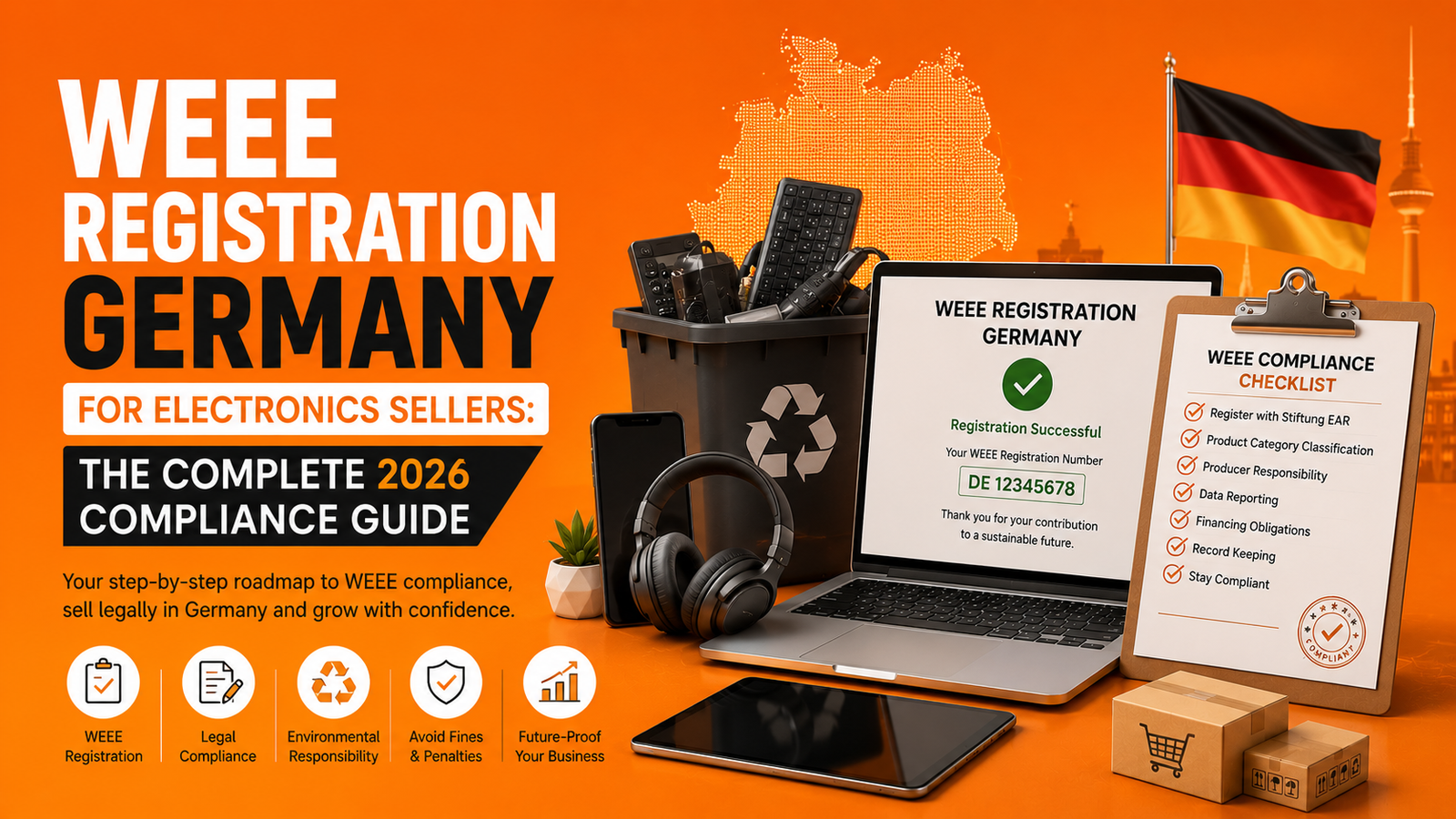
At Complico Consulting GmbH, we specialize in helping businesses cut through European regulatory red tape. In this comprehensive guide, we will break down exactly what the ElektroG (the German WEEE implementation) means for your business, who needs to register, the costs involved, and the step-by-step process to ensure your electronics can be legally sold in Germany in 2026 and beyond.
What is WEEE and the German ElektroG ?
WEEE stands for Waste Electrical and Electronic Equipment. It is an EU directive designed to reduce electronic waste by making the "producers" of these goods financially and operationally responsible for their end-of-life disposal and recycling. This concept is known as Extended Producer Responsibility (EPR).
In Germany, the WEEE Directive is implemented into national law through the ElektroG (Elektro- und Elektronikgerätegesetz). The governing body responsible for enforcing this law and managing the national register is Stiftung EAR (Stiftung Elektro-Altgeräte Register).
Under the ElektroG, you cannot legally place a single piece of covered electronic equipment on the German market without first obtaining a WEEE registration number (WEEE-Reg.-Nr. DE) from Stiftung EAR.
The 2026 Landscape
Enforcement has never been stricter. Following recent amendments, the scrutiny on cross-border e-commerce has intensified. Furthermore, the transition of battery regulations (from BattG to the new BattDG) means that if your electronic device contains a battery, you now face parallel, equally strict registration requirements for both the device itself and its power source.
Who is Required to Register for WEEE Germany ?
A common misconception among online sellers is that only actual manufacturers need to register. Under German law, the definition of a "producer" (Hersteller) is intentionally broad. You must register for WEEE Germany if you meet any of the following criteria:
- You manufacture EEE under your own name or brand and sell it in Germany.
- You resell EEE produced by other suppliers under your own brand (OEM). If the original manufacturer's brand is not visible, you are considered the producer.
- You import EEE into Germany on a commercial basis for the first time. This includes dropshippers and sellers based outside the EU importing goods directly to German consumers, a role closely tied to that of an Importer of Record.
- You are a cross-border distance seller (e-commerce) based outside of Germany, selling directly to German end-users via your own webshop or platforms like Amazon FBA.
The Bottom Line: If you are the first entity to make the electronic product available to a German consumer, the EPR burden falls on you.
The E-Commerce Marketplace Mandate: Amazon, eBay, and Etsy
Since July 1, 2023, the rules of the game for online sellers changed entirely. Under the updated ElektroG, operators of online marketplaces (and fulfillment service providers) face joint liability. This means platforms like Amazon, eBay, and Kaufland are legally forbidden from allowing you to sell electronics to German buyers unless you can prove you have a valid WEEE Germany registration number.
How Marketplaces Enforce Compliance
- Listing Suspensions: If Amazon cannot validate your WEEE-Reg.-Nr. DE with Stiftung EAR, your listings will be deactivated immediately.
- Brand and Type Matching: You cannot simply borrow a registration number. Marketplaces run automated checks against the Stiftung EAR database. The brand name and the equipment category you are selling must perfectly match the details registered to your WEEE number.
- Fulfillment Centers: If you use Amazon FBA or third-party fulfillment centers (3PL) in Germany, they will refuse to store or ship your EEE inventory without proof of compliance.
For e-commerce operators, a suspended top-selling ASIN can result in thousands of euros in lost daily revenue. Securing your WEEE registration proactively is the ultimate insurance policy for your seller account.
The 6 Categories of Electrical and Electronic Equipment
When applying for your WEEE Germany registration, you must classify your products into one of the six official categories. Incorrect categorization is one of the most common reasons Stiftung EAR rejects applications, resulting in costly delays.
| Category | Description | Examples |
|---|---|---|
| 1. Temperature Exchange Equipment | Devices that use substances other than water for heating/cooling. | Refrigerators, air conditioners, freezers, heat pumps. |
| 2. Screens and Monitors | Screens with a surface area larger than 100 cm². | Televisions, computer monitors, laptops, tablets. |
| 3. Lamps | Straight fluorescent lamps, compact fluorescent lamps, and LED lamps. | LED bulbs, fluorescent tubes. (Note: Luminaires/light fixtures belong in category 4 or 5). |
| 4. Large Equipment | Any external dimension is more than 50 cm. | Washing machines, electric ovens, large solar panels, large medical devices. |
| 5. Small Equipment | No external dimension is more than 50 cm. | Microwaves, toasters, small drones, electric kettles, smart home sensors. |
| 6. Small IT and Telecommunication | IT/Telecomm devices with no dimension exceeding 50 cm. | Smartphones, GPS devices, routers, keyboards, mice. |
Expert Tip from Complico Consulting GmbH: Passive devices that merely conduct current (like raw USB cables, audio cables, and simple adapters) were brought into the scope of the ElektroG in recent years. Do not assume your simple cable is exempt!
B2C vs. B2B Equipment: A Critical Distinction
The registration process diverges significantly depending on who your end-user is.
B2C (Business-to-Consumer)
If your equipment can be used in a private household—even if you primarily sell to businesses—it is classified as B2C (dual-use).
- The Insolvency-Proof Guarantee: To register B2C equipment, you must provide a financial guarantee (insolvenzsichere Garantie). This ensures that if your company goes bankrupt in the future, funds are already set aside to cover the recycling costs of your legacy products.
- You must join a collective guarantee system or provide individual surety.
B2B (Business-to-Business)
If your equipment is exclusively used in industrial or commercial environments (e.g., specialized medical scanning equipment or heavy industrial machinery), it is B2B.
- Plausibility Check (Glaubhaftmachung): You must provide evidence to Stiftung EAR that the device will never end up in a private household or municipal waste collection facility.
- Take-Back Concept: You do not need a financial guarantee, but you must submit a written, legally binding concept detailing how you will retrieve and dispose of the equipment from your commercial clients at the end of its life.
The Step-by-Step WEEE Registration Process in Germany
Navigating the Stiftung EAR portal requires precision. A single mistake can reset a process that already takes weeks. Here is how the process unfolds:
Step 1: Account Creation and Appointing an Authorized Representative
If your company does not have a registered legal branch within Germany, you cannot register directly. You are legally required to appoint an Authorized Representative (Bevollmächtigter) located in Germany to act on your behalf, hold liability, and manage the EAR account.
Step 2: Defining Brands and Equipment Types
You must register every distinct brand you sell. The brand does not have to be a legally trademarked name, but it must be the identifier clearly printed on the device. Generic terms like "No Name" or "Electronics" are strictly forbidden. You must then match each brand to the correct equipment type (e.g., Brand X - Category 5 - Small Equipment).
Step 3: Securing the Financial Guarantee (for B2C)
Before submitting the application, you must purchase an insolvency-proof guarantee covering the estimated volume (in tons) of equipment you plan to place on the market for the current calendar year.
Step 4: Submission to Stiftung EAR
Once the data, guarantee, and Authorized Representative mandates are in place, the application is submitted.
Step 5: The Waiting Period
Stiftung EAR operates on a strict first-come, first-served basis. Currently, processing times range from 4 to 12 weeks, depending on application volume. During this time, you are legally prohibited from selling the items in Germany.
Step 6: Issuance of the WEEE-Reg.-Nr. DE
Upon approval, you will receive your official registration number. You must immediately provide this number to your online marketplaces, display it on your invoices, and list it in the legal notice (Impressum) of your website.
Your Ongoing WEEE Obligations
Obtaining your WEEE Germany number is not the finish line; it is the starting point of your ongoing environmental compliance.
- Monthly Quantity Reporting: You must log into the EAR portal (or have your Authorized Representative do it) every single month to report the exact weight of EEE you placed on the German market in the previous month.
- Annual Statistical Reporting: At the beginning of each year, a comprehensive annual report covering the total volumes of the previous year must be submitted by April 30th.
- Product Labeling: All your products must be permanently marked with your registered brand name and the "crossed-out wheeled bin" symbol, indicating they cannot be thrown into standard household trash.
- Updating Registrations: If you launch a new product that falls into a different category, or if you introduce a new brand name, you must apply for an expansion of your registration before selling the new items.
The High Cost of Non-Compliance
German authorities and competitors take environmental laws incredibly seriously. Attempting to bypass WEEE Germany regulations carries severe consequences:
- Marketplace Bans: As previously noted, your Amazon or eBay listings will be blocked by automated systems.
- Crippling Fines: The German Federal Environment Agency (UBA) can issue administrative fines of up to €100,000 per violation.
- Abmahnungen (Competitor Warnings): Germany has a unique legal culture where competitors can issue formal cease-and-desist letters (Abmahnungen) through lawyers if they catch you selling without a WEEE number. You will be forced to pay their legal fees and sign a declaration promising not to sell the items, backed by heavy contractual penalties.
- Confiscation of Goods: Customs authorities and fulfillment centers have the right to freeze non-compliant inventory.
How Complico Consulting GmbH Simplifies WEEE Germany
The complexities of the ElektroG are overwhelming for most business owners whose primary focus is growing their brand, not deciphering German environmental law.
At Complico Consulting GmbH, based right here in Ronneburg, Germany, we take the entire burden of WEEE Germany compliance off your shoulders. We specialize in protecting Amazon sellers, e-commerce brands, and international manufacturers from suspensions and fines.
What We Do For You:
- Authorized Representative Service: As a German-based entity, we act as your legally mandated Authorized Representative, interfacing directly with Stiftung EAR on your behalf.
- End-to-End Registration: We analyze your product catalog, ensure correct categorization, secure your insolvency-proof guarantees, and handle the entire application process to prevent time-wasting rejections.
- Ongoing Reporting Management: You simply send us your sales data; we handle the monthly tonnage reporting and the complex annual statistical declarations, ensuring you never miss a deadline.
- Holistic Compliance: If your electronics contain batteries, we concurrently handle your BattDG (Battery Act) registrations, and we can manage your Packaging Act (VerpackG/LUCID) requirements to ensure 100% marketplace readiness.
Frequently Asked Questions
How long does it take to get a WEEE number in Germany ?
Once the application is submitted flawlessly to Stiftung EAR, the approval process takes between 4 and 12 weeks. Because of this lead time, it is vital to begin the registration process months before you plan to launch a product in Germany.
Do I need a separate registration for batteries ?
Yes. The ElektroG covers the device itself, but if it contains a battery (even a built-in one), you must also register the battery separately under the Battery Act implementation law (BattDG) and receive a Batt-Reg.-Nr. DE.
My supplier already has a WEEE number. Can I use theirs ?
If your supplier is located outside of Germany (e.g., a factory in China) and you are importing the goods under your own brand, their registration does not cover you. If you buy from a German wholesaler who has registered the specific brand, you might be covered, but this must be rigorously verified.
Is a WEEE registration valid across the whole EU ?
No. WEEE is a European directive, but it is implemented at the national level. A German WEEE number is only valid in Germany. If you also sell to France, Spain, or Italy, you need separate registrations in each of those countries.
Frequently Asked Questions (FAQ)
1. What is WEEE Germany ?
WEEE Germany refers to Germany's implementation of the European Waste Electrical and Electronic Equipment (WEEE) Directive through the Electrical and Electronic Equipment Act (ElektroG). It requires producers of electrical and electronic equipment to register, finance recycling, and comply with reporting obligations before selling products in Germany.
2. Who needs WEEE registration in Germany ?
You generally need WEEE registration if you:
- Manufacture electrical or electronic equipment under your own brand.
- Import electronics into Germany.
- Sell private-label or OEM electronic products.
- Operate an online store selling electronics to German consumers.
- Sell through marketplaces such as Amazon, eBay, or Etsy.
3. What is Stiftung EAR ?
Stiftung EAR (Elektro-Altgeräte Register) is Germany's official authority responsible for managing WEEE registrations, producer records, and compliance under the ElektroG.
4. Is WEEE registration mandatory before selling in Germany ?
Yes. Businesses must obtain a valid WEEE registration number before placing covered electrical and electronic equipment on the German market.
5. What is a WEEE registration number ?
A WEEE registration number (WEEE-Reg.-Nr. DE) is an official registration number issued by Stiftung EAR after successful registration. It demonstrates that a producer has met the registration requirements under the ElektroG.
6. Does Amazon Germany require WEEE registration ?
Yes. Amazon and other online marketplaces may require sellers of applicable electronic products to provide a valid WEEE registration number. Failure to do so can result in listing restrictions or product removal.
7. Which products are covered by WEEE Germany ?
Covered products include many types of electrical and electronic equipment, such as:
- Smartphones
- Laptops
- Household appliances
- Consumer electronics
- Smart home devices
- Power tools
- Lighting products
- Chargers
- Cables and adapters
- Electronic accessories
8. What are the six WEEE equipment categories ?
The six categories are:
- Temperature exchange equipment
- Screens and monitors
- Lamps
- Large equipment
- Small equipment
- Small IT and telecommunications equipment
Selecting the correct category is an important part of the registration process.
9. What is the difference between B2B and B2C registration ?
B2C registration generally applies to products that may be used by private households and often requires an insolvency-proof guarantee. B2B registration applies to products intended exclusively for professional use and has different compliance requirements.
10. Do foreign companies need an Authorized Representative ?
Businesses without a legal establishment in Germany generally need to appoint a German Authorized Representative (Bevollmächtigter) to fulfill their producer obligations under the ElektroG.
More About WEEE Germany Resources
- Stiftung EAR (Stiftung Elektro-Altgeräte Register)
- Umweltbundesamt (UBA) – Federal Environment Agency
- European Commission – Official WEEE Directive
- Gesetze im Internet – The ElektroG Legal Text
Ready to get your electronics WEEE-compliant and your Amazon listings protected ? Take a look at our services overview, compare our compliance service pricing, or get in touch with our team for tailored guidance. You may also find our guides on EPR compliance for Amazon FBA and the GPSR (General Product Safety Regulation) useful, or browse more insights on our blog.