
The EU Digital Product Passport Registry is Taking Shape: What Regulation (EU) 2024/1781 Means for Your Business
If your company manufactures, imports, or sells physical products in the European Union, July 2026 just changed your compliance roadmap.
Under the Ecodesign for Sustainable Products Regulation (ESPR)—officially known as Regulation (EU) 2024/1781—the EU has established the legal framework for the Digital Product Passport (DPP). As of mid-July 2026, the digital infrastructure to support this ambitious traceability initiative has finally moved from concept to reality with the launch of the EU DPP Registry's testing environment and the adoption of concrete implementation rules. Here is what you need to know about the new registry, how it works, and how to prepare your supply chain.
What is the Digital Product Passport (DPP) ?
Think of the DPP as a digital identity card for products, components, and materials. Accessed via a data carrier—usually a QR code physically attached to the product or its packaging—the passport links to a machine-readable record of the item's entire lifecycle. Depending on your product category, this passport will share critical data regarding origin, material composition, carbon footprint, repairability, and end-of-life handling with consumers, supply chain partners, and customs authorities.
Mythbusting: What the EU Registry Actually Stores
A common fear among manufacturers is that they will have to upload all their proprietary supply chain and sustainability data to a massive, centralized EU government database. Fortunately, that is not the case.
The EU DPP Registry is a directory, not a filing cabinet.
Under Article 13 of the ESPR, the registry operates as a thin, centralized indexing layer. When a product is registered, the EU system stores only two things:
- The product's unique identifier.
- The commodity code (for goods entering the EU under "release for free circulation").
The actual detailed product data (your materials lists, sustainability metrics, etc.) remains in decentralized storage. You—or your chosen third-party DPP service provider—host the primary data. When a customs agent or consumer scans the QR code, the registry simply confirms that a valid identifier exists and routes the user to the data you are hosting.
The Rules of the Road: Implementing Regulation (EU) 2026/1778
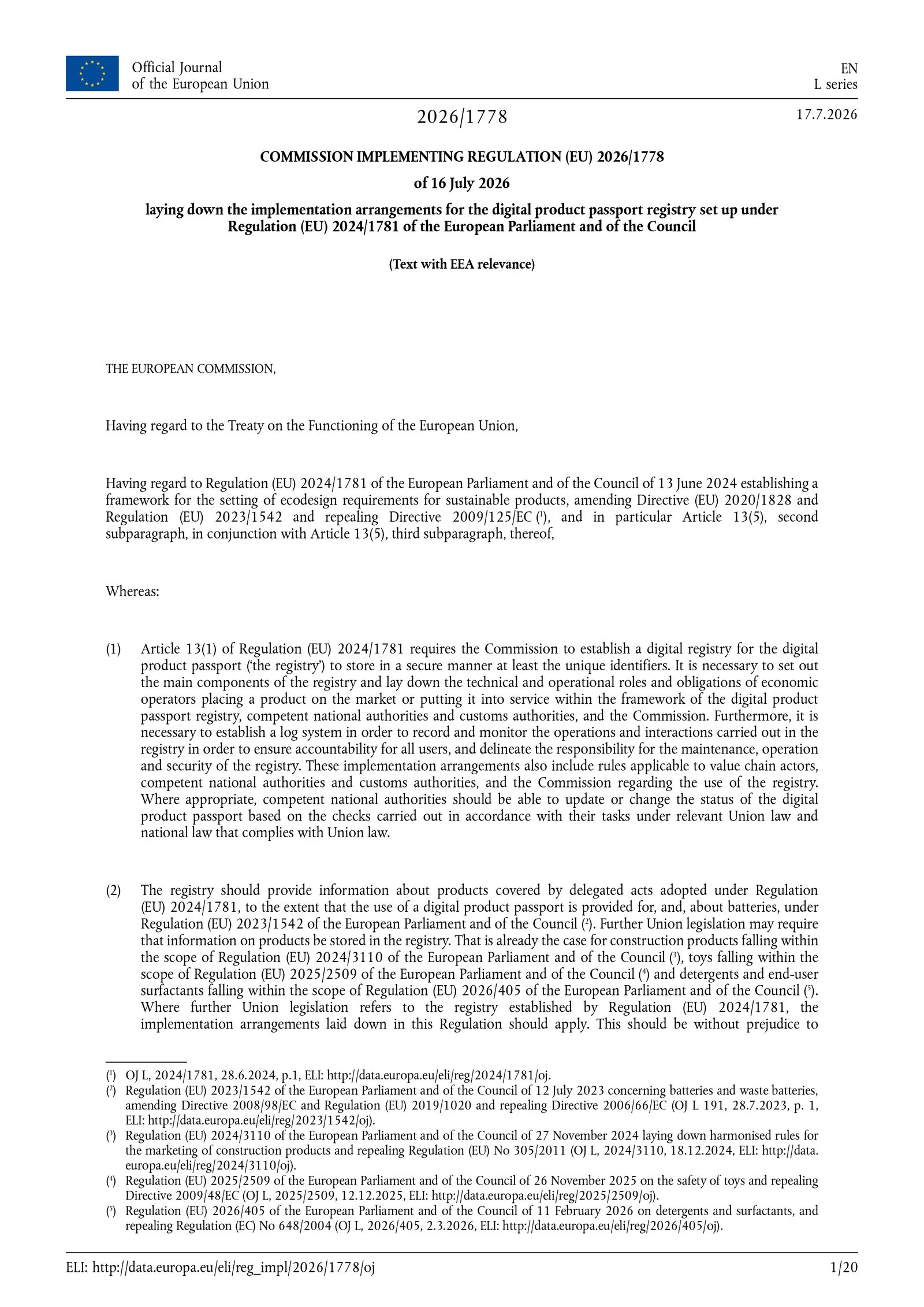
To make the registry operational, the European Commission adopted Implementing Regulation (EU) 2026/1778 on July 16, 2026. This rulebook dictates exactly how businesses will interact with the system:
- Strict Identity Verification: Economic operators must verify their identities using the EU's eIDAS framework (with a qualified electronic signature or seal) before they can register products. This verification must be renewed at least every three years. If your business already manages a digital certificate or NIF and digital certificate setup for other EU filings, the same identity infrastructure will likely extend to DPP registration.
- Automated Checks: When you submit data to the registry, the system automatically checks its semantic structure and granularity (whether at the model, batch, or individual item level) before issuing a unique registration ID.
- Data Longevity: By default, registration data must be maintained and kept available for 10 years, ensuring traceability long after a product hits the shelves.
- Role-Based Access: Not everyone sees everything. The data models ensure that the public, repairers, and market surveillance authorities only get access to the specific data tiers they have a legitimate right to view—an approach that mirrors the tiered access already familiar to businesses managing GPSR compliance obligations.
What is the Timeline ?
While the registry infrastructure is going live in the summer of 2026, your actual deadline to register products depends on your sector. The ESPR allows the Commission to roll out requirements category by category via delegated acts.
The first major deadline hits the battery sector. Under the Battery Regulation (EU) 2023/1542, battery passports become legally mandatory starting February 18, 2027. If you sell batteries across multiple EU markets, it's worth reviewing your national obligations now, including Germany's battery law, Austria's battery law, Spain's battery law, France's battery law, and Italy's battery law.
Other categories—including textiles, construction materials, detergents, and electronics—are fast approaching. Sellers already tracking obligations like French textile compliance, Dutch textile compliance, French building materials rules, or electronics requirements such as Germany's WEEE/electronics rules and the Netherlands' WEEE/electronics rules will find much of that groundwork carries directly over to DPP readiness.
3 Steps to Take Right Now
Even if your product category's delegated act hasn't taken effect yet, building the operational data capability takes time.
- Assign eIDAS Ownership: Identity verification is now a compliance prerequisite. Designate someone in your organization to handle eIDAS certification and track its 3-year renewal clock.
- Audit Your Data Hosting: Because the EU registry only points to your data, your server's uptime is no longer just an IT metric—it's a legal compliance issue. Ensure your DPP hosting infrastructure is robust enough to survive customs lookups at scale.
- Map Your Tier-N Supply Chain: You cannot generate a passport without accurate data on material composition, recycled content, and carbon footprints. Start collaborating with your suppliers now to ensure data is structured and machine-readable, and consider how this intersects with existing EU Authorised Representative and GDPR Article 27 representative obligations you may already have in place.
Product traceability is no longer an optional "nice-to-have" marketing tool. It is a hard condition for market access in the European Union.
Need help mapping the Digital Product Passport requirements onto your product portfolio? Our team tracks EPREL registration, EPR, and GPSR requirements across every EU member state daily. Get in touch, browse our pricing, or read more on our compliance blog and regulatory news pages.