
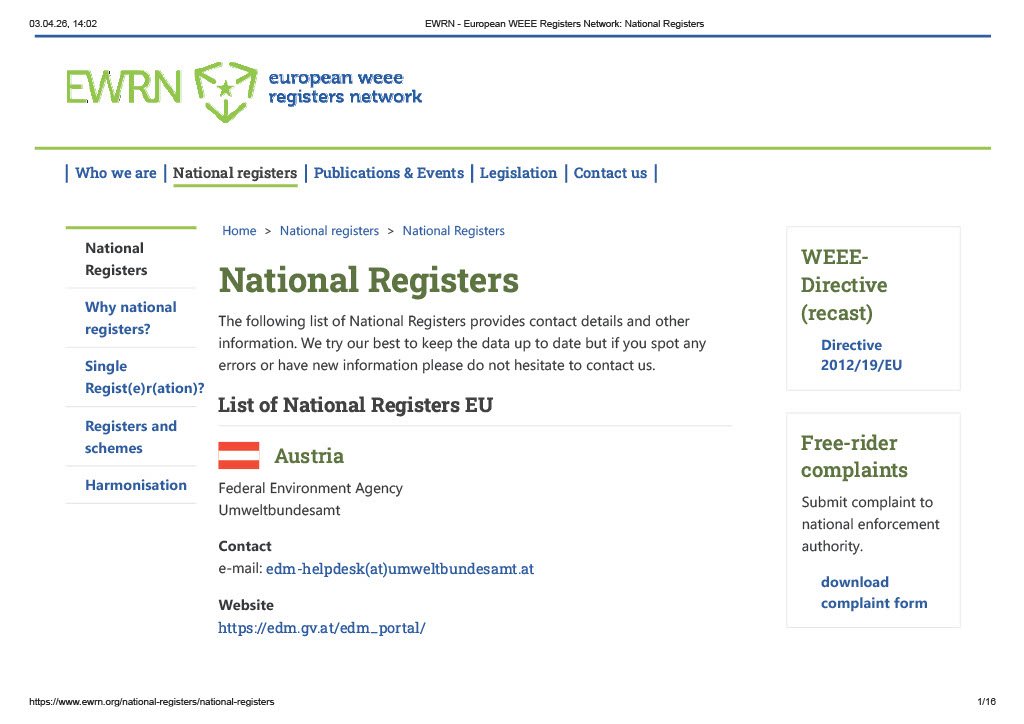
If your business manufactures, distributes, or sells electrical and electronic equipment (EEE) within the European Union, understanding the Waste Electrical and Electronic Equipment (WEEE) Directive is non-negotiable. At the heart of enforcing this environmental directive across the EU is the European WEEE Registers Network (EWRN).
But what exactly is the EWRN, and what do you need to know about the National Registers list to keep your products on the market legally? Let's break it down.
What is the EWRN ?
The European WEEE Registers Network (EWRN) is an independent network composed of the National Registers responsible for overseeing the implementation of the WEEE Directive in their respective EU Member States. Established in 2006, the network's primary goal is to harmonize the interpretation of the WEEE Directive and facilitate information exchange among member countries.
Currently, the National Registers that make up the EWRN manage the compliance data for more than 80% of the total European market for electrical and electronic equipment.
Clarifying the Confusion: Registers vs. Compliance Schemes
One of the biggest stumbling blocks for businesses expanding into Europe is misunderstanding the difference between registering and joining a compliance scheme.
National Registers: These are the official, state-level entities that track how much EEE is placed on the market and how much electronic waste is collected, recycled, and recovered. Registering with them is a mandatory administrative act that results in a WEEE registration number.
Compliance (or Collective) Schemes: These are commercial organizations that producers pay to physically handle the collection and recycling of their electronic waste. Because the WEEE Directive operates on the principle of Extended Producer Responsibility (EPR), you are financially and operationally responsible for the end-of-life disposal of your products.
In short: You register with the National Register to prove you exist legally in the market, and you pay a Compliance Scheme to do the heavy lifting of physical recycling.
The Decentralized Reality of WEEE Registration
Unlike some EU-wide regulations that allow for a single, centralized registration, WEEE compliance is highly decentralized. You must register individually in every single EU country where you place electronic products on the market.
Each member state has its own designated authority and its own National Register. Here is a snapshot of some key registers across Europe:
| Country | National Authority / Register | Website Portal |
|---|---|---|
| Austria | Federal Environment Agency | edm.gv.at |
| France | ADEME (Syderep) | syderep.ademe.fr |
| Ireland | National Producer Registration Body | producerregister.ie |
| Netherlands | Nationaal WEEE Register (NWR) | nationaalweeeregister.nl |
| Sweden | Swedish Environmental Protection Agency | naturvardsverket.se |
(Note: If you are a non-EU company, you are legally required to appoint an Authorized Representative (AR) in each country to handle these registrations on your behalf.)
5 Steps to Achieving WEEE Compliance
If you are expanding your electronics sales across Europe, here is the standard roadmap you need to follow for each target country:
- Classify Your Products: Determine which of the WEEE categories (e.g., screens, large appliances, small IT equipment) your product falls under.
- Register with the National Authority: Do this before you place your products on the market. You will need to provide company details and estimated sales volumes. Learn more with our WEEE registration compliance guide.
- Join a Compliance Scheme: Secure financial guarantees and partner with a local scheme to handle the physical recycling of your end-of-life products.
- Mark Your Products: Every product must conspicuously display the standard crossed-out wheeled bin symbol to indicate it cannot be thrown in regular municipal trash, in line with broader product safety labeling requirements.
- Submit Periodic Reports: You must regularly report the exact quantities and weights of equipment you place on the market, as well as data on what was collected and recycled.
The Cost of Non-Compliance
Ignoring WEEE registration is not an option. Authorities actively monitor unregistered sellers through customs checks and by working directly with online marketplaces. If you fail to comply, you face:
- Marketplace Delisting: Platforms like Amazon actively require your WEEE registration number; without it, your product listings will be blocked. See our guide on EPR compliance for Amazon FBA sellers.
- Prohibition of Sales: Complete legal bans on selling your products in the target country.
- Heavy Fines: Financial penalties can be severe—for example, up to €100,000 in certain jurisdictions. Read more about the EU-wide WEEE compliance crackdown.
- Confiscation of Goods and Profits: Customs can seize your shipments, and authorities can confiscate profits made from illegal, unregistered sales.
Conclusion
The EWRN provides the necessary framework to keep Europe's electronic waste management organized, but the burden of compliance falls squarely on the producer. Because you have to navigate the National Registers list country-by-country, setting up a proactive, organized compliance strategy is crucial before you ship a single electronic device to Europe. Contact our team to get started with your WEEE registration today.