
Summarize this article with:
Navigating product safety regulations in the EU can be overwhelming for e-commerce sellers.
With the General Product Safety Regulation (GPSR) enforcing strict traceability and safety standards, getting your packaging right is no longer optional it is critical for keeping your listings active.
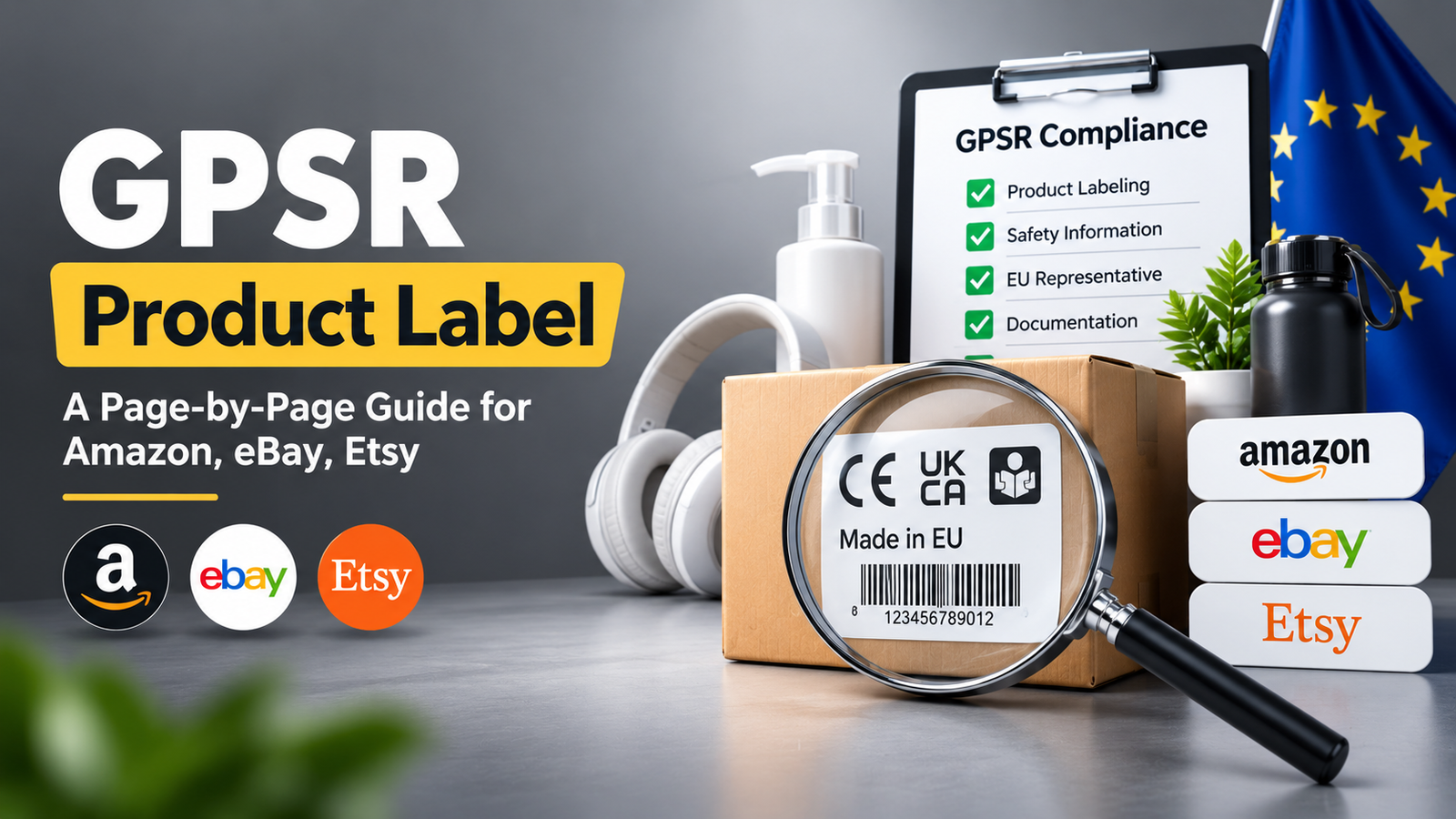
To help simplify this, we are breaking down the comprehensive GPSR Product Label template provided by Complico Consulting GmbH. Let’s explore exactly what information you need on your labels and documentation, page by page
Download GPSR-Label-Template-Amazon-Ebay-seller PDF fo free
Page 1: The Core GPSR Product Label Visuals & Warnings
The first page of the document provides the actual visual layout for a compliant product label. It shows exactly how to arrange the dense information required by EU law.
- Mandatory Identification: Your label must explicitly list the Manufacturer's details alongside the EC REP (European Authorized Representative). In this template, Complico Consulting GmbH acts as the EC REP, providing a registered German address and contact email.
- Granular Product Traceability: Beyond the Product Name , you must include the Batch or LOT Number , Model Number, Country of Origin, and Material Composition. Age Suitability must also be clearly stated.
- Exhaustive Multilingual Warnings: A standout feature of this template is the comprehensive list of safety warnings translated across five major European languages: English, French, German, Spanish, and Italian.
- Specific Hazard Scenarios: The label requires specific phrasing for various risks, such as:
- "Contains small parts - choking hazard."
- "Plastic packaging may cause suffocation. Keep away from babies and young children."
- "Keep away from open flames and other heat sources."
- Warnings regarding adequate airflow to prevent airway obstruction , and strangulation hazards if a child is left unattended.
- Instructions to ensure attachments are secure and not to use if parts are damaged.
- Required Compliance Symbology: The template includes placeholders for critical visual icons, including the CE Marking , Care & Laundry Instructions , and precise Resin Identification Codes for plastics (such as PETE, HDPE, PVC, LDPE, PP, PS, and OTHER). It also features age warning icons, such as the standard 0-3 symbol.
Page 2: Core Directives for General Products and Toys
Page two shifts to a technical matrix, explaining how and where to apply these rules based on your specific product category.
- Universal General Rules: Every single product must have the contact information of both the representative and manufacturer (including company name, business address, and email/URL). Crucially, the commodity safety and warning information must be printed in the language of the country of sale.
- Flexible Application Methods: You have options for placement. Labels can be affixed directly to the product, the product packaging, the parcel itself, or printed on the accompanying documents. The information can be separated or placed on the same side of the product.
- Determining CE Applicability: The guide notes a critical checklist item: Not all products need a CE mark. It is primarily required if the item is for public use, is Personal Protective Equipment (PPE), or falls under Electrical or Toy categories.
- Strict Rules for Toys: If you sell toys, the label must show the precise age range of use. If the toy is not intended for infants under 36 months, a specific warning marking must be included. Furthermore, water-based or functional toys require their own highly specific warnings.
Page 3: Niche Regulations (Electrical, Wood, Energy, and Food)
The third page delves into the specialized compliance logos and regulations that catch many sellers off guard.
- WEEE Compliance for Electronics: For electrical items placed on the market after August 13, 2005, the 'Do Not Dispose' wheeled bin logo is a strict legal requirement. To be fully compliant, you must either add a thick black bar underneath the wheeled bin or specify the exact date the product was placed on the market below the bin.
- Wood Products and the FSC: If your product or packaging uses cardboard or wood and displays the FSC logo, you must ensure it is verified. While the FSC is a voluntary organization, if you use the logo, you must be formally checked for registration.
- Energy-Intensive Goods: Any energy-intensive household appliances specifically including light bulbs, washing machines, and televisions must display standard Energy Efficiency labels showing their rating from A to G. For this, refer to EPREL registration services.
- Food Contact Materials: Products touching food must undergo and display proof of BPA (Bis-Phenol A) Testing. Support is available for Food/Feed Business Operators.
Page 4: The Strict Documentation Behind the Label
A flawless GPSR Product Label is useless if your backend documentation is rejected by Amazon or customs authorities. Page four outlines exactly what evidence you must maintain.
- Foundational Manufacturing Proof: You need a 3rd Party Manufacturing Accreditation to prove the competence of your factory. This can be an ISO 9001 certificate, a Good Manufacturing Practice (GMP) certificate, or another formal audit document.
- The Declaration of Conformity: To legally use the CE mark, you must have a Declaration of Conformity a product risk assessment that proves the item is safe.
- Category-Specific Testing Protocols:
- Toys: Require an official EN71 testing report.
- Electrical: Require RoHS testing to prove batteries contain non-heavy metals.
- Wood: Requires documented evidence that the material comes from ethical sources and not from illegal deforestation.
- The 5 Rules of Document Validity: Complico Consulting GmbH highlights five strict rules your documents must pass to be accepted:
- Documents must be less than two years old.
- Documents must not expire within the next 12 months; they must remain valid for the duration of the service.
- Testing documents must clearly show a "PASS" with absolutely no "FAIL" results.
- You must expect random periodic checks on the test houses issuing your reports.
- There will be random checks on your accreditations to detect fraud.
Top 10 FAQs: GPSR Product Labeling & Compliance
- Who exactly needs to be listed on the GPSR product label ?
You must clearly display the Contact Information for both the Manufacturer and the designated Representative (such as your EC REP). This must include the company name, a physical business address, and an email address or URL. - In what language do my safety warnings need to be printed ?
All commodity safety and warning information must be printed in the official language of the country where the product is being sold. - Do I have to print the label directly onto the product itself ?
Not necessarily. The regulations offer some flexibility; labels can be affixed to the product itself, the product packaging, the outer product parcel, or even included on the accompanying documents. - Does every single product require a CE Mark to be sold in the EU ?
No, not all products need the CE mark. It is required if your product interacts with the public, or if it falls into highly regulated categories such as Safety equipment, Personal Protective Equipment (PPE), Electrical goods, or Toys. - What specific age warnings are required for toys ?
If you sell toys, your label must explicitly show the intended age range of use. Additionally, if the toy is not intended for infants under 36 months of age, you must include a specific visual marking indicating that restriction. - What documentation do I need to prove my CE mark is valid ?
To legally support your CE mark, you must possess a Declaration of Conformity. This document serves as a product risk assessment and provides the necessary evidence to show that your product is safe. - How long are my compliance documents and test reports valid ?
There are strict timelines for documentation. Your compliance documents must be less than two years old and must not expire within the next 12 months. Furthermore, all testing documents must clearly show a "PASS" with absolutely no "FAIL" results. - What extra symbols do I need if I sell electrical items ?
Electrical products must feature the WEEE "Do Not Dispose" wheeled bin symbol, which is a strict legal requirement. Additionally, they must comply with RoHS (Restriction of Hazardous Substances) to demonstrate that any included batteries contain non-heavy metals. - Are there compliance rules for the cardboard boxes or wood I use ?
Yes. Anything made from wood, which includes cardboard packaging, must be sourced from ethical sources. It must not come from illegal deforestation, and you must maintain evidence proving the ethical source of the wood. - How do I prove that my manufacturing factory is up to standard ?
You are required to hold a 3rd Party Manufacturing Accreditation to demonstrate the competence of your manufacturer. This can be an ISO 9001 accreditation, a Good Manufacturing Practice (GMP) certificate, or another recognized formal audit document.
More About GPSR Product Label Resources: