
Summarize this article with:
If you are an online seller, manufacturer, or importer offering electrical and electronic equipment (EEE) to consumers in Germany, you have likely encountered the strict requirements of the German Electrical and Electronic Equipment Act (ElektroG). Among the most complex hurdles in this regulatory landscape is securing an insolvency-proof guarantee. Without it, you cannot legally sell your electronic products to German buyers.
Whether you are navigating compliance for your independent Shopify store or trying to prevent your listings from being suspended on Amazon, eBay, or Etsy, finding the right weee guarantee provider germany is critical to your business continuity.
In this comprehensive guide, we will break down exactly what this guarantee is, why you need it, the severe risks of non-compliance, and the most important factors to evaluate when choosing a partner to protect your business.
What is a WEEE Guarantee in Germany ?
Before diving into how to choose a provider, it is essential to understand the legal framework. The Waste Electrical and Electronic Equipment (WEEE) Directive is a European Union mandate designed to reduce electronic waste and ensure that manufacturers fund the recycling of their products. In Germany, this directive is implemented through the ElektroG (Elektro- und Elektronikgerätegesetz).
Under the ElektroG, any company selling electrical goods directly to private households (B2C) must register with the German national register, the Stiftung ear (Stiftung Elektro-Altgeräte Register).
However, you cannot simply register and walk away. The Stiftung ear requires you to submit an "insolvency-proof guarantee" (insolvenzsichere Garantie).
Why is this guarantee required ?
The logic behind this requirement is straightforward: the German government wants to ensure that if your company goes bankrupt or ceases operations in the future, there will still be financial resources available to properly collect and recycle the electronic products you placed on the market. Without this guarantee, the financial burden of recycling orphaned electronic waste would fall on local municipalities and, ultimately, the taxpayers.
Every single year, you must provide proof to the Stiftung ear that you have adequate financial guarantees in place to cover the anticipated recycling costs of your sales volume, as outlined in our WEEE registration Germany guide.
Individual Guarantee vs. Collective Guarantee System
When it comes to providing this financial security, sellers technically have two options: an individual guarantee or participating in a collective guarantee system.
1. The Individual Guarantee (Rarely Recommended)
You can set up an individual guarantee by locking a specific amount of money in a blocked bank account or obtaining a specialized surety bond from a bank or insurance company. For the vast majority of e-commerce sellers, this is an administrative nightmare. It ties up crucial working capital, requires complex legal paperwork, and must be constantly recalculated and audited based on your exact sales volumes and the specific equipment categories you sell.
2. The Collective Guarantee System (The Industry Standard)
Instead of locking up your own cash, you can join a collective guarantee system (Kollektives Garantiesystem) managed by an approved service provider. By paying an annual fee based on the weight and type of equipment you plan to sell, the provider extends their master guarantee to cover your business.
This is why partnering with a reliable weee guarantee provider germany is the standard, most cost-effective route for modern e-commerce brands and international marketplace sellers.
The Consequences of Ignoring WEEE Compliance
If you are selling on major platforms, the days of flying under the radar are over. Extended Producer Responsibility (EPR) regulations now hold online marketplaces legally accountable for the non-compliance of their third-party sellers.
If you fail to register with the Stiftung ear and secure a valid guarantee, you face immediate and severe consequences:
- Marketplace Suspensions: Amazon, eBay, and Etsy have implemented strict EPR enforcement. If you cannot provide a valid WEEE registration number (WEEE-Reg.-Nr.), your electronic listings will be automatically blocked for the German market, a challenge we cover in depth in our EPR compliance for Amazon FBA guide.
- Devastating Fines: The German Federal Environment Agency (UBA) actively monitors compliance. Selling unregistered electronic goods is an administrative offense punishable by fines of up to €100,000 per violation.
- Competitor Warning Letters (Abmahnungen): In Germany's aggressive legal landscape, competitors can issue cease-and-desist letters through lawyers if they notice you are selling without proper registration. These "Abmahnungen" carry steep legal fees that you are forced to pay out of pocket.
- Confiscation of Goods: Customs authorities have the power to seize unregistered electronic goods entering Germany.
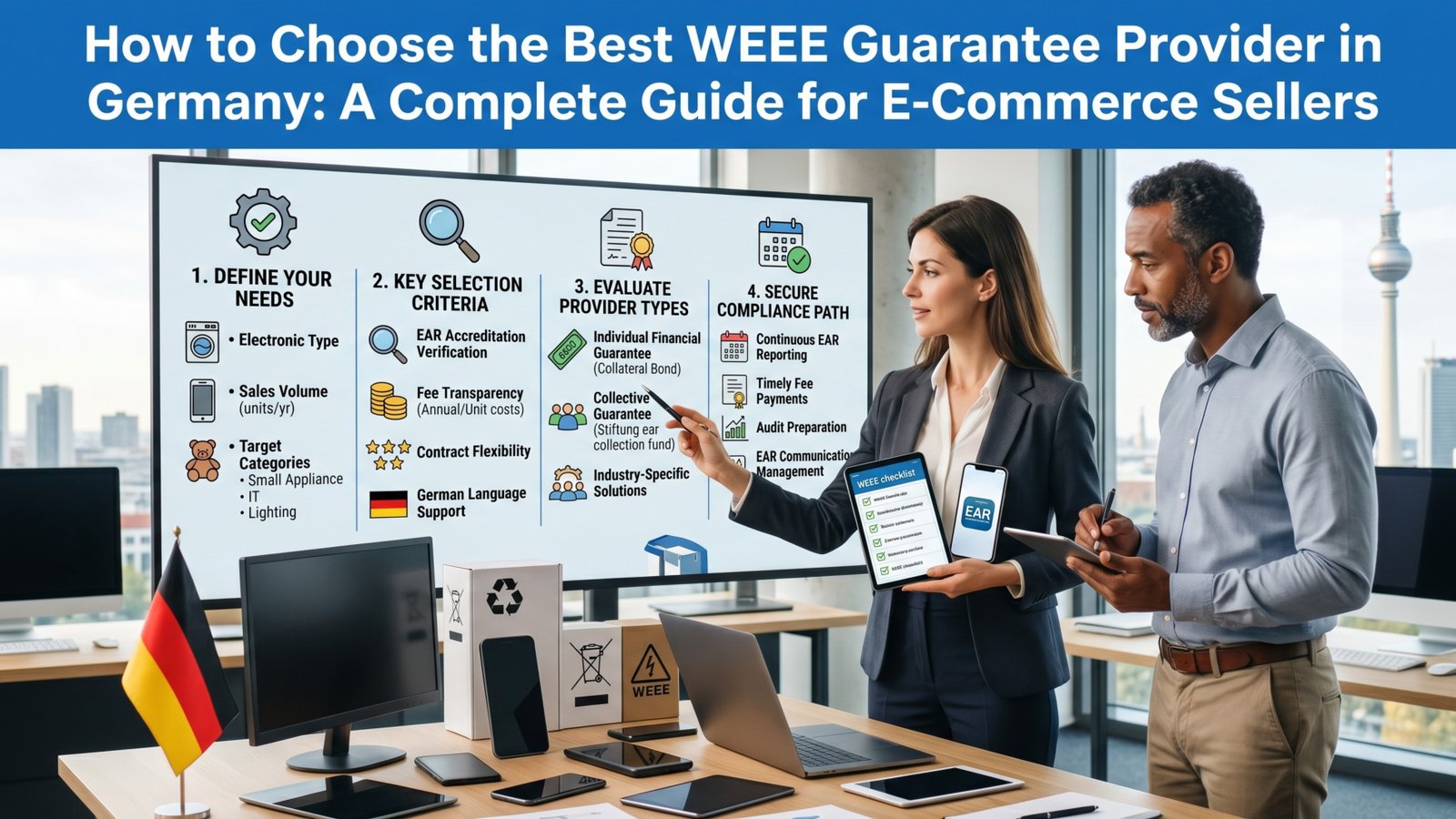
7 Essential Factors to Look for in a WEEE Guarantee Provider Germany
Choosing a provider is not just a matter of picking the cheapest option. You are selecting a compliance partner that holds the keys to your ability to sell in Europe's largest economy. Here is a detailed breakdown of what you must evaluate:
1. Official Approval by the Stiftung ear
This is the non-negotiable baseline. The Stiftung ear maintains strict criteria for collective guarantee systems. If you purchase a guarantee from a company that is not officially recognized, the Stiftung ear will reject your registration application, leaving you out of pocket and out of compliance. Always verify that the provider is fully authorized under the current ElektroG regulations.
2. Transparent and Predictable Cost Structure
EPR compliance costs can be confusing, as they usually involve multiple moving parts:
- The annual fee for the guarantee itself.
- Registration fees paid directly to the Stiftung ear.
- Costs for the actual physical recycling/disposal of goods (if you are called upon to do so).
- Administrative or "setup" fees from the provider.
When evaluating a weee guarantee provider germany, look for absolute transparency. Some providers lure sellers in with rock-bottom guarantee fees but hide massive administrative surcharges in the fine print. Ensure you understand exactly what you are paying for your specific tonnage and equipment category (e.g., small IT equipment, screens, large appliances). See our pricing page for a transparent breakdown of our own compliance fees.
3. Speed of Issuance and Marketplace Urgency
Time is money. If Amazon has just suspended your top-selling electronics listing because you lack a WEEE number, every day of delay costs you revenue and search ranking momentum. Some guarantee providers operate with outdated manual processes that take weeks to issue your compliance certificates. Look for a provider equipped with digital, streamlined workflows that can issue your guarantee documentation rapidly so you can submit your Stiftung ear registration without delay, as detailed in our WEEE registration for electronics sellers guide.
4. Seamless Integration and Administrative Support
The German WEEE registration process is notoriously bureaucratic. You have to submit your guarantee, report your planned quantities, classify your products into the correct of the 6 main categories (and 17 subcategories), and then complete monthly reporting (Ist-Mengen-Meldung). The best providers do more than just sell you a certificate; they offer comprehensive portal access or API integrations that make monthly tonnage reporting painless, a process we outline further in our WEEE registration ElektroG guide.
5. Multi-Marketplace and International Expertise
If you are an international seller—perhaps based in the US, UK, or Asia—navigating German legal jargon is incredibly frustrating. You need a provider that offers English-language support and understands the specific pressures of Amazon FBA, eBay EPR policies, and cross-border fulfillment structures.
Furthermore, if you do not have a physical branch in Germany, you are legally required to appoint an Authorized Representative (Bevollmächtigter) under the ElektroG. Often, top-tier guarantee providers either offer this authorized representation service in-house or partner closely with consulting firms that do.
6. Flexibility for B2C and B2B Operations
While the insolvency-proof guarantee is explicitly required for B2C (Business-to-Consumer) sales, many sellers operate on a hybrid model, selling to both private households and other businesses (B2B). Ensure your provider understands how to properly categorize your dual-use products and can guide you on the specific evidence required for B2B exemptions, preventing you from overpaying on guarantee volumes.
7. Holistic Compliance Partnerships
EPR obligations in Germany do not stop at electronics. If you sell electronics, you also sell packaging (VerpackG) and almost certainly batteries (BattG). Dealing with three different providers for three different registers is inefficient. The ideal scenario is working with a partner that can streamline your compliance across WEEE, Packaging, and Batteries simultaneously through a single compliance services partner.
Step-by-Step: How to Register Using a Guarantee Provider
To demystify the process, here is the standard roadmap for getting your electronics legally onto the German market:
Step 1: Product Classification: Determine exactly which of the 6 ElektroG categories your products fall into (e.g., Category 5: Small equipment, Category 6: Small IT and telecommunication equipment).
Step 2: Estimate Your Sales Volume: Calculate the total weight in kilograms of the electronic products you plan to sell to German consumers over the calendar year.
Step 3: Secure the Guarantee: Purchase the required coverage from your chosen weee guarantee provider germany. They will issue a certificate with a specific guarantee number.
Step 4: Appoint a Representative (If Applicable): If your business is located outside Germany, legally appoint your Authorized Representative.
Step 5: Submit to Stiftung ear: Create an account in the ear-portal, input your company details, brand names, product categories, and submit your guarantee certificate.
Step 6: Pay the Fees & Receive Your Number: Pay the mandatory registration invoices issued by the Stiftung ear. Once approved, you will receive your WEEE-Reg.-Nr.
Step 7: Update Marketplaces: Immediately upload your new WEEE number to your Amazon Seller Central, eBay, or Etsy dashboards to clear your listings, a topic we explore in our Amazon FBA Germany compliance guide.
Overcoming the Complexities with Complico Consulting GmbH
While understanding the theory of the ElektroG is one thing, executing it flawlessly while running a busy e-commerce business is another. A single mistake in categorizing your products or calculating your volumes can lead to rejected applications and weeks of delayed sales, as we detail in our common WEEE guarantee mistakes guide.
This is where expert guidance becomes invaluable. At Complico Consulting GmbH, based in Ronneburg, Germany, we specialize in removing the friction from European regulatory compliance. We understand the unique challenges faced by online marketplace sellers and the urgency of protecting your sales channels.
Navigating the landscape of Extended Producer Responsibility whether it is securing the right weee guarantee provider germany, aligning with the new General Product Safety Regulation (GPSR), or ensuring your packaging and battery reporting are airtight requires a strategic approach. We bridge the gap between complex German environmental laws and the fast-paced realities of modern e-commerce.
By partnering with experts who intimately understand both the legal requirements and the operational demands of platforms like Amazon and eBay, you can shift your focus away from bureaucratic red tape and back to what you do best: growing your business. Contact our team today to get started, or visit our blog for more compliance resources.
Frequently Asked Questions (FAQs)
How much does a WEEE guarantee cost in Germany ? The cost varies significantly based on the weight of the products you plan to sell and the specific category they belong to. It typically includes an annual base fee plus a variable rate per ton. Small sellers might pay a few hundred euros annually, while large importers pay substantially more. See our full WEEE guarantee cost breakdown for more detail.
Do I need a guarantee if I only sell B2B ? No. The insolvency-proof guarantee is designed to protect municipalities from the cost of recycling household waste. If you exclusively sell B2B (and can prove it with a credible disposal concept), you are exempt from the guarantee requirement, though you must still register with the Stiftung ear.
How long does it take to get a WEEE number ? Once you have your guarantee and submit your application to the Stiftung ear, the processing time usually takes between 6 to 10 weeks. This is why acting early and choosing a responsive guarantee provider is essential to avoid marketplace stock-outs. Learn more in our WEEE number guide.
Can I use my UK or French WEEE registration in Germany ? No. WEEE compliance is strictly national. An EPR registration in the UK, France, or Austria holds no legal weight in Germany. You must register locally with the Stiftung ear and secure a German-specific guarantee. Compare requirements across markets in our UK WEEE compliance guide and French WEEE compliance guide.
More About weee guarantee provider germany Resources