
Summarize this article with:
If you are manufacturing, importing, or selling electrical and electronic equipment (EEE) in the European Union, you have likely encountered the term Extended Producer Responsibility (EPR). Under this framework, whoever introduces an electronic product to the market is legally responsible for its end-of-life disposal.
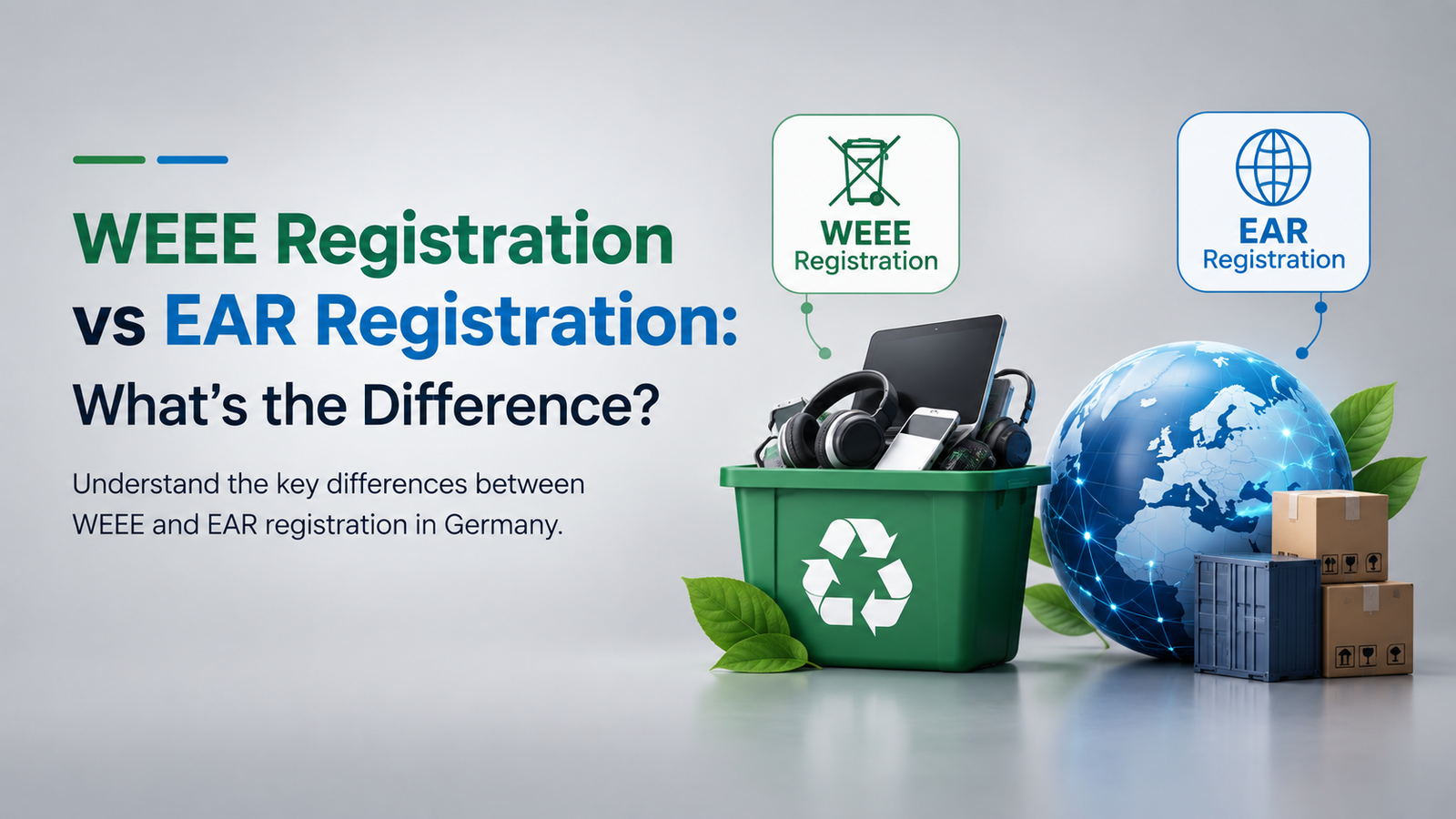
However, as businesses expand into Germany the largest e-commerce and consumer electronics market in Europe—they frequently hit a wall of regulatory jargon. Two terms inevitably surface: WEEE Registration and EAR Registration.
Are they the same thing ? Do you need both ? If you already have a WEEE number from France or Spain, does it cover you in Germany ?
At Complico Consulting GmbH, we guide businesses through the complexities of European compliance every day. In this comprehensive guide, we will break down the exact differences between WEEE Registration and stiftung ear Registration, explain how the German ElektroG law works, and provide a step-by-step roadmap to ensure your products remain compliant, legally safe, and actively selling on platforms like Amazon and your own Shopify or WordPress storefronts.
1. The Core Concepts Defined
Before comparing the two, we must define what they actually are. The confusion arises because one is a broad European concept, while the other is a specific national authority.
What is the WEEE Directive ?
WEEE stands for Waste Electrical and Electronic Equipment. The WEEE Directive (2012/19/EU) is a piece of European Union legislation designed to tackle the rapidly growing ecological footprint of electronic waste.
The directive establishes the principle of Extended Producer Responsibility across the EU. It mandates that "producers" (which includes manufacturers, importers, and distance sellers) must finance the collection, treatment, recycling, and environmentally sound disposal of their electronic products.
However, the EU WEEE Directive is just a framework. It is a blueprint. There is no central "European WEEE Authority," and there is no single "EU WEEE Registration Number". Instead, the EU dictates that every individual member state must write this directive into its own national laws and establish its own national registers.
What is EAR Registration (stiftung ear) ?
This is where Germany's specific legal landscape comes in. Germany transposed the EU WEEE Directive into its national law via the Electrical and Electronic Equipment Act, known as the ElektroG (Elektro- und Elektronikgerätegesetz).
To enforce the ElektroG, the German Federal Environment Agency authorized a specific clearing house to manage the registration of producers and coordinate the logistics of e-waste collection. This body is called stiftung elektro-altgeräte register (abbreviated as stiftung ear).
Therefore, "EAR Registration" simply means registering your company and your electronic products with the official German authority (stiftung ear) to fulfill your WEEE obligations in Germany.
2. WEEE Registration vs. EAR Registration: The Direct Comparison
To put it simply: WEEE Registration is the legal obligation you must fulfill, and EAR Registration is the physical process of fulfilling it in Germany.
When an Amazon account manager or a German customs official asks for your "WEEE Registration Number," they are asking for the specific 8-digit identification number issued by stiftung ear (e.g., WEEE-Reg.-Nr. DE 12345678).
Here is a clear breakdown of how the concepts differ and overlap:
| Feature | WEEE Registration | EAR Registration (stiftung ear) |
|---|---|---|
| Scope | European Union (Directive 2012/19/EU) | Germany specifically (ElektroG Act) |
| Nature | A legal concept and overarching EPR obligation | The practical application and official German registry |
| Authority | 27 different national authorities across Europe | Stiftung Elektro-Altgeräte Register (based in Fürth, Germany) |
| The Output | A legal mandate to track and recycle e-waste | A valid WEEE-Reg.-Nr. DE starting with "DE" |
| Cross-Border Validity | None. You must register in each country separately. | Valid only for the German market. |
Key Takeaway for Sellers: If you are selling electronics in Germany, you cannot buy a "WEEE Registration." You must submit a detailed application to stiftung ear. Once stiftung ear approves your application, they grant you a German WEEE Registration Number.
3. Who is Considered a "Producer" and Must Register ?
The term "producer" under the ElektroG is much broader than just the physical manufacturer of a product. In the eyes of German law, you must complete an EAR Registration if you fit any of the following profiles:
- The Manufacturer: You manufacture electrical and electronic equipment in Germany and offer it under your own brand name.
- The OEM / White-Label Brand Owner: You have equipment manufactured by third parties (e.g., in China) but you place your own brand name or trademark on it and sell it in Germany.
- The Importer: You import EEE from outside of Germany (even from another EU member state) and are the first to place it on the German market.
- The Distance Seller (Dropshipper / E-commerce): You are based outside of Germany but sell electronic products directly to German end-users via an online shop or a marketplace like Amazon, eBay, or Kaufland.
The Zero-Threshold Rule
A common misconception among new startups and e-commerce sellers is that WEEE registration only applies if you sell high volumes. This is false. There is no minimum quantity threshold for WEEE registration in Germany. Even if you intend to sell a single USB cable, a single LED ring light, or one battery-operated watch to a German consumer, you must be fully registered with stiftung ear before that product crosses the border.
4. The 6 Categories of Electrical and Electronic Equipment
When you apply for your WEEE Registration via stiftung ear, you cannot simply register your company as an "electronics seller." You must register specific product brands within specific categories. If you introduce a new type of product later, you must undergo an update registration.
Germany classifies electrical equipment into six primary categories:
- Category 1: Temperature exchange equipment (Refrigerators, freezers, air conditioners).
- Category 2: Screens, monitors, and equipment containing screens having a surface area greater than 100 cm² (Televisions, laptops, tablets).
- Category 3: Lamps (LED bulbs, fluorescent tubes).
- Category 4: Large equipment (Any equipment with at least one external dimension exceeding 50 cm, such as washing machines or large solar panels).
- Category 5: Small equipment (No external dimension more than 50 cm. This is the most common e-commerce category, encompassing toasters, electric toothbrushes, cables, smart home devices, and electronic toys).
- Category 6: Small IT and telecommunication equipment (Smartphones, GPS devices, routers).
5. The Step-by-Step stiftung ear Registration Process
Registering with stiftung ear is known for being bureaucratic, strictly formal, and highly specific. A single error in categorization, brand notation, or company documentation will result in rejection and weeks of delays.
Here is the exact process required to achieve WEEE compliance in Germany:
Step 1: Appoint an Authorized Representative (If Outside Germany)
If your company does not have a legally registered branch office in Germany, you cannot register directly with stiftung ear. Under Section 37 of the ElektroG, non-German companies must appoint an Authorized Representative (WEEE-Bevollmächtigter) located in Germany. This representative takes on the legal and financial responsibility for your WEEE compliance. At Complico Consulting GmbH, providing authorized representative services is a core part of our compliance packages.
Step 2: Prepare Product and Brand Data
You must identify exactly which categories and equipment types your products fall under. You also need to register the specific brand name under which the product is sold. If you sell unbranded generic items, they must be registered under the name of your company.
Step 3: Secure an Insolvency-Proof Guarantee (For B2C Products)
If you are selling B2C (Business-to-Consumer) products, you are legally required to provide an insolvency-proof guarantee. This financial guarantee ensures that if your company goes bankrupt in five years, there is still money set aside in a German trust to pay for the recycling of the products you sold today.
Step 4: Application Submission via the EAR Portal
Your authorized representative will submit your commercial register extracts, brand data, product descriptions, pictures, and the insolvency guarantee to the stiftung ear online portal.
Step 5: Wait for Processing
stiftung ear is a government-mandated body. Processing times typically range from 4 to 8 weeks, depending on their backlog. You are strictly forbidden from selling your products in Germany while the application is pending.
Step 6: Receive your WEEE-Reg.-Nr. DE
Once approved, you will receive an official certificate and your 8-digit WEEE number.
6. Ongoing Obligations: Labeling and Reporting
Compliance does not stop once you receive your WEEE Registration number. Getting the number is just the admission ticket; maintaining it requires continuous operational management.
Mandatory Labeling
Every electronic product placed on the German market must be permanently labeled with the crossed-out wheelie bin symbol.
Furthermore, if the product was put on the market after 2005 (which applies to almost all current sellers), the symbol must include a heavy black bar underneath the bin. You must also include your brand name and your WEEE-Reg.-Nr. on the product, its packaging, and your sales invoices.
Monthly Quantity Reporting (Mengenmitteilung)
Every month, you (or your authorized representative) must log into the stiftung ear portal and report the exact weight (in kilograms) of the electrical equipment you placed on the German market in the previous month.
Annual Reporting
At the beginning of each year, you must submit a cumulative annual report verifying the total volumes placed on the market the previous year.
7. The Risks of Ignoring WEEE Registration in Germany
The German government and market competitors take ElektroG compliance incredibly seriously. Because stiftung ear maintains a publicly searchable database of all registered producers, it is exceptionally easy to get caught if you are operating illegally.
- Amazon and Marketplace Suspensions: Under Extended Producer Responsibility laws, online marketplaces are legally liable if their sellers are non-compliant. Amazon validates WEEE numbers against the stiftung ear database in real-time. If you do not have a valid registration, your listings will be suspended and your inventory stranded immediately.
- Warning Letters (Abmahnungen): Germany has a unique legal mechanism where your direct competitors can hire lawyers to send you cease-and-desist letters with heavy legal fees attached if they discover you are selling without a WEEE number.
- Fines and Customs Seizures: The Federal Environment Agency (UBA) can levy administrative fines of up to €100,000 for deliberate non-compliance. Furthermore, German customs actively check imports; unregistered electronics are routinely confiscated and destroyed at the border at the importer's expense.
8. How Complico Consulting GmbH Simplifies Your Compliance
Navigating the bureaucratic hurdles of stiftung ear, securing an insolvency guarantee, and handling monthly kilogram reporting in German is a massive administrative burden for businesses trying to scale.
At Complico Consulting GmbH, we act as your dedicated compliance department. Our end-to-end WEEE services include:
- Authorized Representative Services: We act as your legally mandated representative in Germany, allowing non-German companies to sell seamlessly.
- Category and Brand Audits: We analyze your product portfolio to ensure you are registered in the correct stiftung ear categories.
- Insolvency Guarantees: We provide the mandatory financial guarantees required for B2C sales at highly competitive rates.
- Monthly Reporting: You send us your sales data; we handle the complex monthly reporting in the stiftung ear portal.
- Holistic EPR Coverage: Beyond WEEE, we also handle your German Packaging Registration (LUCID) and Battery Act (BattG) registrations.
Don't let regulatory bottlenecks keep your products off the German market. Partner with Complico Consulting GmbH to secure your WEEE Registration efficiently and legally.
Frequently Asked Questions (FAQ)
1. Do I need a different WEEE Registration for every EU country ?
Yes. The WEEE Directive is implemented locally by each member state. A German WEEE number (issued by stiftung ear) is only valid in Germany. If you also sell to France, you must register with a French eco-organism (like Ecosystem), and if you sell in Spain, you must register with the Spanish Ministry of Industry. There is no pan-European registration.
2. How long does EAR registration take in Germany ?
Typically, a standard registration with stiftung ear takes between 4 to 8 weeks after all correct documentation and the insolvency guarantee have been submitted. Because of this lead time, you should initiate your compliance process at least two months before you plan to launch your products in Germany or send inventory to a German Amazon FBA warehouse.
3. Does my product need a WEEE Registration if it only has a small battery ?
Yes. If a product requires electrical currents or electromagnetic fields to fulfill at least one of its intended functions, it falls under the ElektroG and requires WEEE Registration. If that product contains a battery, you must also register under the German Battery Act (BattG) in a separate procedure.
4. What happens if Amazon asks for my WEEE number and I don't have one ?
Amazon operates under a strict legal obligation to verify EPR compliance. If you cannot provide a valid stiftung ear WEEE-Reg.-Nr. that exactly matches the brand you are selling, Amazon will block your listings from being visible to German buyers. If your inventory is in a German fulfillment center, you will be forced to remove it or pay for its disposal.
5. Can a non-German company register directly with stiftung ear ?
No. Under Section 37 of the ElektroG, any company that does not have a registered branch office in Germany must appoint a licensed Authorized Representative (WEEE-Bevollmächtigter) based in Germany. This representative legally assumes the compliance duties on your behalf and is the entity that actually interacts with stiftung ear.