
Summarize this article with:
Navigating Netherlands UPV Textiles: A Complete Guide to Compliance and Financial Forecasting
As the European Union moves rapidly toward a circular economy, compliance requirements for producers, importers, and cross-border e-commerce brands are scaling in complexity. In the Netherlands, Extended Producer Responsibility (EPR)—known locally as Uitgebreide Producentenverantwoordelijkheid (UPV Textiel)—is enforcing rigorous financial and operational obligations on companies putting textile products on the Dutch market.
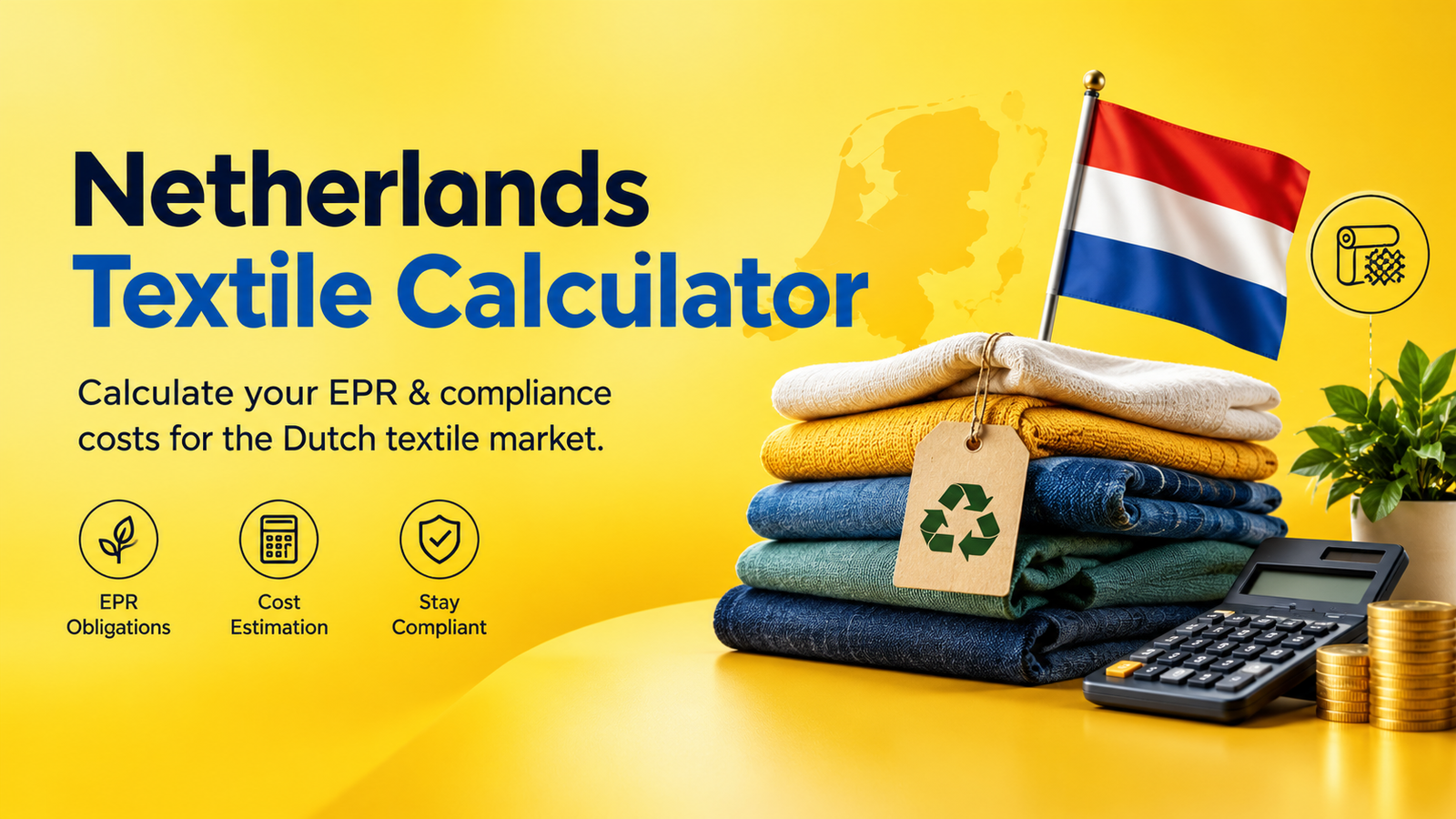
Navigating material categories, baseline tariffs, circularity discounts, and administrative overheads can quickly turn strategic compliance into a manual bottleneck. To streamline your obligations, Complico Consulting GmbH has engineered the Netherlands Textile Calculator—a digital tool designed to automate fee projections, clarify eco-modulation, and maintain full legal alignment with Dutch circularity mandates.
Below is an in-depth operational breakdown of Dutch textile EPR rules, how eco-modulation impacts your bottom line, and how our specialized Textile Calculator optimizes compliance for your business.
1. What is UPV Textiel ? Understanding Dutch Textile EPR
The Dutch government introduced Extended Producer Responsibility for textiles under UPV Textiel to shift end-of-life collection, sorting, recycling, and re-use costs from local municipalities directly onto producers.
┌─────────────────────────────────────────────────────────────────────────┐
│                           UPV TEXTIEL PIPELINE                          │
├─────────────────┬───────────────────┬──────────────────┬────────────────┤
│  Placed on      │  EPR Registration │  Fee Collection  │  End-of-Life   │
│  Dutch Market   ├─► & Annual        ├─► & Eco-Modulation ├─► Collection & │
│  (Clothing/Bed) │   Reporting       │   Tariffs        │  Recycling     │
└─────────────────┴───────────────────┴──────────────────┴────────────────┘
Who Holds Responsibility?
Under Dutch law, any entity considered a "Producer" holds legal responsibility. You are subject to UPV Textiel if you:
- Manufacture clothing or household textiles in the Netherlands and sell them domestically.
- Import clothing or household textiles into the Netherlands for distribution or commercial sale. Non-EU companies may also need an Importer of Record (IOR) service.
- Operate as a Cross-Border E-Commerce Merchant (e.g., selling via Shopify, Amazon, or Zalando) shipping directly to end consumers in the Netherlands from abroad.
- Brand/Private Label Owner selling finished textile goods under your commercial brand in the Netherlands.
2. Scope: Covered Categories vs. Excluded Items
Compliance requirements depend heavily on accurate product categorization. Under UPV Textiel, obligations focus primarily on consumer apparel and household linens. For a broader look at fashion-sector obligations, see our guide on textile EPR for fashion brands.
| Product Category | Included / Excluded | Examples & Notes |
|---|---|---|
| Consumer Apparel | Included | T-shirts, jackets, trousers, dresses, underwear, sportswear, coats. |
| Household Textiles | Included | Bed sheets, duvet covers, pillowcases, towels, tablecloths, curtains. |
| Workwear & Uniforms | Included | Corporate clothing and non-protective work apparel sold B2C or B2B. |
| Footwear & Leather | Excluded (Separate Rules) | Shoes, boots, and leather goods currently fall outside UPV Textiel parameters. |
| Industrial / Technical | Excluded | Automotive fabrics, medical textiles, filters, geotextiles. |
| Accessories | Partial / Excluded | Belts, hats, and bags are generally excluded unless classified under garment subsets. |
3. How the Netherlands Textile Calculator Works
Calculating your annual EPR fee in the Netherlands involves more than multiplying net weight by a static rate. The financial outcome relies on four core factors: volume, fiber composition, eco-modulation, and administrative representation.
       [ Net Weight (kg) ]  ×  [ Base Category Tariff (€/kg) ]
                                    │
                                    ▼
                      [ Eco-Modulation Adjustment ]
                ┌───────────────────┴───────────────────┐
                ▼                                       ▼
    [ Discount: Recycled Content ]        [ Penalty: Fiber Blends ]
                └───────────────────┬───────────────────┘
                                    │
                                    ▼
                     [ + Authorized Rep Overhead ]
                                    │
                                    ▼
                      [ Total Annual Liability (€) ]
Step-by-Step Calculation Engine
- Category Weight Input: Enter total weight in kilograms (kg) for garments and household textiles placed on the Dutch market during the reporting calendar year.
- Fiber Blend Profile: Identify primary raw material compositions (e.g., 100% Cotton, Poly-Cotton blends, Synthetics).
- Eco-Modulation Adjustment: Apply dynamic discounts or surcharges based on circular design features:
- Post-Consumer Recycled (PCR) Content: Higher percentages of verified PCR fiber qualify for tariff reductions.
- Recyclability & Monomaterial Composition: Pure single-fiber products qualify for favorable rates compared to complex multi-fiber blends.
- Durability & Repairability: Certified extended longevity lowers baseline liability fees.
- Foreign Enterprise Status: Non-Dutch merchants automatically factor in mandatory Authorized Representative (AR) fees, ensuring complete compliance without hidden administrative expenses.
4. Why Use the Complico Consulting Textile Calculator ?
Manual fee calculation exposes businesses to financial misprojections, audit liabilities, and administrative penalties. Using our specialized Textile Calculator delivers key operational advantages:
- Real-Time Regulatory Alignment: Automatically synced with official Dutch Producer Responsibility Organization (PRO) tariff updates and statutory modifications.
- Granular Eco-Modulation Modeling: Interactively test how switching to recycled fibers or monomaterials reduces your annual financial burden.
- Cross-Border AR Integration: Incorporates legal representation overheads directly into cost estimates for international sellers. Learn more about EU authorised representatives.
- Audit-Ready Exporting: Generate structured, exportable financial reports designed for internal accounting and compliance audits. See our pricing for details.
5. Frequently Asked Questions (FAQ)
FAQ 1: What is the primary purpose of the Netherlands Textile Calculator ?
The Textile Calculator by Complico Consulting GmbH is a compliance tool that calculates estimated annual Extended Producer Responsibility (EPR) financial liabilities under the Dutch UPV Textiel framework. It evaluates total textile volume in kilograms, fiber compositions, and eco-modulation variables (such as recycled fiber content) to provide precise financial and reporting projections.
FAQ 2: Does UPV Textiel apply to international brands shipping into the Netherlands ?
Yes. If your business is located outside the Netherlands (e.g., in Germany, the UK, the US, or Asia) and sells apparel or household textiles directly to Dutch end-consumers via e-commerce, you are legally classified as an importer/producer. You must register under UPV Textiel, report product volumes, pay recycling fees, and appoint a Dutch Authorized Representative.
FAQ 3: How does eco-modulation reduce EPR textile fees ?
Eco-modulation adjusts EPR tariffs based on environmental performance. Under Dutch UPV Textiel, products engineered for circularity—such as those utilizing high percentages of post-consumer recycled (PCR) fibers, monomaterials, or certified durable construction—qualify for lowered fee tiers. Conversely, hard-to-recycle multi-fiber blends face financial surcharges. For more context, read our textile EPR compliance guide.
FAQ 4: What penalties exist for non-compliance with Dutch textile regulations ?
Failing to register, report, or remit recycling contributions under UPV Textiel can result in substantial administrative fines from Dutch environmental inspection authorities (ILT), marketplace bans on platforms like Amazon and Zalando, and retroactive fee enforcement accompanied by interest penalties. See also EU compliance fines for GPSR and EPR.
FAQ 5: What is the difference between EU ESPR, DPP, and Dutch UPV Textiel ?
UPV Textiel is a national Dutch EPR framework focused on financial responsibility for waste management, recycling, and re-use. The Ecodesign for Sustainable Products Regulation (ESPR) is an EU-wide legislative framework setting physical durability and environmental standards. The Digital Product Passport (DPP) is the EU traceability tool that stores material sourcing, repairability, and recyclability data on individual products to prove compliance under both ESPR and national EPR rules. Explore more in our EPR Europe guide or browse our FAQ.