
Summarize this article with:
If you are an international manufacturer or an e-commerce seller expanding into the German market, you have likely encountered a hard stop: the requirement for a WEEE number. Perhaps you received an urgent compliance notification from Amazon FBA, or your listings on eBay and Etsy were suddenly suspended. Navigating European Union environmental regulations can feel like decoding a complex puzzle, but the reality is straightforward without proper compliance, your electronics simply cannot be sold in Germany.
The German Electrical and Electronic Equipment Act (ElektroG) strictly enforces the European WEEE (Waste Electrical and Electronic Equipment) Directive. To legally sell electronics, you must complete your WEEE Registration through the national authority, Stiftung EAR (Elektro-Altgeräte Register).
In this comprehensive guide, we will break down exactly what a WEEE number is, who needs one, the classification of equipment, and the step-by-step process to achieve compliance so you can keep your products active and your business growing.
What is a WEEE Number in Germany ?
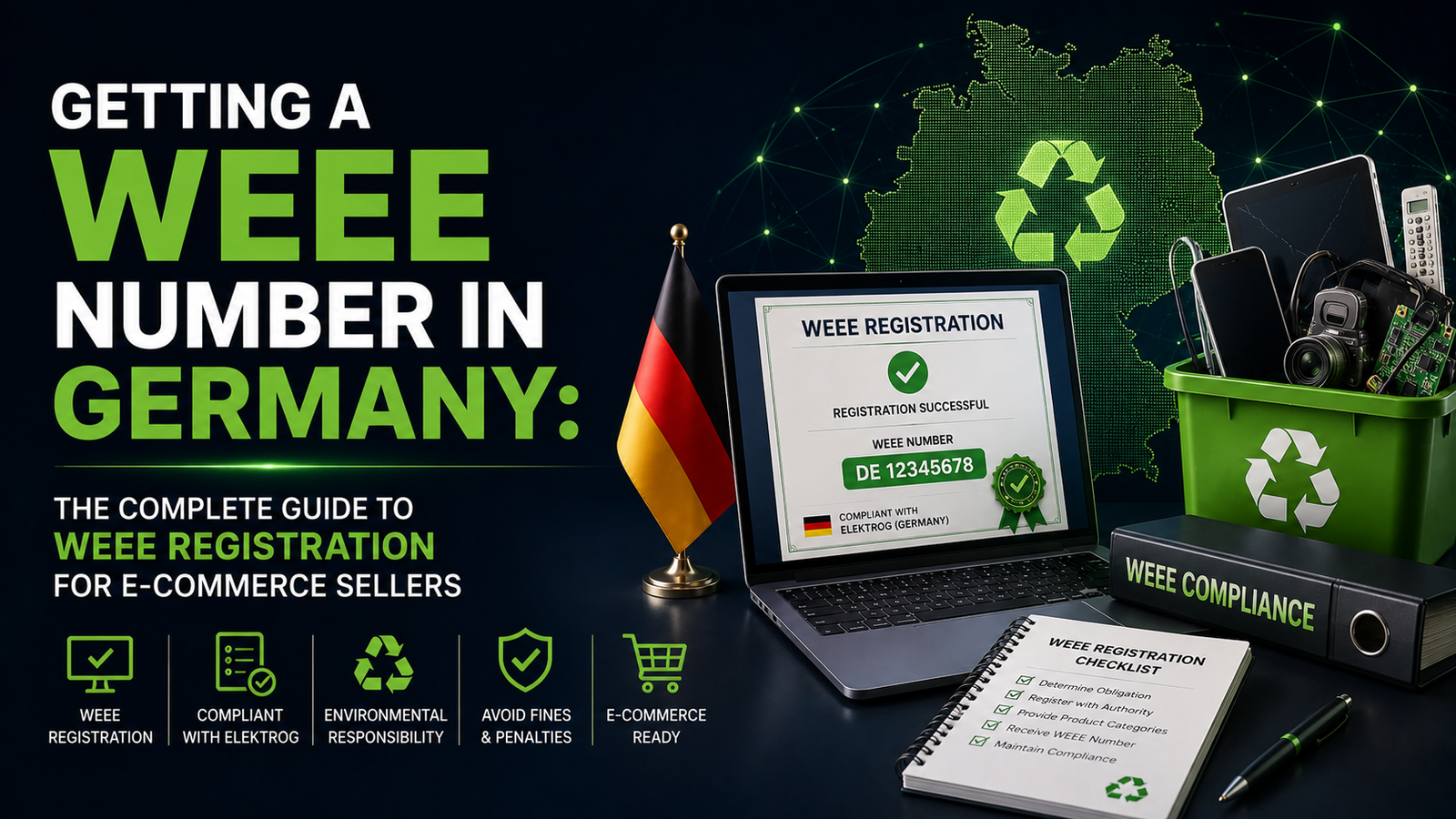
A WEEE number is a unique, eight-digit alphanumeric identifier (formatted as "WEEE-Reg.-Nr. DE 12345678") issued by Stiftung EAR. It serves as your legal proof that you have taken financial and administrative responsibility for the end-of-life disposal and recycling of the electronic goods you introduce to the German market.
The core philosophy behind the ElektroG legislation is Extended Producer Responsibility (EPR). When a consumer throws away a broken toaster, a burned-out LED lamp, or an old smartphone charger, the local municipalities should not have to bear the financial burden of recycling that electronic waste. Instead, the companies that profit from selling these devices are required to fund the recycling infrastructure.
Achieving your WEEE Registration ensures that your business contributes fairly to this system. Once registered, you are legally permitted to distribute your products, and you must display your WEEE number on all commercial invoices and product listings.
Who is Legally Obligated to Complete WEEE Registration ?
A common misconception among e-commerce sellers is that only the physical factory that manufactured the product needs to worry about compliance. Under German law, the definition of a "Producer" (Hersteller) is much broader. You are legally required to complete the WEEE Registration process if you fit any of the following profiles:
- The Original Manufacturer: You design and manufacture electrical and electronic equipment (EEE) under your own brand name and sell it within Germany.
- The Re-Brander (White Label Seller): You purchase unbranded products from overseas manufacturers (OEMs) and affix your own logo or brand name to them before selling them in Germany. In the eyes of the law, you are the producer.
- The Importer: You import EEE from outside of Germany (e.g., from China, the US, or even another EU member state) and are the first to place it on the German market.
- The Direct-to-Consumer Seller: You are based outside of Germany but sell EEE directly to German end-users via your own website or online marketplaces like Amazon, eBay, TikTok Shop, or Etsy.
If you fall into any of these categories, you cannot piggyback on the compliance of your overseas factory. You must secure your own WEEE number.
The 6 Categories of Electrical and Electronic Equipment
Before initiating your WEEE Registration, you must correctly classify your products. Stiftung EAR categorizes all electrical waste into six distinct groups. Misclassifying your product can lead to rejected applications and months of delays.
- Temperature Exchange Equipment: Devices that use fluids to cool or heat (e.g., refrigerators, freezers, air conditioning units, heat pumps).
- Screens, Monitors, and Equipment Containing Screens: Devices where the primary purpose is displaying information on a screen larger than 100 cm² (e.g., televisions, computer monitors, laptops, tablets).
- Lamps: Any kind of standalone light bulb or tube (e.g., straight fluorescent tubes, compact fluorescent lamps, LED lamps). Note: This does not include lighting fixtures (luminaires) themselves.
- Large Equipment: Any electronic device with at least one external dimension exceeding 50 centimeters (e.g., washing machines, large solar panels, full-sized electronic keyboards, large printing machines).
- Small Equipment: Electronic devices where no external dimension exceeds 50 centimeters. This is the most common category for e-commerce sellers (e.g., vacuum cleaners, microwaves, toasters, electric shavers, electronic toys, smartwatches, power tools).
- Small IT and Telecommunication Equipment: IT devices with no external dimension exceeding 50 centimeters (e.g., smartphones, GPS devices, routers, personal computers, USB flash drives).
B2B vs. B2C: A Critical Distinction
Your WEEE Registration process changes significantly depending on who your end-user is.
- B2C (Business-to-Consumer): If your product could reasonably be used in a private household, it is classified as B2C. Even if you only intend to sell to businesses, if a private consumer could buy and use it (like a standard computer mouse or a coffee maker), it defaults to B2C. For B2C equipment, sellers must provide an insolvency-proof guarantee. This ensures that if your company goes bankrupt in five years, the funds to recycle your products are already secured.
- B2B (Business-to-Business): If your product is exclusively designed for industrial or commercial use (like heavy medical imaging machinery or industrial server racks), it is classified as B2B. You do not need to provide an insolvency guarantee for B2B products, but you must provide a credible conceptual return plan detailing how you will retrieve and dispose of the equipment at the end of its life.
The Step-by-Step WEEE Registration Process
Securing your WEEE number requires patience and strict attention to detail. The governmental review process typically takes between 6 to 10 weeks, so it is crucial to apply well before your planned product launch.
Step 1: Establish Your Ear-Portal Account
The first step is setting up a user account in the official Stiftung EAR online portal. You will need to provide your company's master data, billing information, and designate a primary contact person. If your company is already registered in the German "Mein Unternehmenskonto" system, you can integrate those credentials.
Step 2: Determine Brand and Equipment Type
You cannot simply register your company as a whole; you must register specific combinations of your brand name and the equipment category. For example, if you sell hair dryers and smartwatches under the brand "TechGlow," you must apply for two separate registrations: one for TechGlow Small Equipment, and one for TechGlow Small IT Equipment.
Step 3: Secure an Insolvency-Proof Guarantee (For B2C)
As mentioned earlier, if you are selling to private consumers, you must submit proof of financial guarantee before your WEEE Registration can be approved. Rather than locking up funds in a blocked bank account, most e-commerce sellers partner with approved collective guarantee systems. You pay a variable premium based on the volume you expect to place on the market, and the guarantor vouches for your future recycling liabilities.
Step 4: Submit the Application and Await Approval
Once your account is configured, your brand and categories are defined, and your guarantee is uploaded, you submit the application to Stiftung EAR. The authorities will review your technical product specifications, brochures, and uploaded images to verify that your categorization is accurate.
If Stiftung EAR has doubts about your product classification, they may pause the process and request a formal justification. Once everything is verified and government processing fees are paid, you will be issued your official 8-digit WEEE number.
The Authorized Representative Requirement for International Sellers
Here is the most significant hurdle for international manufacturers: If your company does not have a legally registered branch office in Germany, you cannot apply for WEEE Registration directly.
Stiftung EAR requires a domestic legal entity to hold accountable for environmental compliance. If you operate from China, the UK, the USA, or even another EU country without a physical German branch (complete with local employees and a German tax number), you must appoint an Authorized Representative (Bevollmächtigter).
This is where expert compliance partners become indispensable. Based in Ronneburg, our team at Complico Consulting GmbH steps in to bridge this legal gap for international sellers. When you appoint us as your Authorized Representative, we take over your legal obligations under the ElektroG. We handle the complex communications with Stiftung EAR, manage the guarantee contracts, and hold the WEEE registration in our name on your behalf. This allows you to legally access the German market without the massive overhead of opening a local corporate office.
Ongoing Obligations: Compliance Does Not End at Registration
Receiving your WEEE number is just the beginning of your compliance journey. To maintain your WEEE Registration and avoid losing your selling privileges, you must adhere to strict ongoing reporting requirements:
1. Monthly Quantity Reporting
Every month, you (or your Authorized Representative) must log into the EAR portal and report the exact weight of electrical equipment you placed on the German market during the previous month. This data is critical, as it determines your financial share of the national recycling burden.
2. Annual Statistics and Updates
By the end of April each year, you must submit an annual statistical report summarizing the previous year's activities. Furthermore, you must continually update the portal if your company undergoes any legal name changes or if you introduce new brands or product categories to your portfolio.
3. Product Labeling Requirements
Your physical products must be correctly labeled before they enter the European market. Every electronic device must bear the symbol of the crossed-out wheeled bin, indicating that it cannot be disposed of in standard household trash. Depending on the product size, this symbol must be printed visibly, legibly, and indelibly on the product itself, or on its packaging and instructions if the device is too small.
Marketplace Enforcement and the Cost of Non-Compliance
The days of flying under the radar are over. In recent years, Germany has shifted the enforcement burden directly onto online marketplaces. Under the Extended Producer Responsibility (EPR) regulations, platforms like Amazon, eBay, and Etsy are legally liable if their third-party sellers are non-compliant.
If you fail to complete your WEEE Registration, these marketplaces will proactively deactivate your electronic listings in Germany. They require you to input your valid WEEE number into their compliance portals; if the number cannot be verified against the official Stiftung EAR database, your products will be suppressed.
Beyond marketplace suspensions, non-compliance carries severe legal risks. Competitors frequently monitor the EAR database and can issue costly legal warnings (Abmahnungen) to unregistered sellers. Furthermore, the German Federal Environment Agency can levy administrative fines of up to €100,000 for systemic violations of the ElektroG, alongside immediate bans on distributing your products.
Streamlining Your Entry into the German Market
Expanding your e-commerce business into Europe is highly lucrative, but navigating the bureaucratic maze of environmental regulations can be draining. Your primary focus should be on digital marketing, sourcing high-quality products, and optimizing your listings not wrestling with German administrative portals or managing insolvency guarantees.
At Complico Consulting GmbH, we specialize in making European regulatory compliance seamless for B2B enterprises and e-commerce sellers. From serving as your official Authorized Representative to navigating the complexities of your initial WEEE Registration and handling your ongoing monthly reporting, we ensure your business remains compliant, protected, and operational.
Do not let regulatory roadblocks stall your growth. Ensure your supply chain is bulletproof and your marketplace listings stay active by prioritizing your environmental compliance today.
Frequently Asked Questions (FAQs)
1. What is an EU Responsible Person ?
An EU Responsible Person is an economic operator established within the European Union who is legally responsible for ensuring that products comply with applicable EU safety and regulatory requirements. They also serve as the official point of contact for EU market surveillance authorities.
2. Who needs to appoint an EU Responsible Person ?
Non-EU manufacturers, brand owners, and cross-border e-commerce sellers that place consumer products on the European market typically need to appoint an EU Responsible Person if they do not have an EU-based manufacturer or importer assuming that responsibility.
3. Is an EU Responsible Person mandatory under the GPSR ?
Yes. Under the General Product Safety Regulation (GPSR) and Market Surveillance Regulation (EU) 2019/1020, most consumer products sold within the European Union must have a designated economic operator, such as an EU Responsible Person, before they can be legally placed on the market.
4. What is the difference between an EU Responsible Person and an Authorized Representative ?
An Authorized Representative is appointed by a non-EU manufacturer through a written mandate to perform specific compliance tasks. When authorized, they can also act as the EU Responsible Person. However, an EU importer may automatically become the Responsible Person without being formally appointed as an Authorized Representative.
5. What are the main responsibilities of an EU Responsible Person ?
An EU Responsible Person verifies technical documentation, ensures regulatory compliance, communicates with EU market surveillance authorities, checks product labeling and traceability, maintains compliance records, and supports product recalls or corrective actions when required.
6. Where should the EU Responsible Person's details be displayed ?
The EU Responsible Person's name, postal address, and email address must appear on the product, its packaging, or an accompanying document, where applicable. Many online marketplaces, including Amazon, Etsy, and other e-commerce platforms, also require these details to be displayed on product listings.
7. What happens if I sell products in the EU without an EU Responsible Person ?
Selling products without an EU Responsible Person can lead to customs delays or seizures, marketplace listing suspensions, product recalls, financial penalties, and restrictions or bans on selling products within the European Union.
8. Do Amazon FBA, Shopify, Etsy, and eBay sellers need an EU Responsible Person ?
Yes. If you sell consumer products to customers in the European Union through Amazon FBA, Shopify, Etsy, eBay, TikTok Shop, or similar platforms from outside the EU, you may be legally required to appoint an EU Responsible Person to meet GPSR compliance requirements.
9. Which products require an EU Responsible Person ?
Most non-food consumer products sold in the European Union require an EU Responsible Person. These include electronics, toys, household goods, furniture, cosmetics, personal care products, and many other product categories covered by EU product safety legislation.
10. How can Complico Consulting GmbH help with EU Responsible Person services ?
Complico Consulting GmbH provides comprehensive EU Responsible Person services for international manufacturers, brand owners, and e-commerce sellers. The company supports businesses with technical documentation reviews, GPSR compliance, product labeling, communication with EU authorities, EPR guidance, and ongoing regulatory support to help maintain uninterrupted access to the European market.
More About WEEE Registration Resources:
- The Legal Foundation (EUR-Lex)
- The European Commission Portal
- Germany's Official Clearing House (Stiftung EAR)
- Official Market Statistics (Eurostat)
Ready to get your WEEE registration sorted and keep your German listings active ? Explore our services overview, check our compliance pricing, or contact our team for a tailored WEEE compliance audit. You may also find our guides on WEEE registration under ElektroG and EPREL registration services useful, or browse more insights on our blog.